

decrease membrane permeability for ions [128, 143]. It is interesting that these
hydrocarbons are predominantly oriented parallel to the membrane plane [135],
which probably enhances the barrier effect and minimizes H
+ leakage [136] and
OH
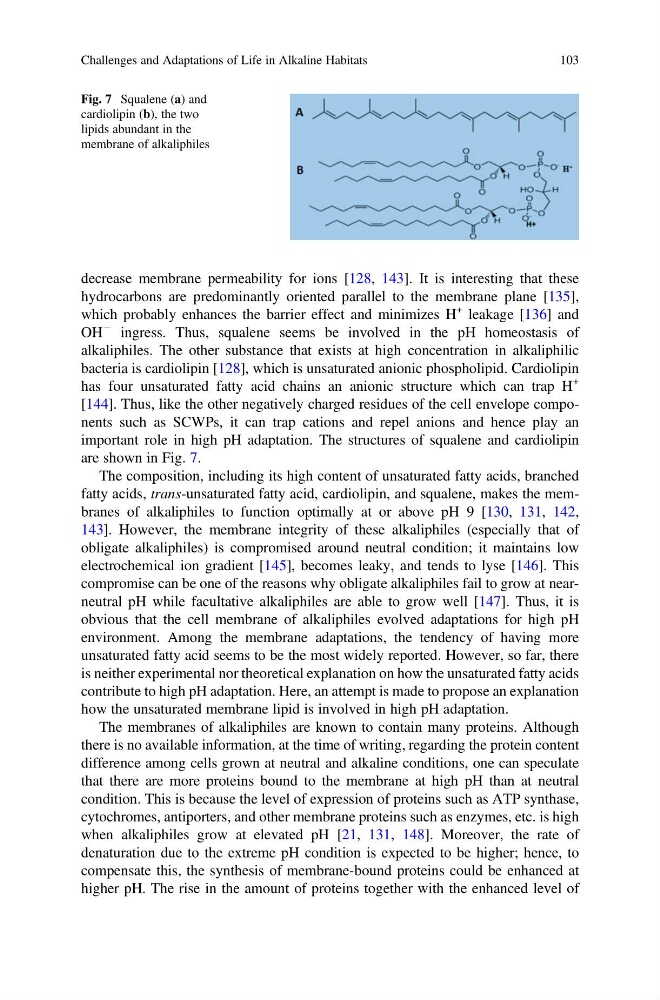
À ingress. Thus, squalene seems be involved in the pH homeostasis of
alkaliphiles. The other substance that exists at high concentration in alkaliphilic
bacteria is cardiolipin [128], which is unsaturated anionic phospholipid. Cardiolipin
has four unsaturated fatty acid chains an anionic structure which can trap H
+
[144]. Thus, like the other negatively charged residues of the cell envelope components such as SCWPs, it can trap cations and repel anions and hence play an
important role in high pH adaptation. The structures of squalene and cardiolipin
are shown in Fig. 7.
The composition, including its high content of unsaturated fatty acids, branched
fatty acids, trans-unsaturated fatty acid, cardiolipin, and squalene, makes the membranes of alkaliphiles to function optimally at or above pH 9 [130, 131, 142,
143]. However, the membrane integrity of these alkaliphiles (especially that of
obligate alkaliphiles) is compromised around neutral condition; it maintains low
electrochemical ion gradient [145], becomes leaky, and tends to lyse [146]. This
compromise can be one of the reasons why obligate alkaliphiles fail to grow at nearneutral pH while facultative alkaliphiles are able to grow well [147]. Thus, it is
obvious that the cell membrane of alkaliphiles evolved adaptations for high pH
environment. Among the membrane adaptations, the tendency of having more
unsaturated fatty acid seems to be the most widely reported. However, so far, there
is neither experimental nor theoretical explanation on how the unsaturated fatty acids
contribute to high pH adaptation. Here, an attempt is made to propose an explanation
how the unsaturated membrane lipid is involved in high pH adaptation.
The membranes of alkaliphiles are known to contain many proteins. Although
there is no available information, at the time of writing, regarding the protein content
difference among cells grown at neutral and alkaline conditions, one can speculate
that there are more proteins bound to the membrane at high pH than at neutral
condition. This is because the level of expression of proteins such as ATP synthase,
cytochromes, antiporters, and other membrane proteins such as enzymes, etc. is high
when alkaliphiles grow at elevated pH [21, 131, 148]. Moreover, the rate of
denaturation due to the extreme pH condition is expected to be higher; hence, to
compensate this, the synthesis of membrane-bound proteins could be enhanced at
higher pH. The rise in the amount of proteins together with the enhanced level of
Fig. 7 Squalene (a) and
cardiolipin (b), the two
lipids abundant in the
membrane of alkaliphiles
Challenges and Adaptations of Life in Alkaline Habitats
103
hydrocarbons are predominantly oriented parallel to the membrane plane [135],
which probably enhances the barrier effect and minimizes H
+ leakage [136] and
OH
À ingress. Thus, squalene seems be involved in the pH homeostasis of
alkaliphiles. The other substance that exists at high concentration in alkaliphilic
bacteria is cardiolipin [128], which is unsaturated anionic phospholipid. Cardiolipin
has four unsaturated fatty acid chains an anionic structure which can trap H
+
[144]. Thus, like the other negatively charged residues of the cell envelope components such as SCWPs, it can trap cations and repel anions and hence play an
important role in high pH adaptation. The structures of squalene and cardiolipin
are shown in Fig. 7.
The composition, including its high content of unsaturated fatty acids, branched
fatty acids, trans-unsaturated fatty acid, cardiolipin, and squalene, makes the membranes of alkaliphiles to function optimally at or above pH 9 [130, 131, 142,
143]. However, the membrane integrity of these alkaliphiles (especially that of
obligate alkaliphiles) is compromised around neutral condition; it maintains low
electrochemical ion gradient [145], becomes leaky, and tends to lyse [146]. This
compromise can be one of the reasons why obligate alkaliphiles fail to grow at nearneutral pH while facultative alkaliphiles are able to grow well [147]. Thus, it is
obvious that the cell membrane of alkaliphiles evolved adaptations for high pH
environment. Among the membrane adaptations, the tendency of having more
unsaturated fatty acid seems to be the most widely reported. However, so far, there
is neither experimental nor theoretical explanation on how the unsaturated fatty acids
contribute to high pH adaptation. Here, an attempt is made to propose an explanation
how the unsaturated membrane lipid is involved in high pH adaptation.
The membranes of alkaliphiles are known to contain many proteins. Although
there is no available information, at the time of writing, regarding the protein content
difference among cells grown at neutral and alkaline conditions, one can speculate
that there are more proteins bound to the membrane at high pH than at neutral
condition. This is because the level of expression of proteins such as ATP synthase,
cytochromes, antiporters, and other membrane proteins such as enzymes, etc. is high
when alkaliphiles grow at elevated pH [21, 131, 148]. Moreover, the rate of
denaturation due to the extreme pH condition is expected to be higher; hence, to
compensate this, the synthesis of membrane-bound proteins could be enhanced at
higher pH. The rise in the amount of proteins together with the enhanced level of
Fig. 7 Squalene (a) and
cardiolipin (b), the two
lipids abundant in the
membrane of alkaliphiles
Challenges and Adaptations of Life in Alkaline Habitats
103