

fatty acids and hydrocarbons can decrease the “free” volume within the alkaliphiles
membrane. This molecular crowding can favor lipid-lipid interaction that may result
in rigidity. Thus, it may be important to increase the membrane fluidity by increasing
the unsaturated fatty acid content, and this is expected to alleviate the potential
problems emanating due to membrane rigidity.
The other explanation for high amount of unsaturated fatty acids may be related to
scavenging OH
À . The free radical OH
À is known to react with fatty acids or other
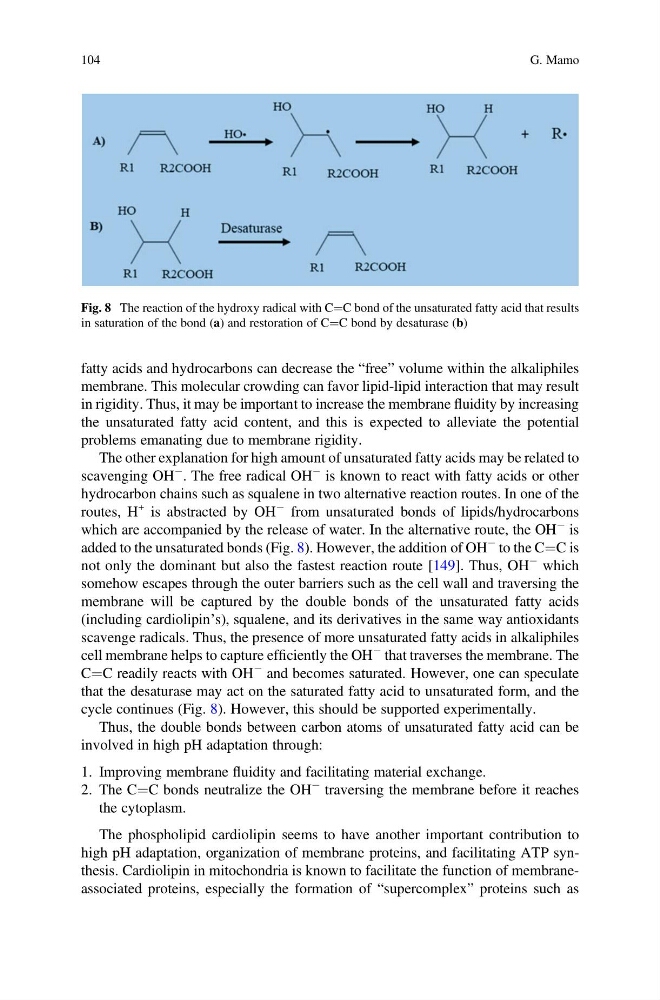
hydrocarbon chains such as squalene in two alternative reaction routes. In one of the
routes, H
+ is abstracted by OH
À from unsaturated bonds of lipids/hydrocarbons
which are accompanied by the release of water. In the alternative route, the OH
À is
added to the unsaturated bonds (Fig. 8). However, the addition of OH
À to the C¼C is
not only the dominant but also the fastest reaction route [149]. Thus, OH
À which
somehow escapes through the outer barriers such as the cell wall and traversing the
membrane will be captured by the double bonds of the unsaturated fatty acids
(including cardiolipin’s), squalene, and its derivatives in the same way antioxidants
scavenge radicals. Thus, the presence of more unsaturated fatty acids in alkaliphiles
cell membrane helps to capture efficiently the OH
À that traverses the membrane. The
C¼C readily reacts with OH
À and becomes saturated. However, one can speculate
that the desaturase may act on the saturated fatty acid to unsaturated form, and the
cycle continues (Fig. 8). However, this should be supported experimentally.
Thus, the double bonds between carbon atoms of unsaturated fatty acid can be
involved in high pH adaptation through:
1. Improving membrane fluidity and facilitating material exchange.
2. The C¼C bonds neutralize the OH
À traversing the membrane before it reaches
the cytoplasm.
The phospholipid cardiolipin seems to have another important contribution to
high pH adaptation, organization of membrane proteins, and facilitating ATP synthesis. Cardiolipin in mitochondria is known to facilitate the function of membraneassociated proteins, especially the formation of “supercomplex” proteins such as
Fig. 8 The reaction of the hydroxy radical with C¼C bond of the unsaturated fatty acid that results
in saturation of the bond (a) and restoration of C¼C bond by desaturase (b)
104
G. Mamo
membrane. This molecular crowding can favor lipid-lipid interaction that may result
in rigidity. Thus, it may be important to increase the membrane fluidity by increasing
the unsaturated fatty acid content, and this is expected to alleviate the potential
problems emanating due to membrane rigidity.
The other explanation for high amount of unsaturated fatty acids may be related to
scavenging OH
À . The free radical OH
À is known to react with fatty acids or other
hydrocarbon chains such as squalene in two alternative reaction routes. In one of the
routes, H
+ is abstracted by OH
À from unsaturated bonds of lipids/hydrocarbons
which are accompanied by the release of water. In the alternative route, the OH
À is
added to the unsaturated bonds (Fig. 8). However, the addition of OH
À to the C¼C is
not only the dominant but also the fastest reaction route [149]. Thus, OH
À which
somehow escapes through the outer barriers such as the cell wall and traversing the
membrane will be captured by the double bonds of the unsaturated fatty acids
(including cardiolipin’s), squalene, and its derivatives in the same way antioxidants
scavenge radicals. Thus, the presence of more unsaturated fatty acids in alkaliphiles
cell membrane helps to capture efficiently the OH
À that traverses the membrane. The
C¼C readily reacts with OH
À and becomes saturated. However, one can speculate
that the desaturase may act on the saturated fatty acid to unsaturated form, and the
cycle continues (Fig. 8). However, this should be supported experimentally.
Thus, the double bonds between carbon atoms of unsaturated fatty acid can be
involved in high pH adaptation through:
1. Improving membrane fluidity and facilitating material exchange.
2. The C¼C bonds neutralize the OH
À traversing the membrane before it reaches
the cytoplasm.
The phospholipid cardiolipin seems to have another important contribution to
high pH adaptation, organization of membrane proteins, and facilitating ATP synthesis. Cardiolipin in mitochondria is known to facilitate the function of membraneassociated proteins, especially the formation of “supercomplex” proteins such as
Fig. 8 The reaction of the hydroxy radical with C¼C bond of the unsaturated fatty acid that results
in saturation of the bond (a) and restoration of C¼C bond by desaturase (b)
104
G. Mamo