

high pH adaptation. Similarly, there are some substances that are known to be
correlated to alkaliphiles or to growth at alkaline condition, but their high pH
adaptation role is not clear. Bis(monoacylglycero) phosphate (BMB) could be an
example. BMB exists in most alkaliphiles and known to be absent at least in many
nuteralophiles [128, 133, 134]. But it is not clear if it contributes to high pH
adaptation.
A difference is also observed in the membrane content of branched fatty acids.
About 90% and 66–76% of the fatty acids in the phospholipids of obligate and
facultative alkaliphiles, respectively, were found to be branched [128]. This
branching may help in pH homeostasis by reducing H
+ leakage. It has been
known that branched fatty acids are common in membranes maintaining H
+ gradient
[135]. Moreover, studies revealed that the fatty acid chain length is tending to be
shorter in facultative alkaliphiles cell membrane than those from obligate
alkaliphiles. This may be related to inhibition of H
+ leakage. In the model proposed
by Haines [136], it is indicated that branched fatty acids at the center of the bilayer
are involved in preventing H
+ leakage. Thus, the longer the fatty acid chains, the
better the chance it reaches at the center of the membrane bilayer. This probably
suggests that the alkaliphilic membrane fatty acids which tend to be branched and
longer plays a role in the pH homeostasis of these fascinating group of organisms.
Another interesting observation was made on the Gram-negative bacterium
Pseudomonas alcaliphila fatty acid content which shows a difference in the amount
of cis- and trans-unsaturated fatty acid with varying growth pH. When the bacterium
is grown at high pH, the concentration of the trans-unsaturated fatty acid increases,
while the amount of the cis-unsaturated fatty acid decreases proportionally [137].
But how this can contribute to the high pH adaptation is not clear. On the other hand,
this phenomenon of high concentration of trans-unsaturated membrane fatty acids
has been detected in bacteria exposed to environmental stresses including acidity
[138–141]. Thus, one can speculate that its contribution to coping stress (including
high pH) might be due to the better stability of the trans than the cis form.
Analysis of the content of alkaliphiles’ membranes has also shown that it is rich in
squalene and cardiolipin [128, 130, 142], which contain unsaturated bonds. In fact,
one of the unique features of alkaliphiles membrane is the presence of high amount
of isoprenes (including squalene) which accounts up to 40 mol% of the membrane
lipids [128, 135]. The squalene and its derivatives account for about 10–11 mol% of
the alkaliphilic Bacillus spp. total membrane lipid [128, 142]. Being apolar, this
substance may occur inside the lipid bilayer and hence can serve as barrier and
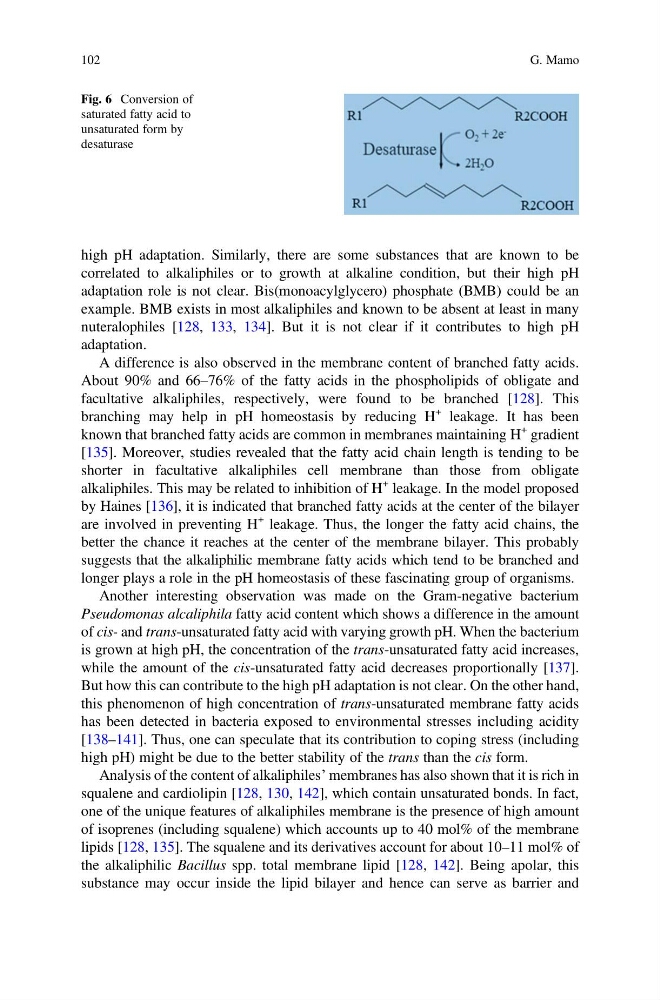
Fig. 6 Conversion of
saturated fatty acid to
unsaturated form by
desaturase
102
G. Mamo
correlated to alkaliphiles or to growth at alkaline condition, but their high pH
adaptation role is not clear. Bis(monoacylglycero) phosphate (BMB) could be an
example. BMB exists in most alkaliphiles and known to be absent at least in many
nuteralophiles [128, 133, 134]. But it is not clear if it contributes to high pH
adaptation.
A difference is also observed in the membrane content of branched fatty acids.
About 90% and 66–76% of the fatty acids in the phospholipids of obligate and
facultative alkaliphiles, respectively, were found to be branched [128]. This
branching may help in pH homeostasis by reducing H
+ leakage. It has been
known that branched fatty acids are common in membranes maintaining H
+ gradient
[135]. Moreover, studies revealed that the fatty acid chain length is tending to be
shorter in facultative alkaliphiles cell membrane than those from obligate
alkaliphiles. This may be related to inhibition of H
+ leakage. In the model proposed
by Haines [136], it is indicated that branched fatty acids at the center of the bilayer
are involved in preventing H
+ leakage. Thus, the longer the fatty acid chains, the
better the chance it reaches at the center of the membrane bilayer. This probably
suggests that the alkaliphilic membrane fatty acids which tend to be branched and
longer plays a role in the pH homeostasis of these fascinating group of organisms.
Another interesting observation was made on the Gram-negative bacterium
Pseudomonas alcaliphila fatty acid content which shows a difference in the amount
of cis- and trans-unsaturated fatty acid with varying growth pH. When the bacterium
is grown at high pH, the concentration of the trans-unsaturated fatty acid increases,
while the amount of the cis-unsaturated fatty acid decreases proportionally [137].
But how this can contribute to the high pH adaptation is not clear. On the other hand,
this phenomenon of high concentration of trans-unsaturated membrane fatty acids
has been detected in bacteria exposed to environmental stresses including acidity
[138–141]. Thus, one can speculate that its contribution to coping stress (including
high pH) might be due to the better stability of the trans than the cis form.
Analysis of the content of alkaliphiles’ membranes has also shown that it is rich in
squalene and cardiolipin [128, 130, 142], which contain unsaturated bonds. In fact,
one of the unique features of alkaliphiles membrane is the presence of high amount
of isoprenes (including squalene) which accounts up to 40 mol% of the membrane
lipids [128, 135]. The squalene and its derivatives account for about 10–11 mol% of
the alkaliphilic Bacillus spp. total membrane lipid [128, 142]. Being apolar, this
substance may occur inside the lipid bilayer and hence can serve as barrier and
Fig. 6 Conversion of
saturated fatty acid to
unsaturated form by
desaturase
102
G. Mamo