

59
Process-Induced Stress Engineering in CMOS Technology
Si 1–x Ge x alloy depends on the Ge concentration. Consequently, the stress in
the channel also depends on the Ge concentration. The strain in the channel also depends on the source/drain regions etch depth and on the Si 1–x Ge x
overgrowth. Typically, germanium concentrations around 20% are used
for the S/D regions. Ge concentrations above 30% are not beneficial due to
increased defect formation and subsequent strain relaxation. The stress in
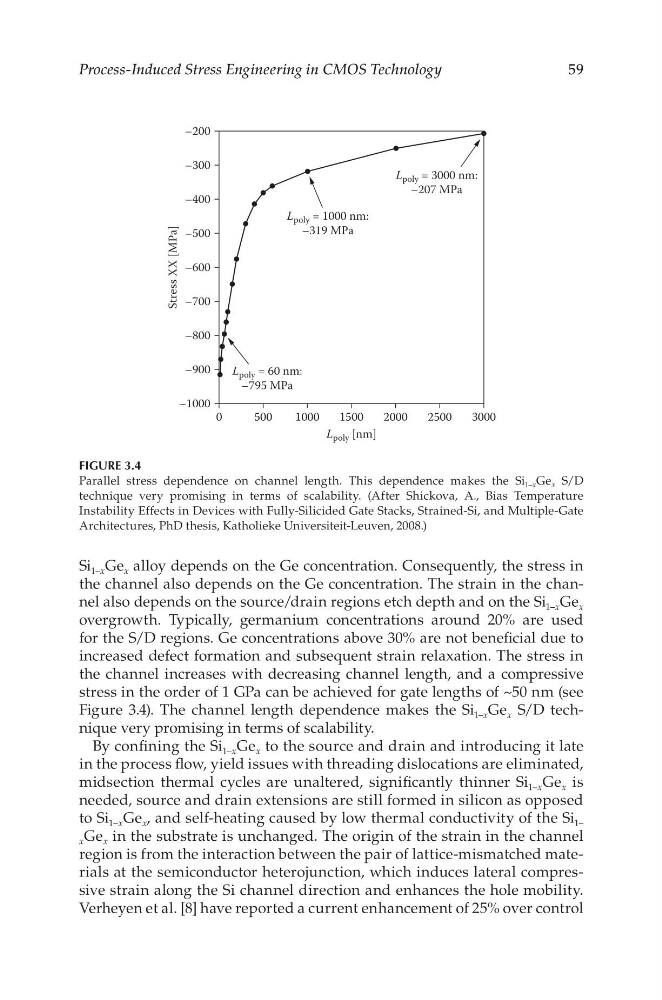
the channel increases with decreasing channel length, and a compressive
stress in the order of 1 GPa can be achieved for gate lengths of ~50 nm (see
Figure 3.4). The channel length dependence makes the Si 1–x Ge x S/D technique very promising in terms of scalability.
By confining the Si 1–x Ge x to the source and drain and introducing it late
in the process flow, yield issues with threading dislocations are eliminated,
midsection thermal cycles are unaltered, significantly thinner Si 1–x Ge x is
needed, source and drain extensions are still formed in silicon as opposed
to Si 1–x Ge x , and self-heating caused by low thermal conductivity of the Si 1–
x Ge x in the substrate is unchanged. The origin of the strain in the channel
region is from the interaction between the pair of lattice-mismatched materials at the semiconductor heterojunction, which induces lateral compressive strain along the Si channel direction and enhances the hole mobility.
Verheyen et al. [8] have reported a current enhancement of 25% over control
–200
–300
–500
L poly = 1000 nm:
–319 MPa
L poly = 60 nm:
–795 MPa
L poly = 3000 nm:
–207 MPa
–400
–700
–600
Stress XX [MPa]
–800
–900
–1000
0
1000
500
2000
1500
L poly [nm]
2500
3000
FIGURE 3.4
Parallel stress dependence on channel length. This dependence makes the Si 1–x Ge x S/D
technique very promising in terms of scalability. (After Shickova, A., Bias Temperature
Instability Effects in Devices with Fully-Silicided Gate Stacks, Strained-Si, and Multiple-Gate
Architectures, PhD thesis, Katholieke Universiteit-Leuven, 2008.)
Process-Induced Stress Engineering in CMOS Technology
Si 1–x Ge x alloy depends on the Ge concentration. Consequently, the stress in
the channel also depends on the Ge concentration. The strain in the channel also depends on the source/drain regions etch depth and on the Si 1–x Ge x
overgrowth. Typically, germanium concentrations around 20% are used
for the S/D regions. Ge concentrations above 30% are not beneficial due to
increased defect formation and subsequent strain relaxation. The stress in
the channel increases with decreasing channel length, and a compressive
stress in the order of 1 GPa can be achieved for gate lengths of ~50 nm (see
Figure 3.4). The channel length dependence makes the Si 1–x Ge x S/D technique very promising in terms of scalability.
By confining the Si 1–x Ge x to the source and drain and introducing it late
in the process flow, yield issues with threading dislocations are eliminated,
midsection thermal cycles are unaltered, significantly thinner Si 1–x Ge x is
needed, source and drain extensions are still formed in silicon as opposed
to Si 1–x Ge x , and self-heating caused by low thermal conductivity of the Si 1–
x Ge x in the substrate is unchanged. The origin of the strain in the channel
region is from the interaction between the pair of lattice-mismatched materials at the semiconductor heterojunction, which induces lateral compressive strain along the Si channel direction and enhances the hole mobility.
Verheyen et al. [8] have reported a current enhancement of 25% over control
–200
–300
–500
L poly = 1000 nm:
–319 MPa
L poly = 60 nm:
–795 MPa
L poly = 3000 nm:
–207 MPa
–400
–700
–600
Stress XX [MPa]
–800
–900
–1000
0
1000
500
2000
1500
L poly [nm]
2500
3000
FIGURE 3.4
Parallel stress dependence on channel length. This dependence makes the Si 1–x Ge x S/D
technique very promising in terms of scalability. (After Shickova, A., Bias Temperature
Instability Effects in Devices with Fully-Silicided Gate Stacks, Strained-Si, and Multiple-Gate
Architectures, PhD thesis, Katholieke Universiteit-Leuven, 2008.)