

35
Substrate-Induced Strain Engineering in CMOS Technology
reported by having biaxial tensile Si as a channel layer in the transistors. The
main reason for higher mobility is reduction of intervalley and interband
phonon scatterings. Although biaxial tensile strain increases the hole mobility, this effect is diminished at high vertical electric fields.
In the biaxially strained SiC/Si system, the amount of strain is increased by
increasing the C content. The exact effect of carbon in fully or partially straincompensated SiGe:C layers is not well known. Mainly, the band splitting is
believed to decrease as the strain is compensated. However, the incorporation of small amounts of C into the Si 1–x–y Ge x C y matrix leads to an increase
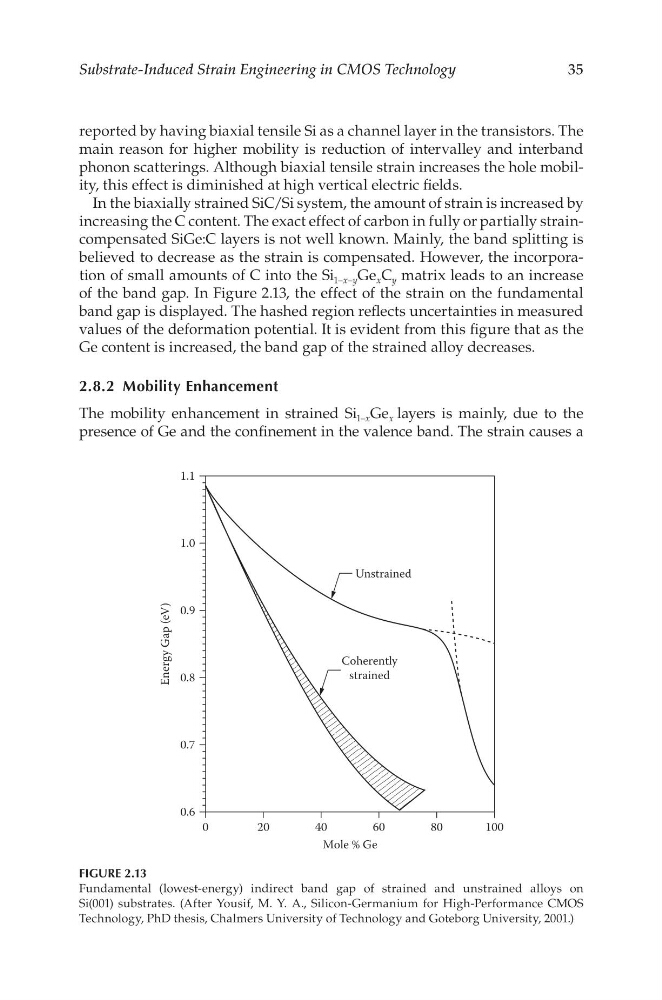
of the band gap. In Figure 2.13, the effect of the strain on the fundamental
band gap is displayed. The hashed region reflects uncertainties in measured
values of the deformation potential. It is evident from this figure that as the
Ge content is increased, the band gap of the strained alloy decreases.
2.8.2 Mobility Enhancement
The mobility enhancement in strained Si 1–x Ge x layers is mainly, due to the
presence of Ge and the confinement in the valence band. The strain causes a
0.6
20
0
6 0
8 0
40
Mole % Ge
100
Coherently
strained
Unstrained
0.7
Energy Gap (eV)
0.8
0.9
1.0
1.1
FIGURE 2.13
Fundamental (lowest-energy) indirect band gap of strained and unstrained alloys on
Si(001) substrates. (After Yousif, M. Y. A., Silicon-Germanium for High-Performance CMOS
Technology, PhD thesis, Chalmers University of Technology and Goteborg University, 2001.)
Substrate-Induced Strain Engineering in CMOS Technology
reported by having biaxial tensile Si as a channel layer in the transistors. The
main reason for higher mobility is reduction of intervalley and interband
phonon scatterings. Although biaxial tensile strain increases the hole mobility, this effect is diminished at high vertical electric fields.
In the biaxially strained SiC/Si system, the amount of strain is increased by
increasing the C content. The exact effect of carbon in fully or partially straincompensated SiGe:C layers is not well known. Mainly, the band splitting is
believed to decrease as the strain is compensated. However, the incorporation of small amounts of C into the Si 1–x–y Ge x C y matrix leads to an increase
of the band gap. In Figure 2.13, the effect of the strain on the fundamental
band gap is displayed. The hashed region reflects uncertainties in measured
values of the deformation potential. It is evident from this figure that as the
Ge content is increased, the band gap of the strained alloy decreases.
2.8.2 Mobility Enhancement
The mobility enhancement in strained Si 1–x Ge x layers is mainly, due to the
presence of Ge and the confinement in the valence band. The strain causes a
0.6
20
0
6 0
8 0
40
Mole % Ge
100
Coherently
strained
Unstrained
0.7
Energy Gap (eV)
0.8
0.9
1.0
1.1
FIGURE 2.13
Fundamental (lowest-energy) indirect band gap of strained and unstrained alloys on
Si(001) substrates. (After Yousif, M. Y. A., Silicon-Germanium for High-Performance CMOS
Technology, PhD thesis, Chalmers University of Technology and Goteborg University, 2001.)