

212
Strain-Engineered MOSFETs
the channel is much higher than the longer one. Raising the SiGe source/
drain depth to a certain extent transfers higher stress to the channel, thereby
further improving the mobility of holes.
Although the stress induced in the channel due to Ge incorporation is
insignificant for long-channel devices, for CMOS transistors with channel
lengths in the nanometer range, the stress developed plays a significant
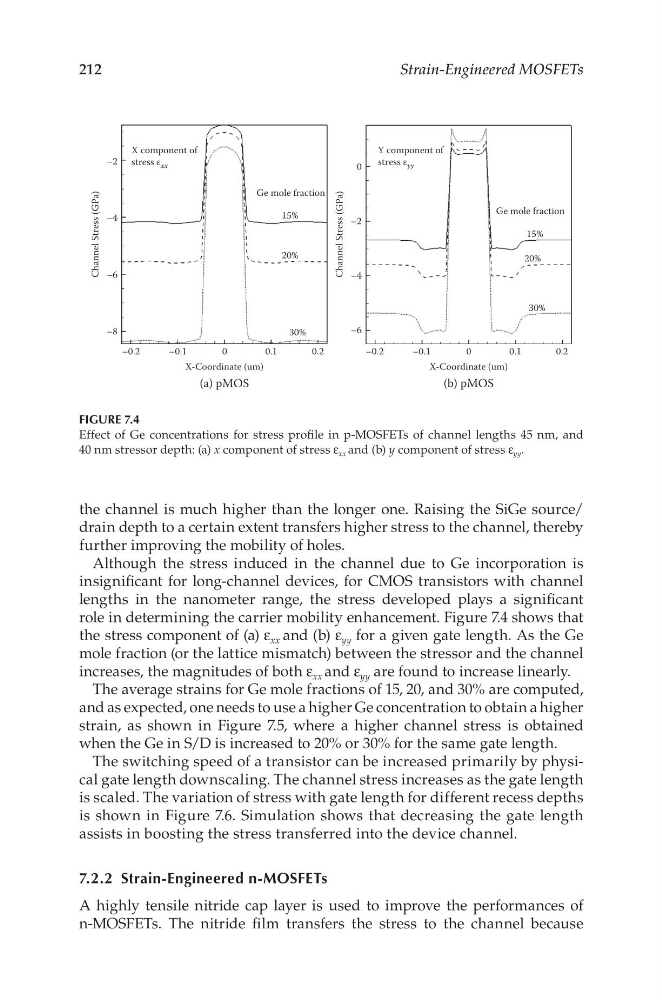
role in determining the carrier mobility enhancement. Figure 7.4 shows that
the stress component of (a) ε xx and (b) ε yy for a given gate length. As the Ge
mole fraction (or the lattice mismatch) between the stressor and the channel
increases, the magnitudes of both ε xx and ε yy are found to increase linearly.
The average strains for Ge mole fractions of 15, 20, and 30% are computed,
and as expected, one needs to use a higher Ge concentration to obtain a higher
strain, as shown in Figure 7.5, where a higher channel stress is obtained
when the Ge in S/D is increased to 20% or 30% for the same gate length.
The switching speed of a transistor can be increased primarily by physical gate length downscaling. The channel stress increases as the gate length
is scaled. The variation of stress with gate length for different recess depths
is shown in Figure 7.6. Simulation shows that decreasing the gate length
assists in boosting the stress transferred into the device channel.
7.2.2 Strain-Engineered n-MOSFETs
A highly tensile nitride cap layer is used to improve the performances of
n-MOSFETs. The nitride film transfers the stress to the channel because
Ge mole fraction
15%
20%
30%
Ge mole fraction
15%
20%
30%
X component of
stress ε xx
Y component of
stress ε yy
–2
–4
–6
–8
0
–2
–4
–6
Channel Stress (GPa)
Channel Stress (GPa)
–0.2
–0.1
0
0.1
0.2
X-Coordinate (um)
(a) pMOS
–0.2
–0.1
0
0.1
0.2
X-Coordinate (um)
(b) pMOS
FIGURE 7.4
Effect of Ge concentrations for stress profile in p-MOSFETs of channel lengths 45 nm, and
40 nm stressor depth: (a) x component of stress ε xx and (b) y component of stress ε yy .
Strain-Engineered MOSFETs
the channel is much higher than the longer one. Raising the SiGe source/
drain depth to a certain extent transfers higher stress to the channel, thereby
further improving the mobility of holes.
Although the stress induced in the channel due to Ge incorporation is
insignificant for long-channel devices, for CMOS transistors with channel
lengths in the nanometer range, the stress developed plays a significant
role in determining the carrier mobility enhancement. Figure 7.4 shows that
the stress component of (a) ε xx and (b) ε yy for a given gate length. As the Ge
mole fraction (or the lattice mismatch) between the stressor and the channel
increases, the magnitudes of both ε xx and ε yy are found to increase linearly.
The average strains for Ge mole fractions of 15, 20, and 30% are computed,
and as expected, one needs to use a higher Ge concentration to obtain a higher
strain, as shown in Figure 7.5, where a higher channel stress is obtained
when the Ge in S/D is increased to 20% or 30% for the same gate length.
The switching speed of a transistor can be increased primarily by physical gate length downscaling. The channel stress increases as the gate length
is scaled. The variation of stress with gate length for different recess depths
is shown in Figure 7.6. Simulation shows that decreasing the gate length
assists in boosting the stress transferred into the device channel.
7.2.2 Strain-Engineered n-MOSFETs
A highly tensile nitride cap layer is used to improve the performances of
n-MOSFETs. The nitride film transfers the stress to the channel because
Ge mole fraction
15%
20%
30%
Ge mole fraction
15%
20%
30%
X component of
stress ε xx
Y component of
stress ε yy
–2
–4
–6
–8
0
–2
–4
–6
Channel Stress (GPa)
Channel Stress (GPa)
–0.2
–0.1
0
0.1
0.2
X-Coordinate (um)
(a) pMOS
–0.2
–0.1
0
0.1
0.2
X-Coordinate (um)
(b) pMOS
FIGURE 7.4
Effect of Ge concentrations for stress profile in p-MOSFETs of channel lengths 45 nm, and
40 nm stressor depth: (a) x component of stress ε xx and (b) y component of stress ε yy .