

158
Strain-Engineered MOSFETs
1/f noise is obtained for an even distribution of traps in energy. The problem
with this theory is the difficulty to find a physical process with the property
given by Equation (6.25). The emission time for a thermally activated trap
depends exponentially on the activation energy, but the capture time is normally independent of energy.
6.3.2 Mobility Fluctuations
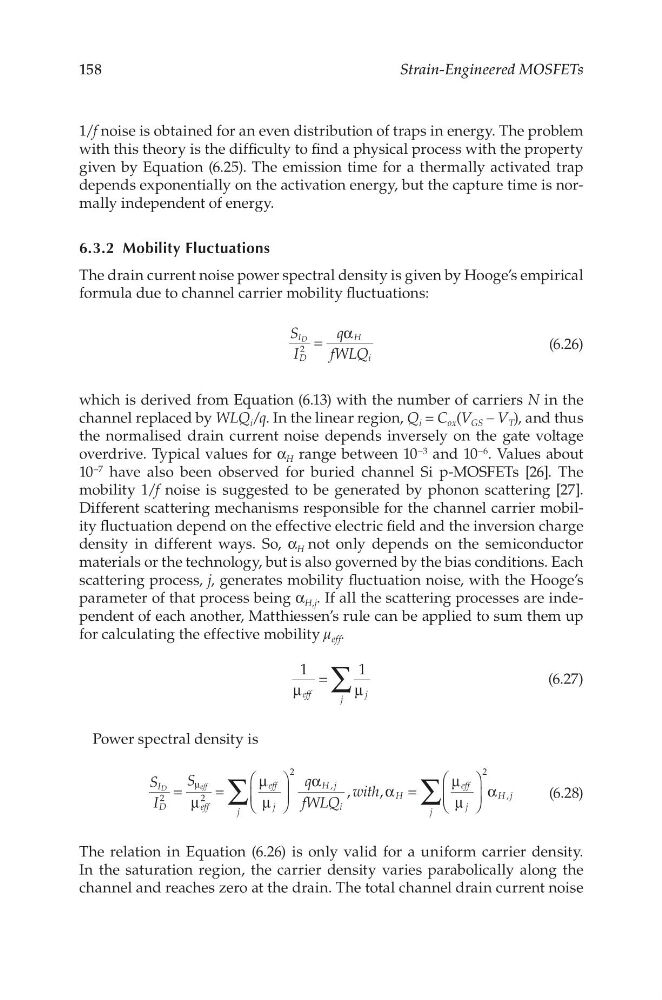
The drain current noise power spectral density is given by Hooge’s empirical
formula due to channel carrier mobility fluctuations:
S
I
q
fWLQ
I
D
H
i
2
D
=
α
(6.26)
which is derived from Equation (6.13) with the number of carriers N in the
channel replaced by WLQ i /q. In the linear region, Q i = C ox (V GS – V T ), and thus
the normalised drain current noise depends inversely on the gate voltage
overdrive. Typical values for α H range between 10 –3 and 10 –6 . Values about
10 –7 have also been observed for buried channel Si p-MOSFETs [26]. The
mobility 1/f noise is suggested to be generated by phonon scattering [27].
Different scattering mechanisms responsible for the channel carrier mobility fluctuation depend on the effective electric field and the inversion charge
density in different ways. So, α H not only depends on the semiconductor
materials or the technology, but is also governed by the bias conditions. Each
scattering process, j, generates mobility fluctuation noise, with the Hooge’s
parameter of that process being α H,j . If all the scattering processes are independent of each another, Matthiessen’s rule can be applied to sum them up
for calculating the effective mobility μ eff .
1
1
eff
j
j
∑
µ
=
µ
(6.27)
Power spectral density is
S
I
S
q
fWLQ
with
,
,
I
D
e ff
eff
j
j
H j
i
H
eff
j
j
H j
2
2
2
,
2
,
D
eff
∑
∑
= µ
=
µ
µ
α
α =
µ
µ
α
µ
(6.28)
The relation in Equation (6.26) is only valid for a uniform carrier density.
In the saturation region, the carrier density varies parabolically along the
channel and reaches zero at the drain. The total channel drain current noise
Strain-Engineered MOSFETs
1/f noise is obtained for an even distribution of traps in energy. The problem
with this theory is the difficulty to find a physical process with the property
given by Equation (6.25). The emission time for a thermally activated trap
depends exponentially on the activation energy, but the capture time is normally independent of energy.
6.3.2 Mobility Fluctuations
The drain current noise power spectral density is given by Hooge’s empirical
formula due to channel carrier mobility fluctuations:
S
I
q
fWLQ
I
D
H
i
2
D
=
α
(6.26)
which is derived from Equation (6.13) with the number of carriers N in the
channel replaced by WLQ i /q. In the linear region, Q i = C ox (V GS – V T ), and thus
the normalised drain current noise depends inversely on the gate voltage
overdrive. Typical values for α H range between 10 –3 and 10 –6 . Values about
10 –7 have also been observed for buried channel Si p-MOSFETs [26]. The
mobility 1/f noise is suggested to be generated by phonon scattering [27].
Different scattering mechanisms responsible for the channel carrier mobility fluctuation depend on the effective electric field and the inversion charge
density in different ways. So, α H not only depends on the semiconductor
materials or the technology, but is also governed by the bias conditions. Each
scattering process, j, generates mobility fluctuation noise, with the Hooge’s
parameter of that process being α H,j . If all the scattering processes are independent of each another, Matthiessen’s rule can be applied to sum them up
for calculating the effective mobility μ eff .
1
1
eff
j
j
∑
µ
=
µ
(6.27)
Power spectral density is
S
I
S
q
fWLQ
with
,
,
I
D
e ff
eff
j
j
H j
i
H
eff
j
j
H j
2
2
2
,
2
,
D
eff
∑
∑
= µ
=
µ
µ
α
α =
µ
µ
α
µ
(6.28)
The relation in Equation (6.26) is only valid for a uniform carrier density.
In the saturation region, the carrier density varies parabolically along the
channel and reaches zero at the drain. The total channel drain current noise