

Theor Chem Acc (2015) 134:114
1 3
mentioned already earlier that in most cases the planar
structure proved to be unstable. Our aim was to consider
further ring confi gurations and to fi nd possible structures
in local energy minima. In order to do this, we have
chosen density functional theory using the B3LYP/631G(d,p) functional of the G09 program package [ 27 ].
This fi rst principles method already takes into account
the correlation, but it is still manageable for molecules
shown in Sect. 2 .
We optimized the geometry with various constraints:
(a) The structure was relaxed in plane with all - cis geometry
(see, e.g. Fig. 2 left part), for n C = 6, 10, . . . 34 and 66.
(b) The structure was relaxed in plane with all - trans geometry (see, e.g. Fig. 2 right part), for n C = 6, 10, . . . 34
and 66.
(c) The structure was relaxed in plane starting from the
special sp 2 structure for n C = 10 and 14 (see Figs. 3 , 4
left parts).
(d) The structure was relaxed in 3D starting from the special sp 2 structure for n C = 10 and 14 (see Figs. 3 , 4
right parts).
(e) The structure was relaxed in plane starting from
D 6h structure for n C = 18 , 30 and 66 (see Fig. 5 for
n C = 18 and 30).
(f) The structure was relaxed in 3D for nanorings with
n C = 6, 10, . . . 34 and 66 (see, e.g. Fig. 6 for the case
of n C = 18 ).
As it was mentioned earlier, all molecules fulfi l Hückel’s
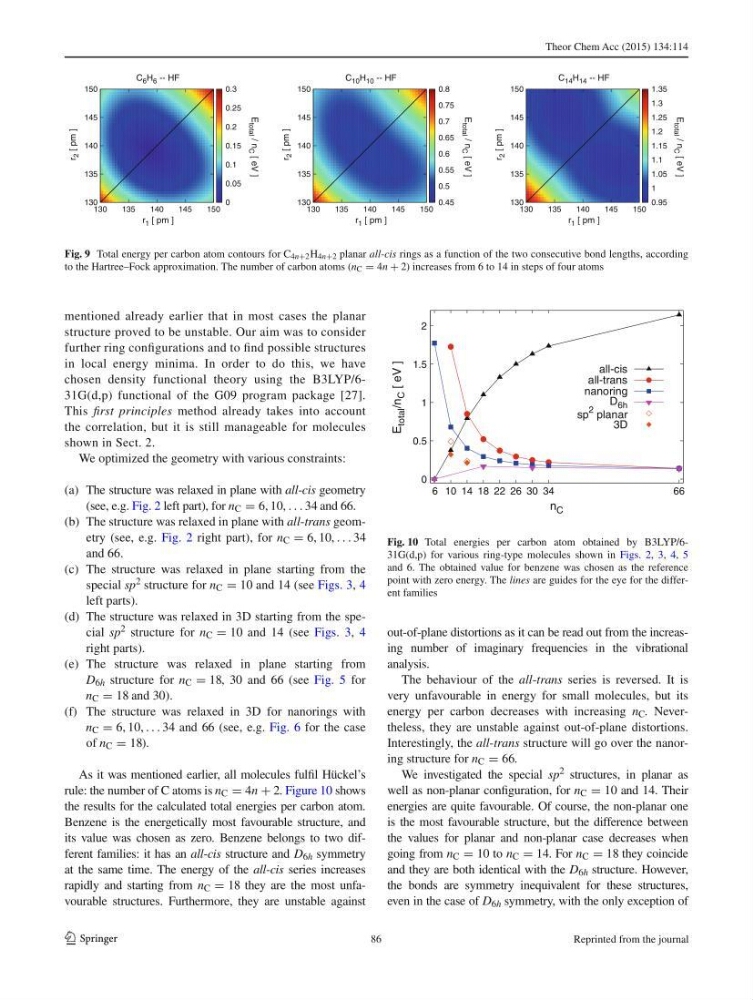
rule: the number of C atoms is n C = 4n + 2 . Figure 10 shows
the results for the calculated total energies per carbon atom.
Benzene is the energetically most favourable structure, and
its value was chosen as zero. Benzene belongs to two different families: it has an all - cis structure and D 6h symmetry
at the same time. The energy of the all - cis series increases
rapidly and starting from n C = 18 they are the most unfavourable structures. Furthermore, they are unstable against
out-of-plane distortions as it can be read out from the increasing number of imaginary frequencies in the vibrational
analysis.
The behaviour of the all - trans series is reversed. It is
very unfavourable in energy for small molecules, but its
energy per carbon decreases with increasing n C . Nevertheless, they are unstable against out-of-plane distortions.
Interestingly, the all - trans structure will go over the nanoring structure for n C = 66 .
We investigated the special sp 2 structures, in planar as
well as non-planar confi guration, for n C = 10 and 14. Their
energies are quite favourable. Of course, the non-planar one
is the most favourable structure, but the difference between
the values for planar and non-planar case decreases when
going from n C = 10 to n C = 14 . For n C = 18 they coincide
and they are both identical with the D 6h structure. However,
the bonds are symmetry inequivalent for these structures,
even in the case of D 6h symmetry, with the only exception of
C 6 H 6 -- HF
E total / n C [ eV ]
130
135
140
145
150
r 1 [ pm ]
130
135
140
145
150
r
2 [ pm ]
0
0.05
0.1
0.15
0.2
0.25
0.3
C 10 H 10 -- HF
E total / n C [ eV ]
130
135
140
145
150
r 1 [ pm ]
130
135
140
145
150
r
2 [ pm ]
0.45
0.5
0.55
0.6
0.65
0.7
0.75
0.8
C 14 H 14 -- HF
E total / n C [ eV ]
130
135
140
145
150
r 1 [ pm ]
130
135
140
145
150
r
2 [ pm ]
0.95
1
1.05
1.1
1.15
1.2
1.25
1.3
1.35
Fig. 9 Total energy per carbon atom contours for C 4n+2 H 4n+2 planar all - cis rings as a function of the two consecutive bond lengths, according
to the Hartree–Fock approximation. The number of carbon atoms ( n C = 4n + 2 ) increases from 6 to 14 in steps of four atoms
0
0.5
1
1.5
2
6 10 14 18 22 26 30 34
66
E
total /n
C [ eV ]
n C
all-cis
all-trans
nanoring
D 6h
sp
2 planar
3D
Fig. 10 Total energies per carbon atom obtained by B3LYP/631G(d,p) for various ring-type molecules shown in Figs. 2 , 3 , 4 , 5
and 6 . The obtained value for benzene was chosen as the reference
point with zero energy. The lines are guides for the eye for the different families
86
Reprinted from the journal
1 3
mentioned already earlier that in most cases the planar
structure proved to be unstable. Our aim was to consider
further ring confi gurations and to fi nd possible structures
in local energy minima. In order to do this, we have
chosen density functional theory using the B3LYP/631G(d,p) functional of the G09 program package [ 27 ].
This fi rst principles method already takes into account
the correlation, but it is still manageable for molecules
shown in Sect. 2 .
We optimized the geometry with various constraints:
(a) The structure was relaxed in plane with all - cis geometry
(see, e.g. Fig. 2 left part), for n C = 6, 10, . . . 34 and 66.
(b) The structure was relaxed in plane with all - trans geometry (see, e.g. Fig. 2 right part), for n C = 6, 10, . . . 34
and 66.
(c) The structure was relaxed in plane starting from the
special sp 2 structure for n C = 10 and 14 (see Figs. 3 , 4
left parts).
(d) The structure was relaxed in 3D starting from the special sp 2 structure for n C = 10 and 14 (see Figs. 3 , 4
right parts).
(e) The structure was relaxed in plane starting from
D 6h structure for n C = 18 , 30 and 66 (see Fig. 5 for
n C = 18 and 30).
(f) The structure was relaxed in 3D for nanorings with
n C = 6, 10, . . . 34 and 66 (see, e.g. Fig. 6 for the case
of n C = 18 ).
As it was mentioned earlier, all molecules fulfi l Hückel’s
rule: the number of C atoms is n C = 4n + 2 . Figure 10 shows
the results for the calculated total energies per carbon atom.
Benzene is the energetically most favourable structure, and
its value was chosen as zero. Benzene belongs to two different families: it has an all - cis structure and D 6h symmetry
at the same time. The energy of the all - cis series increases
rapidly and starting from n C = 18 they are the most unfavourable structures. Furthermore, they are unstable against
out-of-plane distortions as it can be read out from the increasing number of imaginary frequencies in the vibrational
analysis.
The behaviour of the all - trans series is reversed. It is
very unfavourable in energy for small molecules, but its
energy per carbon decreases with increasing n C . Nevertheless, they are unstable against out-of-plane distortions.
Interestingly, the all - trans structure will go over the nanoring structure for n C = 66 .
We investigated the special sp 2 structures, in planar as
well as non-planar confi guration, for n C = 10 and 14. Their
energies are quite favourable. Of course, the non-planar one
is the most favourable structure, but the difference between
the values for planar and non-planar case decreases when
going from n C = 10 to n C = 14 . For n C = 18 they coincide
and they are both identical with the D 6h structure. However,
the bonds are symmetry inequivalent for these structures,
even in the case of D 6h symmetry, with the only exception of
C 6 H 6 -- HF
E total / n C [ eV ]
130
135
140
145
150
r 1 [ pm ]
130
135
140
145
150
r
2 [ pm ]
0
0.05
0.1
0.15
0.2
0.25
0.3
C 10 H 10 -- HF
E total / n C [ eV ]
130
135
140
145
150
r 1 [ pm ]
130
135
140
145
150
r
2 [ pm ]
0.45
0.5
0.55
0.6
0.65
0.7
0.75
0.8
C 14 H 14 -- HF
E total / n C [ eV ]
130
135
140
145
150
r 1 [ pm ]
130
135
140
145
150
r
2 [ pm ]
0.95
1
1.05
1.1
1.15
1.2
1.25
1.3
1.35
Fig. 9 Total energy per carbon atom contours for C 4n+2 H 4n+2 planar all - cis rings as a function of the two consecutive bond lengths, according
to the Hartree–Fock approximation. The number of carbon atoms ( n C = 4n + 2 ) increases from 6 to 14 in steps of four atoms
0
0.5
1
1.5
2
6 10 14 18 22 26 30 34
66
E
total /n
C [ eV ]
n C
all-cis
all-trans
nanoring
D 6h
sp
2 planar
3D
Fig. 10 Total energies per carbon atom obtained by B3LYP/631G(d,p) for various ring-type molecules shown in Figs. 2 , 3 , 4 , 5
and 6 . The obtained value for benzene was chosen as the reference
point with zero energy. The lines are guides for the eye for the different families
86
Reprinted from the journal