

Theor Chem Acc (2015) 134:114
1 3
The second important improvement is the explicit accounting for the σ -electrons by an empirical potential:
where R 1 and R 2 are the lengths of the pure single and double bonds, respectively. This potential can be derived from,
therefore is equivalent to, the empirical linear Coulson relation between bond length and (mobile) bond order [ 26 ]:
where p is the bond order for the π -electrons. The details
of the model, together with some of its applications, can
be found in the references mentioned above. We emphasize
here only the most important property of the LHS method:
as opposed to the usual Hückel theory, it allows the optimization of the bond lengths in a self-consistent manner
by satisfying the Coulson relation, which at the same time
minimizes the total ( π + σ ) energy. However, one has to
keep in mind that the LHS model cannot handle the bond
angles, only the bond lengths.
H atoms are neglected in this model. We used our LHS
code to calculate the total energy of the C 4n+2 rings, starting
with n C = 4n + 2 = 6 (benzene) until n C = 4n + 2 = 42.
We scanned the geometry according to dimerization, having only two independent bond lengths. The two consecutive bonds ( r 1 and r 2 ) can be different, but all odd-numbered
bonds are identical in length, as are all even-numbered bonds.
Figure 7 shows the 2D total energy map, that is, the total
energy per carbon atom contours as a function of the two
neighbouring bond lengths, for rings C 6 to C 26 . The maps are
symmetric with respect to the r 1 = r 2 (BLA = 0) line.
The total energy has a stable minimum for C 6 and C 10 at
r 1 = r 2 = 140 pm . However, starting from C 14 the minimum
(2)
f σ (r) = 2 · β(r) · (r − R 1 + B)/(R 1 − R 2 ),
(3)
r = R 1 − (R 1 − R 2 ) · p,
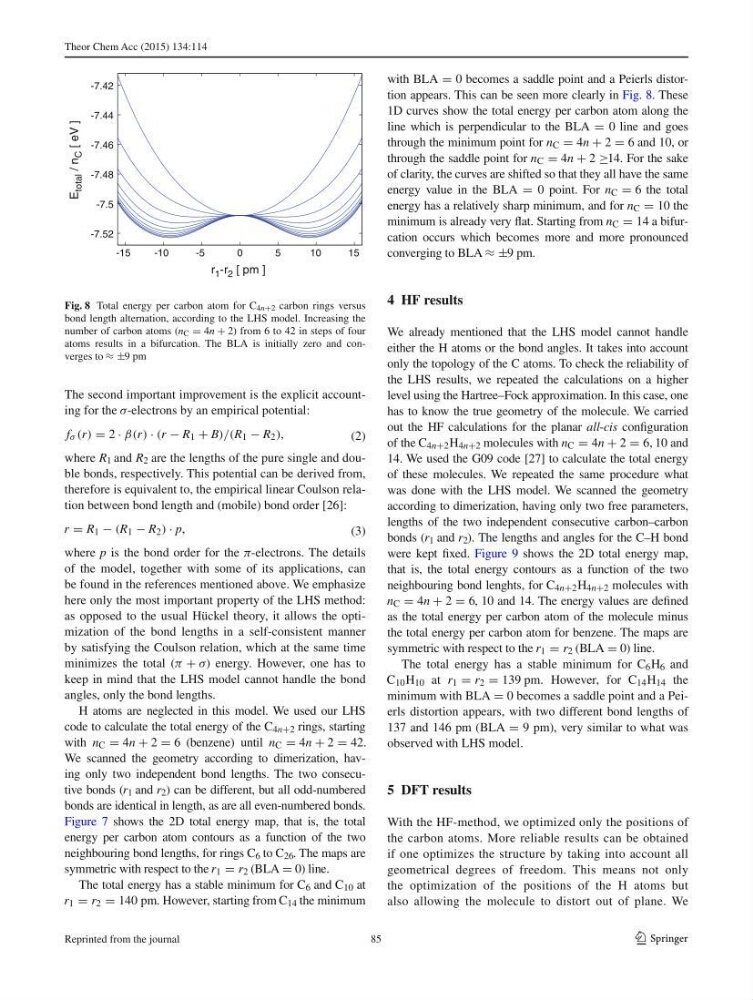
with BLA = 0 becomes a saddle point and a Peierls distortion appears. This can be seen more clearly in Fig. 8 . These
1D curves show the total energy per carbon atom along the
line which is perpendicular to the BLA = 0 line and goes
through the minimum point for n C = 4n + 2 = 6 and 10, or
through the saddle point for n C = 4n + 2 ≥ 14. For the sake
of clarity, the curves are shifted so that they all have the same
energy value in the BLA = 0 point. For n C = 6 the total
energy has a relatively sharp minimum, and for n C = 10 the
minimum is already very fl at. Starting from n C = 14 a bifurcation occurs which becomes more and more pronounced
converging to BLA ≈ ± 9 pm.
4 HF results
We already mentioned that the LHS model cannot handle
either the H atoms or the bond angles. It takes into account
only the topology of the C atoms. To check the reliability of
the LHS results, we repeated the calculations on a higher
level using the Hartree–Fock approximation. In this case, one
has to know the true geometry of the molecule. We carried
out the HF calculations for the planar all - cis confi guration
of the C 4n+2 H 4n+2 molecules with n C = 4n + 2 = 6, 10 and
14. We used the G09 code [ 27 ] to calculate the total energy
of these molecules. We repeated the same procedure what
was done with the LHS model. We scanned the geometry
according to dimerization, having only two free parameters,
lengths of the two independent consecutive carbon–carbon
bonds ( r 1 and r 2 ). The lengths and angles for the C–H bond
were kept fi xed. Figure 9 shows the 2D total energy map,
that is, the total energy contours as a function of the two
neighbouring bond lenghts, for C 4n+2 H 4n+2 molecules with
n C = 4n + 2 = 6 , 10 and 14. The energy values are defi ned
as the total energy per carbon atom of the molecule minus
the total energy per carbon atom for benzene. The maps are
symmetric with respect to the r 1 = r 2 (BLA = 0) line.
The total energy has a stable minimum for C 6 H 6 and
C 10 H 10 at r 1 = r 2 = 139 pm . However, for C 14 H 14 the
minimum with BLA = 0 becomes a saddle point and a Peierls distortion appears, with two different bond lengths of
137 and 146 pm (BLA = 9 pm), very similar to what was
observed with LHS model.
5 DFT results
With the HF-method, we optimized only the positions of
the carbon atoms. More reliable results can be obtained
if one optimizes the structure by taking into account all
geometrical degrees of freedom. This means not only
the optimization of the positions of the H atoms but
also allowing the molecule to distort out of plane. We
-7.52
-7.5
-7.48
-7.46
-7.44
-7.42
-15
-10
-5
0
5
10
15
E
total / n
C [ eV ]
r 1 -r 2 [ pm ]
Fig. 8 Total energy per carbon atom for C 4n+2 carbon rings versus
bond length alternation, according to the LHS model. Increasing the
number of carbon atoms ( n C = 4n + 2 ) from 6 to 42 in steps of four
atoms results in a bifurcation. The BLA is initially zero and converges to ≈ ± 9 pm
85
Reprinted from the journal
1 3
The second important improvement is the explicit accounting for the σ -electrons by an empirical potential:
where R 1 and R 2 are the lengths of the pure single and double bonds, respectively. This potential can be derived from,
therefore is equivalent to, the empirical linear Coulson relation between bond length and (mobile) bond order [ 26 ]:
where p is the bond order for the π -electrons. The details
of the model, together with some of its applications, can
be found in the references mentioned above. We emphasize
here only the most important property of the LHS method:
as opposed to the usual Hückel theory, it allows the optimization of the bond lengths in a self-consistent manner
by satisfying the Coulson relation, which at the same time
minimizes the total ( π + σ ) energy. However, one has to
keep in mind that the LHS model cannot handle the bond
angles, only the bond lengths.
H atoms are neglected in this model. We used our LHS
code to calculate the total energy of the C 4n+2 rings, starting
with n C = 4n + 2 = 6 (benzene) until n C = 4n + 2 = 42.
We scanned the geometry according to dimerization, having only two independent bond lengths. The two consecutive bonds ( r 1 and r 2 ) can be different, but all odd-numbered
bonds are identical in length, as are all even-numbered bonds.
Figure 7 shows the 2D total energy map, that is, the total
energy per carbon atom contours as a function of the two
neighbouring bond lengths, for rings C 6 to C 26 . The maps are
symmetric with respect to the r 1 = r 2 (BLA = 0) line.
The total energy has a stable minimum for C 6 and C 10 at
r 1 = r 2 = 140 pm . However, starting from C 14 the minimum
(2)
f σ (r) = 2 · β(r) · (r − R 1 + B)/(R 1 − R 2 ),
(3)
r = R 1 − (R 1 − R 2 ) · p,
with BLA = 0 becomes a saddle point and a Peierls distortion appears. This can be seen more clearly in Fig. 8 . These
1D curves show the total energy per carbon atom along the
line which is perpendicular to the BLA = 0 line and goes
through the minimum point for n C = 4n + 2 = 6 and 10, or
through the saddle point for n C = 4n + 2 ≥ 14. For the sake
of clarity, the curves are shifted so that they all have the same
energy value in the BLA = 0 point. For n C = 6 the total
energy has a relatively sharp minimum, and for n C = 10 the
minimum is already very fl at. Starting from n C = 14 a bifurcation occurs which becomes more and more pronounced
converging to BLA ≈ ± 9 pm.
4 HF results
We already mentioned that the LHS model cannot handle
either the H atoms or the bond angles. It takes into account
only the topology of the C atoms. To check the reliability of
the LHS results, we repeated the calculations on a higher
level using the Hartree–Fock approximation. In this case, one
has to know the true geometry of the molecule. We carried
out the HF calculations for the planar all - cis confi guration
of the C 4n+2 H 4n+2 molecules with n C = 4n + 2 = 6, 10 and
14. We used the G09 code [ 27 ] to calculate the total energy
of these molecules. We repeated the same procedure what
was done with the LHS model. We scanned the geometry
according to dimerization, having only two free parameters,
lengths of the two independent consecutive carbon–carbon
bonds ( r 1 and r 2 ). The lengths and angles for the C–H bond
were kept fi xed. Figure 9 shows the 2D total energy map,
that is, the total energy contours as a function of the two
neighbouring bond lenghts, for C 4n+2 H 4n+2 molecules with
n C = 4n + 2 = 6 , 10 and 14. The energy values are defi ned
as the total energy per carbon atom of the molecule minus
the total energy per carbon atom for benzene. The maps are
symmetric with respect to the r 1 = r 2 (BLA = 0) line.
The total energy has a stable minimum for C 6 H 6 and
C 10 H 10 at r 1 = r 2 = 139 pm . However, for C 14 H 14 the
minimum with BLA = 0 becomes a saddle point and a Peierls distortion appears, with two different bond lengths of
137 and 146 pm (BLA = 9 pm), very similar to what was
observed with LHS model.
5 DFT results
With the HF-method, we optimized only the positions of
the carbon atoms. More reliable results can be obtained
if one optimizes the structure by taking into account all
geometrical degrees of freedom. This means not only
the optimization of the positions of the H atoms but
also allowing the molecule to distort out of plane. We
-7.52
-7.5
-7.48
-7.46
-7.44
-7.42
-15
-10
-5
0
5
10
15
E
total / n
C [ eV ]
r 1 -r 2 [ pm ]
Fig. 8 Total energy per carbon atom for C 4n+2 carbon rings versus
bond length alternation, according to the LHS model. Increasing the
number of carbon atoms ( n C = 4n + 2 ) from 6 to 42 in steps of four
atoms results in a bifurcation. The BLA is initially zero and converges to ≈ ± 9 pm
85
Reprinted from the journal