

Theor Chem Acc (2015) 134:114
1 3
with D 6h symmetry. Actually, with some indulgence, benzene can be regarded as the smallest molecule of this family, with no trans segments.
However, also the planar D 6h confi gurations are not
without problems, because the bonds are symmetry
inequivalent. The cis parts act as boundaries for the trans
segments, so these molecules can be viewed as ones with
internal delimiting effects, which can trigger the BLA
even inside the trans segments. This leads us to consider
non-planar hydrocarbon rings, with no end-group effects
or internal delimitation (see Fig. 6 as an example). These
C 4n+2 H 4n+2 nanorings can be regarded as cut out appropriately from a ( 4n + 2, 0 ) zig-zag nanotube and hydrogenized. In other words, they can be viewed as a fi nite
piece of trans -polyacetylene wrapped up perpendicular to
the plane of the polymer. They are energetically unfavourable for short rings. However, they become more and more
stable with increasing size as we will see, and they develop
into trans -polyacetylene in the infi nite limit. Their advantage is that they are the adequate molecules to investigate
the length dependence of the Peierls transition. Before Peierls distortion switches on, the molecule has D ˜
nd symmetry
(where ˜
n = 2n + 1 ) and all bonds are symmetry equivalent.
The ground state is degenerated, and the BLA can appear
only by symmetry breaking.
3 LHS results
The LHS model originates from an early work of LonguetHiggins and Salem [ 7 ]. The model was further developed
by Surján [ 11 ] and Kertész [ 23 ] and by Surján and Kürti
[ 8 , 20 , 24 , 25 ]. It is a Hückel-type method in essence but
with two important extensions. First, the β parameter of
the Hückel method is not constant but depends on the bond
length:
Here the parameters A and B were optimized for carbon–
carbon bonding so that the model can reproduce the BLA
and the gap of trans -polyacetylene (see, e.g. in Ref. [ 8 ]).
(1)
β(r) = −A · exp(−r/B).
Fig. 6 [18]Annulene in nanoring form
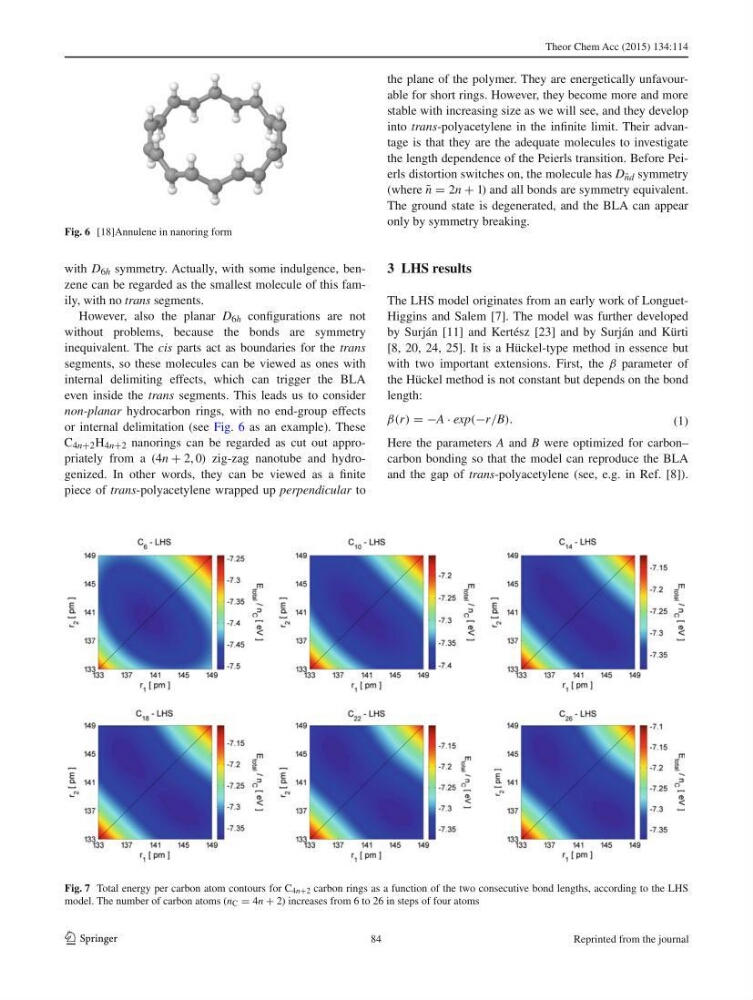
Fig. 7 Total energy per carbon atom contours for C 4n+2 carbon rings as a function of the two consecutive bond lengths, according to the LHS
model. The number of carbon atoms ( n C = 4n + 2 ) increases from 6 to 26 in steps of four atoms
84
Reprinted from the journal
1 3
with D 6h symmetry. Actually, with some indulgence, benzene can be regarded as the smallest molecule of this family, with no trans segments.
However, also the planar D 6h confi gurations are not
without problems, because the bonds are symmetry
inequivalent. The cis parts act as boundaries for the trans
segments, so these molecules can be viewed as ones with
internal delimiting effects, which can trigger the BLA
even inside the trans segments. This leads us to consider
non-planar hydrocarbon rings, with no end-group effects
or internal delimitation (see Fig. 6 as an example). These
C 4n+2 H 4n+2 nanorings can be regarded as cut out appropriately from a ( 4n + 2, 0 ) zig-zag nanotube and hydrogenized. In other words, they can be viewed as a fi nite
piece of trans -polyacetylene wrapped up perpendicular to
the plane of the polymer. They are energetically unfavourable for short rings. However, they become more and more
stable with increasing size as we will see, and they develop
into trans -polyacetylene in the infi nite limit. Their advantage is that they are the adequate molecules to investigate
the length dependence of the Peierls transition. Before Peierls distortion switches on, the molecule has D ˜
nd symmetry
(where ˜
n = 2n + 1 ) and all bonds are symmetry equivalent.
The ground state is degenerated, and the BLA can appear
only by symmetry breaking.
3 LHS results
The LHS model originates from an early work of LonguetHiggins and Salem [ 7 ]. The model was further developed
by Surján [ 11 ] and Kertész [ 23 ] and by Surján and Kürti
[ 8 , 20 , 24 , 25 ]. It is a Hückel-type method in essence but
with two important extensions. First, the β parameter of
the Hückel method is not constant but depends on the bond
length:
Here the parameters A and B were optimized for carbon–
carbon bonding so that the model can reproduce the BLA
and the gap of trans -polyacetylene (see, e.g. in Ref. [ 8 ]).
(1)
β(r) = −A · exp(−r/B).
Fig. 6 [18]Annulene in nanoring form
Fig. 7 Total energy per carbon atom contours for C 4n+2 carbon rings as a function of the two consecutive bond lengths, according to the LHS
model. The number of carbon atoms ( n C = 4n + 2 ) increases from 6 to 26 in steps of four atoms
84
Reprinted from the journal