

Theor Chem Acc (2015) 134:114
1 3
8 and 16. In other words, we consider annulenes, those
ones which obey the Hückel’s rule. Otherwise, the molecule cannot be aromatic, so there is ab ovo a bond length
alternation. The next question is whether these molecules
are planar or not. For the LHS model, this does not matter. In Hückel-type calculations, only the bond lengths play
a role. However, for more sophisticated methods we need
to know the precise spatial structure in three dimensions
(3D). Therefore, we consider several possible confi gurations which correspond to local energy minima. Note that
the structure of annulenes has been the subject of extensive
research, see. for example, Refs. [ 21 , 22 ].
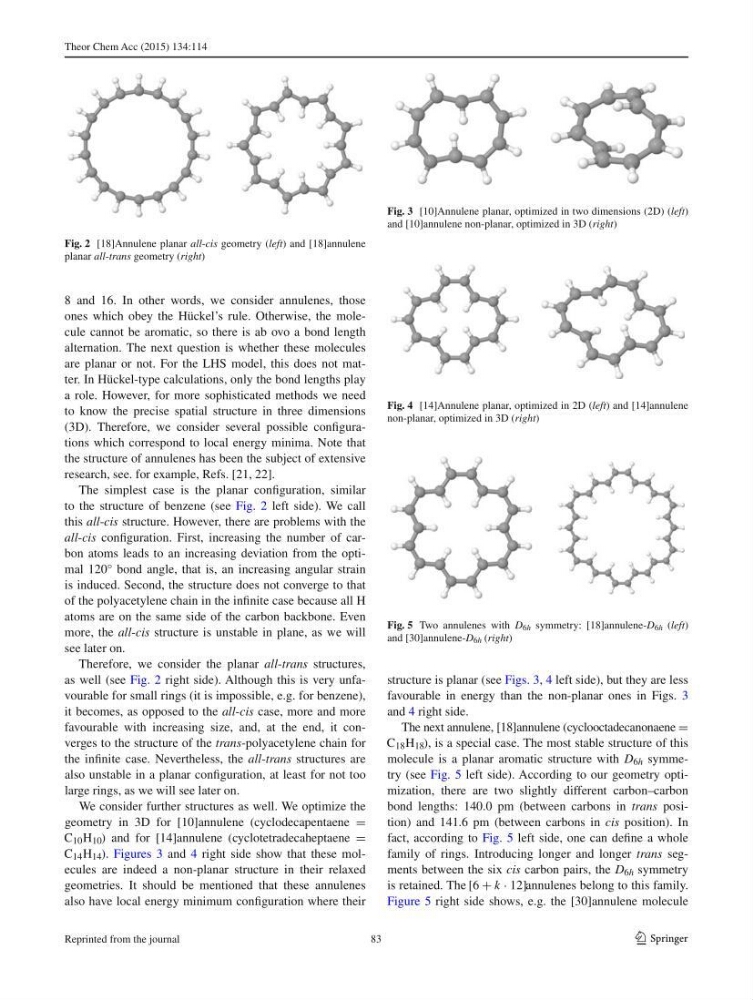
The simplest case is the planar confi guration, similar
to the structure of benzene (see Fig. 2 left side). We call
this all - cis structure. However, there are problems with the
all - cis confi guration. First, increasing the number of carbon atoms leads to an increasing deviation from the optimal 120° bond angle, that is, an increasing angular strain
is induced. Second, the structure does not converge to that
of the polyacetylene chain in the infi nite case because all H
atoms are on the same side of the carbon backbone. Even
more, the all - cis structure is unstable in plane, as we will
see later on.
Therefore, we consider the planar all - trans structures,
as well (see Fig. 2 right side). Although this is very unfavourable for small rings (it is impossible, e.g. for benzene),
it becomes, as opposed to the all - cis case, more and more
favourable with increasing size, and, at the end, it converges to the structure of the trans -polyacetylene chain for
the infi nite case. Nevertheless, the all - trans structures are
also unstable in a planar confi guration, at least for not too
large rings, as we will see later on.
We consider further structures as well. We optimize the
geometry in 3D for [10]annulene (cyclodecapentaene =
C 10 H 10 ) and for [14]annulene (cyclotetradecaheptaene =
C 14 H 14 ). Figures 3 and 4 right side show that these molecules are indeed a non-planar structure in their relaxed
geometries. It should be mentioned that these annulenes
also have local energy minimum confi guration where their
structure is planar (see Figs. 3 , 4 left side), but they are less
favourable in energy than the non-planar ones in Figs. 3
and 4 right side.
The next annulene, [18]annulene (cyclooctadecanonaene =
C 18 H 18 ), is a special case. The most stable structure of this
molecule is a planar aromatic structure with D 6h symmetry (see Fig. 5 left side). According to our geometry optimization, there are two slightly different carbon–carbon
bond lengths: 140.0 pm (between carbons in trans position) and 141.6 pm (between carbons in cis position). In
fact, according to Fig. 5 left side, one can defi ne a whole
family of rings. Introducing longer and longer trans segments between the six cis carbon pairs, the D 6h symmetry
is retained. The [6 + k · 12] annulenes belong to this family.
Figure 5 right side shows, e.g. the [30]annulene molecule
Fig. 2 [18]Annulene planar all - cis geometry ( left ) and [18]annulene
planar all - trans geometry ( right )
Fig. 3 [10]Annulene planar, optimized in two dimensions (2D) ( left )
and [10]annulene non-planar, optimized in 3D ( right )
Fig. 4 [14]Annulene planar, optimized in 2D ( left ) and [14]annulene
non-planar, optimized in 3D ( right )
Fig. 5 Two annulenes with D 6h symmetry: [18]annulene- D 6h ( left )
and [30]annulene- D 6h ( right )
83
Reprinted from the journal
1 3
8 and 16. In other words, we consider annulenes, those
ones which obey the Hückel’s rule. Otherwise, the molecule cannot be aromatic, so there is ab ovo a bond length
alternation. The next question is whether these molecules
are planar or not. For the LHS model, this does not matter. In Hückel-type calculations, only the bond lengths play
a role. However, for more sophisticated methods we need
to know the precise spatial structure in three dimensions
(3D). Therefore, we consider several possible confi gurations which correspond to local energy minima. Note that
the structure of annulenes has been the subject of extensive
research, see. for example, Refs. [ 21 , 22 ].
The simplest case is the planar confi guration, similar
to the structure of benzene (see Fig. 2 left side). We call
this all - cis structure. However, there are problems with the
all - cis confi guration. First, increasing the number of carbon atoms leads to an increasing deviation from the optimal 120° bond angle, that is, an increasing angular strain
is induced. Second, the structure does not converge to that
of the polyacetylene chain in the infi nite case because all H
atoms are on the same side of the carbon backbone. Even
more, the all - cis structure is unstable in plane, as we will
see later on.
Therefore, we consider the planar all - trans structures,
as well (see Fig. 2 right side). Although this is very unfavourable for small rings (it is impossible, e.g. for benzene),
it becomes, as opposed to the all - cis case, more and more
favourable with increasing size, and, at the end, it converges to the structure of the trans -polyacetylene chain for
the infi nite case. Nevertheless, the all - trans structures are
also unstable in a planar confi guration, at least for not too
large rings, as we will see later on.
We consider further structures as well. We optimize the
geometry in 3D for [10]annulene (cyclodecapentaene =
C 10 H 10 ) and for [14]annulene (cyclotetradecaheptaene =
C 14 H 14 ). Figures 3 and 4 right side show that these molecules are indeed a non-planar structure in their relaxed
geometries. It should be mentioned that these annulenes
also have local energy minimum confi guration where their
structure is planar (see Figs. 3 , 4 left side), but they are less
favourable in energy than the non-planar ones in Figs. 3
and 4 right side.
The next annulene, [18]annulene (cyclooctadecanonaene =
C 18 H 18 ), is a special case. The most stable structure of this
molecule is a planar aromatic structure with D 6h symmetry (see Fig. 5 left side). According to our geometry optimization, there are two slightly different carbon–carbon
bond lengths: 140.0 pm (between carbons in trans position) and 141.6 pm (between carbons in cis position). In
fact, according to Fig. 5 left side, one can defi ne a whole
family of rings. Introducing longer and longer trans segments between the six cis carbon pairs, the D 6h symmetry
is retained. The [6 + k · 12] annulenes belong to this family.
Figure 5 right side shows, e.g. the [30]annulene molecule
Fig. 2 [18]Annulene planar all - cis geometry ( left ) and [18]annulene
planar all - trans geometry ( right )
Fig. 3 [10]Annulene planar, optimized in two dimensions (2D) ( left )
and [10]annulene non-planar, optimized in 3D ( right )
Fig. 4 [14]Annulene planar, optimized in 2D ( left ) and [14]annulene
non-planar, optimized in 3D ( right )
Fig. 5 Two annulenes with D 6h symmetry: [18]annulene- D 6h ( left )
and [30]annulene- D 6h ( right )
83
Reprinted from the journal