

Theor Chem Acc (2015) 134:114
1 3
To further demonstrate the robustness of the appearance
of the Peierls distortion, we also use ab initio (Hartree–
Fock, HF) and fi rst principles (density functional theory,
DFT) methods.
We start our investigation with the benzene molecule,
where no BLA appears. We increase the number of carbon atoms by four atoms in each step in order to topologically allow the potential appearance of a BLA. Our goal
is to fi nd the critical number of carbon atoms where the
ring becomes Peierls distorted. As it will turn out, it is not
enough to consider only the simplest planar rings. Therefore, we consider various possible ring-type structures,
determining their optimized geometries. The next section
discusses which molecules come into question. This is
followed by the results for the energies and for the BLA,
starting with the LHS model, continuing with HF and DFT
results. The paper is concluded by a summary.
2 Investigated molecules
Theoretically, the simplest possible carbon systems showing
BLA are linear carbon chains with sp 1 hybridization. Imagine
a row of carbon atoms where each atom is covalently bonded
to its left and right neighbours. The question is, are the bond
lengths uniform, or do they vary? Theoretically the purest
case is the infi nite long carbon chain. It can be shown, based
on solid-state physics arguments, that for the infi nite long
chain the structure with alternating bond lengths (polyyne) is
energetically more favourable than the structure with uniform
bond lengths (polycumulene)—this is an example of the wellknown Peierls distortion [ 1 , 12 ]. However, this is only a speculative situation. In fact the longest isolated linear carbon chain
consists of ‘only’ 44 carbon atoms [ 13 ], which is still far from
a length which can be considered as infi nite. The structure of
a fi nite chain is strongly infl uenced by how it is terminated.
The chain can be stabilized by relatively large end groups [ 13 ]
or it can simply have a nitrogen atom or a hydrogen atom at
the end [ 14 ]. There is even the possibility that the chain has
no end groups, consisting of only carbon atoms [ 15 , 16 ].
However, the accurate treatment of pure carbon molecules is
a delicate problem which is outside the scope of this paper.
We just mention that a linear C n molecule is unstable against
bending, crosslinking, forming fused rings or cage-like molecules, depending on the number of carbon atoms. The relatively long carbon chains are stable and accessible for experiments only if they exist inside carbon nanotubes [ 3 , 17 ] or if
they are separated from each other by alkali fl uoride particles
when preparing them from polytetrafl uoroethylene [ 18 , 19 ]. In
any case the end groups have a drastic infl uence on the bond
length alternation. For example, H–C ≡ group or N ≡ C– group
at the end immediately triggers the BLA starting from the end
of the chain. Therefore, the BLA is always present in linear
carbon chains, and only its amount changes (decreases) when
going from fi nite molecules to the infi nite limit. We can say,
with some exaggeration, that qualitatively nothing special happens in this case.
The situation is more intriguing if we go from sp 1 to
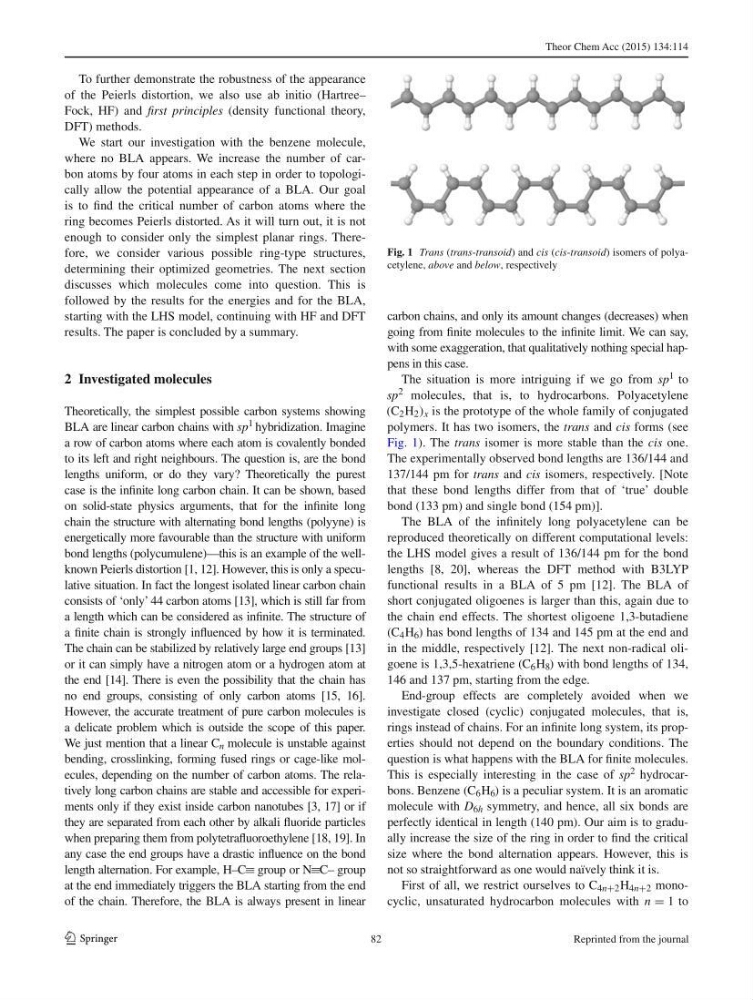
sp 2 molecules, that is, to hydrocarbons. Polyacetylene
(C 2 H 2 ) x is the prototype of the whole family of conjugated
polymers. It has two isomers, the trans and cis forms (see
Fig. 1 ). The trans isomer is more stable than the cis one.
The experimentally observed bond lengths are 136/144 and
137/144 pm for trans and cis isomers, respectively. [Note
that these bond lengths differ from that of ‘true’ double
bond (133 pm) and single bond (154 pm)].
The BLA of the infi nitely long polyacetylene can be
reproduced theoretically on different computational levels:
the LHS model gives a result of 136/144 pm for the bond
lengths [ 8 , 20 ], whereas the DFT method with B3LYP
functional results in a BLA of 5 pm [ 12 ]. The BLA of
short conjugated oligoenes is larger than this, again due to
the chain end effects. The shortest oligoene 1,3-butadiene
( C 4 H 6 ) has bond lengths of 134 and 145 pm at the end and
in the middle, respectively [ 12 ]. The next non-radical oligoene is 1,3,5-hexatriene ( C 6 H 8 ) with bond lengths of 134,
146 and 137 pm, starting from the edge.
End-group effects are completely avoided when we
investigate closed (cyclic) conjugated molecules, that is,
rings instead of chains. For an infi nite long system, its properties should not depend on the boundary conditions. The
question is what happens with the BLA for fi nite molecules.
This is especially interesting in the case of sp 2 hydrocarbons. Benzene ( C 6 H 6 ) is a peculiar system. It is an aromatic
molecule with D 6h symmetry, and hence, all six bonds are
perfectly identical in length (140 pm). Our aim is to gradually increase the size of the ring in order to fi nd the critical
size where the bond alternation appears. However, this is
not so straightforward as one would naïvely think it is.
First of all, we restrict ourselves to C 4n+2 H 4n+2 monocyclic, unsaturated hydrocarbon molecules with n = 1 to
Fig. 1 Trans ( trans - transoid ) and cis ( cis - transoid ) isomers of polyacetylene, above and below , respectively
82
Reprinted from the journal
1 3
To further demonstrate the robustness of the appearance
of the Peierls distortion, we also use ab initio (Hartree–
Fock, HF) and fi rst principles (density functional theory,
DFT) methods.
We start our investigation with the benzene molecule,
where no BLA appears. We increase the number of carbon atoms by four atoms in each step in order to topologically allow the potential appearance of a BLA. Our goal
is to fi nd the critical number of carbon atoms where the
ring becomes Peierls distorted. As it will turn out, it is not
enough to consider only the simplest planar rings. Therefore, we consider various possible ring-type structures,
determining their optimized geometries. The next section
discusses which molecules come into question. This is
followed by the results for the energies and for the BLA,
starting with the LHS model, continuing with HF and DFT
results. The paper is concluded by a summary.
2 Investigated molecules
Theoretically, the simplest possible carbon systems showing
BLA are linear carbon chains with sp 1 hybridization. Imagine
a row of carbon atoms where each atom is covalently bonded
to its left and right neighbours. The question is, are the bond
lengths uniform, or do they vary? Theoretically the purest
case is the infi nite long carbon chain. It can be shown, based
on solid-state physics arguments, that for the infi nite long
chain the structure with alternating bond lengths (polyyne) is
energetically more favourable than the structure with uniform
bond lengths (polycumulene)—this is an example of the wellknown Peierls distortion [ 1 , 12 ]. However, this is only a speculative situation. In fact the longest isolated linear carbon chain
consists of ‘only’ 44 carbon atoms [ 13 ], which is still far from
a length which can be considered as infi nite. The structure of
a fi nite chain is strongly infl uenced by how it is terminated.
The chain can be stabilized by relatively large end groups [ 13 ]
or it can simply have a nitrogen atom or a hydrogen atom at
the end [ 14 ]. There is even the possibility that the chain has
no end groups, consisting of only carbon atoms [ 15 , 16 ].
However, the accurate treatment of pure carbon molecules is
a delicate problem which is outside the scope of this paper.
We just mention that a linear C n molecule is unstable against
bending, crosslinking, forming fused rings or cage-like molecules, depending on the number of carbon atoms. The relatively long carbon chains are stable and accessible for experiments only if they exist inside carbon nanotubes [ 3 , 17 ] or if
they are separated from each other by alkali fl uoride particles
when preparing them from polytetrafl uoroethylene [ 18 , 19 ]. In
any case the end groups have a drastic infl uence on the bond
length alternation. For example, H–C ≡ group or N ≡ C– group
at the end immediately triggers the BLA starting from the end
of the chain. Therefore, the BLA is always present in linear
carbon chains, and only its amount changes (decreases) when
going from fi nite molecules to the infi nite limit. We can say,
with some exaggeration, that qualitatively nothing special happens in this case.
The situation is more intriguing if we go from sp 1 to
sp 2 molecules, that is, to hydrocarbons. Polyacetylene
(C 2 H 2 ) x is the prototype of the whole family of conjugated
polymers. It has two isomers, the trans and cis forms (see
Fig. 1 ). The trans isomer is more stable than the cis one.
The experimentally observed bond lengths are 136/144 and
137/144 pm for trans and cis isomers, respectively. [Note
that these bond lengths differ from that of ‘true’ double
bond (133 pm) and single bond (154 pm)].
The BLA of the infi nitely long polyacetylene can be
reproduced theoretically on different computational levels:
the LHS model gives a result of 136/144 pm for the bond
lengths [ 8 , 20 ], whereas the DFT method with B3LYP
functional results in a BLA of 5 pm [ 12 ]. The BLA of
short conjugated oligoenes is larger than this, again due to
the chain end effects. The shortest oligoene 1,3-butadiene
( C 4 H 6 ) has bond lengths of 134 and 145 pm at the end and
in the middle, respectively [ 12 ]. The next non-radical oligoene is 1,3,5-hexatriene ( C 6 H 8 ) with bond lengths of 134,
146 and 137 pm, starting from the edge.
End-group effects are completely avoided when we
investigate closed (cyclic) conjugated molecules, that is,
rings instead of chains. For an infi nite long system, its properties should not depend on the boundary conditions. The
question is what happens with the BLA for fi nite molecules.
This is especially interesting in the case of sp 2 hydrocarbons. Benzene ( C 6 H 6 ) is a peculiar system. It is an aromatic
molecule with D 6h symmetry, and hence, all six bonds are
perfectly identical in length (140 pm). Our aim is to gradually increase the size of the ring in order to fi nd the critical
size where the bond alternation appears. However, this is
not so straightforward as one would naïvely think it is.
First of all, we restrict ourselves to C 4n+2 H 4n+2 monocyclic, unsaturated hydrocarbon molecules with n = 1 to
Fig. 1 Trans ( trans - transoid ) and cis ( cis - transoid ) isomers of polyacetylene, above and below , respectively
82
Reprinted from the journal