

Theor Chem Acc (2015) 134:114
1 3
benzene. Therefore, these molecules are not suitable for studying the appearance of Peierls distortion. (We mention that
the D 6h symmetry lowers to D 3h symmetry for n C = 30 and
66).
We arrive at the nanorings. As mentioned in Sect. 2 , they
are ring-like molecules with symmetry equivalent carbon–
carbon bonds. The consecutive H atoms are all in trans position, and they lay not in the plane of the ring of C atoms, but
perpendicular to this plane. The optimized geometry proves
to be stable, without any imaginary frequency vibrational
modes, until the largest nanoring we considered ( n C = 66 ).
Due to the symmetry and the stability, the nanorings are the
ideal systems to study the appearance of the bond length
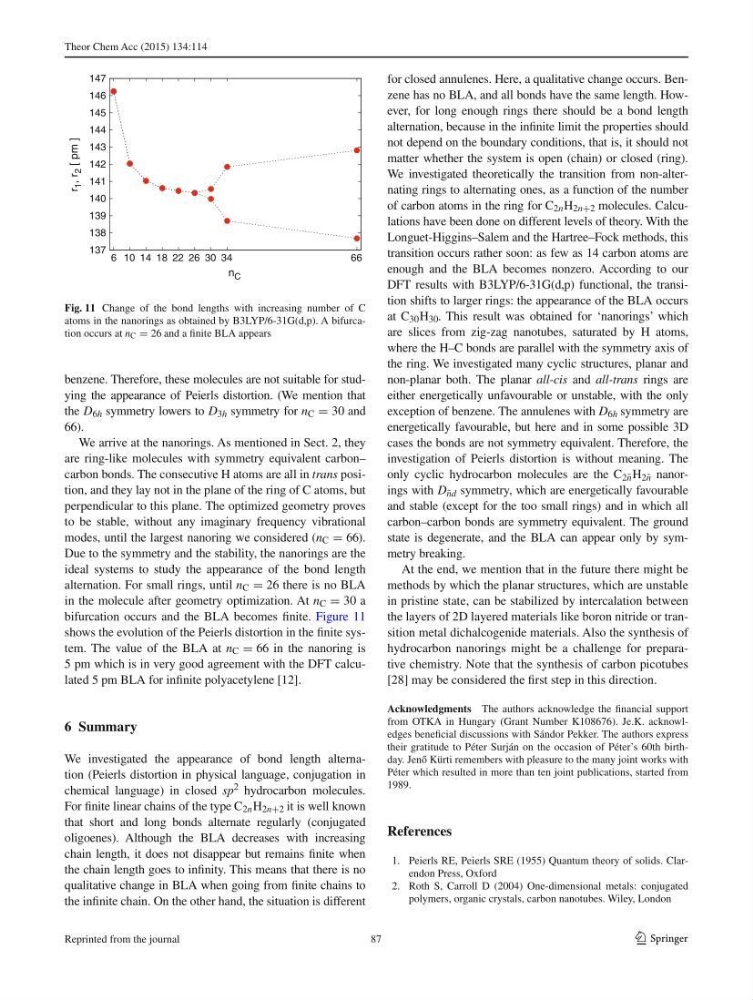
alternation. For small rings, until n C = 26 there is no BLA
in the molecule after geometry optimization. At n C = 30 a
bifurcation occurs and the BLA becomes fi nite. Figure 11
shows the evolution of the Peierls distortion in the fi nite system. The value of the BLA at n C = 66 in the nanoring is
5 pm which is in very good agreement with the DFT calculated 5 pm BLA for infi nite polyacetylene [ 12 ].
6 Summary
We investigated the appearance of bond length alternation (Peierls distortion in physical language, conjugation in
chemical language) in closed sp 2 hydrocarbon molecules.
For fi nite linear chains of the type C 2n H 2n+2 it is well known
that short and long bonds alternate regularly (conjugated
oligoenes). Although the BLA decreases with increasing
chain length, it does not disappear but remains fi nite when
the chain length goes to infi nity. This means that there is no
qualitative change in BLA when going from fi nite chains to
the infi nite chain. On the other hand, the situation is different
for closed annulenes. Here, a qualitative change occurs. Benzene has no BLA, and all bonds have the same length. However, for long enough rings there should be a bond length
alternation, because in the infi nite limit the properties should
not depend on the boundary conditions, that is, it should not
matter whether the system is open (chain) or closed (ring).
We investigated theoretically the transition from non-alternating rings to alternating ones, as a function of the number
of carbon atoms in the ring for C 2n H 2n+2 molecules. Calculations have been done on different levels of theory. With the
Longuet-Higgins–Salem and the Hartree–Fock methods, this
transition occurs rather soon: as few as 14 carbon atoms are
enough and the BLA becomes nonzero. According to our
DFT results with B3LYP/6-31G(d,p) functional, the transition shifts to larger rings: the appearance of the BLA occurs
at C 30 H 30 . This result was obtained for ‘nanorings’ which
are slices from zig-zag nanotubes, saturated by H atoms,
where the H–C bonds are parallel with the symmetry axis of
the ring. We investigated many cyclic structures, planar and
non-planar both. The planar all-cis and all-trans rings are
either energetically unfavourable or unstable, with the only
exception of benzene. The annulenes with D 6h symmetry are
energetically favourable, but here and in some possible 3D
cases the bonds are not symmetry equivalent. Therefore, the
investigation of Peierls distortion is without meaning. The
only cyclic hydrocarbon molecules are the C 2˜ n H 2˜ n nanorings with D ˜
nd symmetry, which are energetically favourable
and stable (except for the too small rings) and in which all
carbon–carbon bonds are symmetry equivalent. The ground
state is degenerate, and the BLA can appear only by symmetry breaking.
At the end, we mention that in the future there might be
methods by which the planar structures, which are unstable
in pristine state, can be stabilized by intercalation between
the layers of 2D layered materials like boron nitride or transition metal dichalcogenide materials. Also the synthesis of
hydrocarbon nanorings might be a challenge for preparative chemistry. Note that the synthesis of carbon picotubes
[ 28 ] may be considered the fi rst step in this direction.
Acknowledgments The authors acknowledge the fi nancial support
from OTKA in Hungary (Grant Number K108676). Je.K. acknowledges benefi cial discussions with Sándor Pekker. The authors express
their gratitude to Péter Surján on the occasion of Péter’s 60th birthday. Jenő Kürti remembers with pleasure to the many joint works with
Péter which resulted in more than ten joint publications, started from
1989.
References
1. Peierls RE, Peierls SRE (1955) Quantum theory of solids. Clarendon Press, Oxford
2. Roth S, Carroll D (2004) One-dimensional metals: conjugated
polymers, organic crystals, carbon nanotubes. Wiley, London
137
138
139
140
141
142
143
144
145
146
147
6 10 14 18 22 26 30 34
66
r
1 , r
2 [ pm ]
n C
Fig. 11 Change of the bond lengths with increasing number of C
atoms in the nanorings as obtained by B3LYP/6-31G(d,p). A bifurcation occurs at n C = 26 and a fi nite BLA appears
87
Reprinted from the journal
1 3
benzene. Therefore, these molecules are not suitable for studying the appearance of Peierls distortion. (We mention that
the D 6h symmetry lowers to D 3h symmetry for n C = 30 and
66).
We arrive at the nanorings. As mentioned in Sect. 2 , they
are ring-like molecules with symmetry equivalent carbon–
carbon bonds. The consecutive H atoms are all in trans position, and they lay not in the plane of the ring of C atoms, but
perpendicular to this plane. The optimized geometry proves
to be stable, without any imaginary frequency vibrational
modes, until the largest nanoring we considered ( n C = 66 ).
Due to the symmetry and the stability, the nanorings are the
ideal systems to study the appearance of the bond length
alternation. For small rings, until n C = 26 there is no BLA
in the molecule after geometry optimization. At n C = 30 a
bifurcation occurs and the BLA becomes fi nite. Figure 11
shows the evolution of the Peierls distortion in the fi nite system. The value of the BLA at n C = 66 in the nanoring is
5 pm which is in very good agreement with the DFT calculated 5 pm BLA for infi nite polyacetylene [ 12 ].
6 Summary
We investigated the appearance of bond length alternation (Peierls distortion in physical language, conjugation in
chemical language) in closed sp 2 hydrocarbon molecules.
For fi nite linear chains of the type C 2n H 2n+2 it is well known
that short and long bonds alternate regularly (conjugated
oligoenes). Although the BLA decreases with increasing
chain length, it does not disappear but remains fi nite when
the chain length goes to infi nity. This means that there is no
qualitative change in BLA when going from fi nite chains to
the infi nite chain. On the other hand, the situation is different
for closed annulenes. Here, a qualitative change occurs. Benzene has no BLA, and all bonds have the same length. However, for long enough rings there should be a bond length
alternation, because in the infi nite limit the properties should
not depend on the boundary conditions, that is, it should not
matter whether the system is open (chain) or closed (ring).
We investigated theoretically the transition from non-alternating rings to alternating ones, as a function of the number
of carbon atoms in the ring for C 2n H 2n+2 molecules. Calculations have been done on different levels of theory. With the
Longuet-Higgins–Salem and the Hartree–Fock methods, this
transition occurs rather soon: as few as 14 carbon atoms are
enough and the BLA becomes nonzero. According to our
DFT results with B3LYP/6-31G(d,p) functional, the transition shifts to larger rings: the appearance of the BLA occurs
at C 30 H 30 . This result was obtained for ‘nanorings’ which
are slices from zig-zag nanotubes, saturated by H atoms,
where the H–C bonds are parallel with the symmetry axis of
the ring. We investigated many cyclic structures, planar and
non-planar both. The planar all-cis and all-trans rings are
either energetically unfavourable or unstable, with the only
exception of benzene. The annulenes with D 6h symmetry are
energetically favourable, but here and in some possible 3D
cases the bonds are not symmetry equivalent. Therefore, the
investigation of Peierls distortion is without meaning. The
only cyclic hydrocarbon molecules are the C 2˜ n H 2˜ n nanorings with D ˜
nd symmetry, which are energetically favourable
and stable (except for the too small rings) and in which all
carbon–carbon bonds are symmetry equivalent. The ground
state is degenerate, and the BLA can appear only by symmetry breaking.
At the end, we mention that in the future there might be
methods by which the planar structures, which are unstable
in pristine state, can be stabilized by intercalation between
the layers of 2D layered materials like boron nitride or transition metal dichalcogenide materials. Also the synthesis of
hydrocarbon nanorings might be a challenge for preparative chemistry. Note that the synthesis of carbon picotubes
[ 28 ] may be considered the fi rst step in this direction.
Acknowledgments The authors acknowledge the fi nancial support
from OTKA in Hungary (Grant Number K108676). Je.K. acknowledges benefi cial discussions with Sándor Pekker. The authors express
their gratitude to Péter Surján on the occasion of Péter’s 60th birthday. Jenő Kürti remembers with pleasure to the many joint works with
Péter which resulted in more than ten joint publications, started from
1989.
References
1. Peierls RE, Peierls SRE (1955) Quantum theory of solids. Clarendon Press, Oxford
2. Roth S, Carroll D (2004) One-dimensional metals: conjugated
polymers, organic crystals, carbon nanotubes. Wiley, London
137
138
139
140
141
142
143
144
145
146
147
6 10 14 18 22 26 30 34
66
r
1 , r
2 [ pm ]
n C
Fig. 11 Change of the bond lengths with increasing number of C
atoms in the nanorings as obtained by B3LYP/6-31G(d,p). A bifurcation occurs at n C = 26 and a fi nite BLA appears
87
Reprinted from the journal