

Theor Chem Acc (2015) 134:104
1 3
Fig. 2 a, polyhex structure of fi ve hexagons and 22 vertices
is shown.
Figure 3 shows our numbering of the vertices. The m
-th hexagon has the vertices 6m , 6m − 1 , 6m − 2 , 6m − 3 ,
6m − 4 and 6m − 5 .
In Fig. 4 , we present two structures obtained by the topological coordinates of Eqs. 2 and 3 . For hexagons h = 5 ,
we obtained the second and the 5th eigenvectors as bi-lobal
eigenvectors. For the adjacency matrix of the bar structure of 15 hexagons, we obtained the second and the 12th
adjacency matrix bi-lobal eigenvectors. In both structures,
we can see that the bonds at the ends of the bars are much
smaller than those in the central part. The other peculiarity
is that the structure turns back at the ends. If we increase
the number of hexagons, these problems of the structures
are much more pronounced.
In Fig. 5 , we used once more the same relations of
Eqs. 2 and 3 , but we replaced the adjacency matrix with
the Laplacian matrix. The bond lengths are still smaller at
the ends of the bars, but the structure does not turns back at
the ends. The bi-lobal eigenvectors of the Laplacian are the
second and 12th in the case of 5 hexagon bar, and they are
the second and the 10th eigenvectors in the case of the 15
hexagon structure.
Figures 4 and 5 show that the eigenvectors of the adjacency matrix and of the Laplacian matrix cannot be used
for constructing topological coordinates for bar polyhex
structures. Here we study the eigenvectors of the matrix
W . We shall use the harmonic potential of Eq. ( 12 ). We
take k μν = k = 1 for each bond. In the potential function,
we suppose only fi rst- and second-neighbour interactions.
We use the value a1 = 1.4 for the fi rst neighbours and
a2 = 3.0 for the second neighbours. Here we remark that
a2 = a1
√
3 should give w uv = 0 for each matrix elements
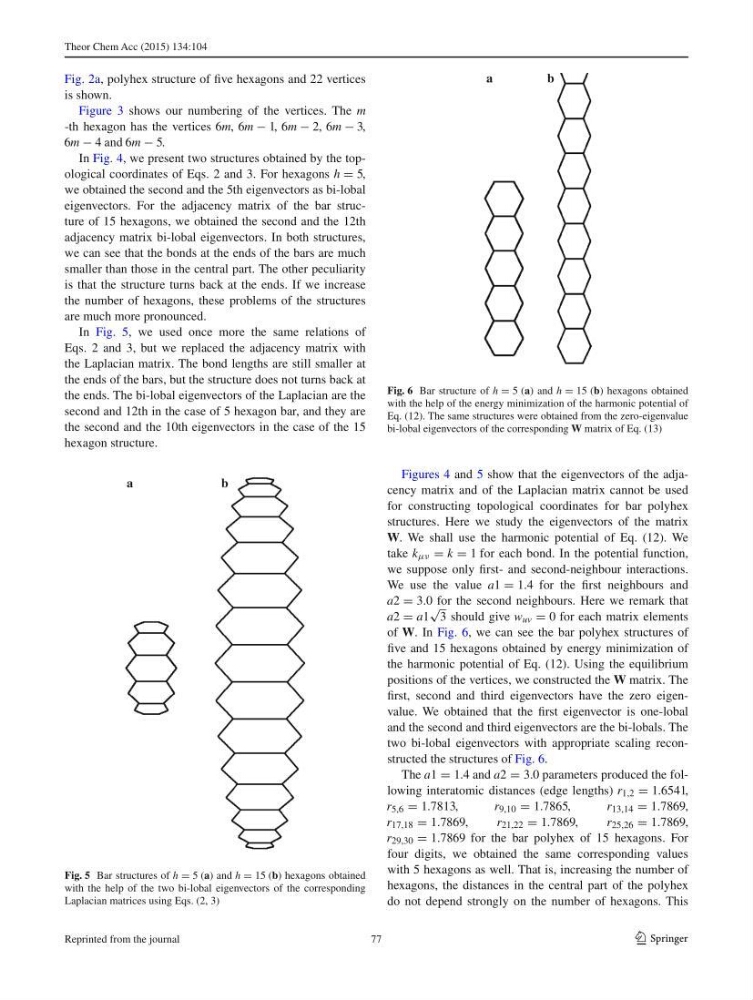
of W . In Fig. 6 , we can see the bar polyhex structures of
fi ve and 15 hexagons obtained by energy minimization of
the harmonic potential of Eq. ( 12 ). Using the equilibrium
positions of the vertices, we constructed the W matrix. The
fi rst, second and third eigenvectors have the zero eigenvalue. We obtained that the fi rst eigenvector is one-lobal
and the second and third eigenvectors are the bi-lobals. The
two bi-lobal eigenvectors with appropriate scaling reconstructed the structures of Fig. 6 .
The a1 = 1.4 and a2 = 3.0 parameters produced the following interatomic distances (edge lengths) r 1,2 = 1.6541 ,
r 5,6 = 1.7813 ,
r 9,10 = 1.7865 ,
r 13,14 = 1.7869 ,
r 17,18 = 1.7869 ,
r 21,22 = 1.7869 ,
r 25,26 = 1.7869 ,
r 29,30 = 1.7869 for the bar polyhex of 15 hexagons. For
four digits, we obtained the same corresponding values
with 5 hexagons as well. That is, increasing the number of
hexagons, the distances in the central part of the polyhex
do not depend strongly on the number of hexagons. This
Fig. 5 Bar structures of h = 5 ( a ) and h = 15 ( b ) hexagons obtained
with the help of the two bi-lobal eigenvectors of the corresponding
Laplacian matrices using Eqs. ( 2 , 3 )
Fig. 6 Bar structure of h = 5 ( a ) and h = 15 ( b ) hexagons obtained
with the help of the energy minimization of the harmonic potential of
Eq. ( 12 ). The same structures were obtained from the zero-eigenvalue
bi-lobal eigenvectors of the corresponding W matrix of Eq. ( 13 )
77
Reprinted from the journal
1 3
Fig. 2 a, polyhex structure of fi ve hexagons and 22 vertices
is shown.
Figure 3 shows our numbering of the vertices. The m
-th hexagon has the vertices 6m , 6m − 1 , 6m − 2 , 6m − 3 ,
6m − 4 and 6m − 5 .
In Fig. 4 , we present two structures obtained by the topological coordinates of Eqs. 2 and 3 . For hexagons h = 5 ,
we obtained the second and the 5th eigenvectors as bi-lobal
eigenvectors. For the adjacency matrix of the bar structure of 15 hexagons, we obtained the second and the 12th
adjacency matrix bi-lobal eigenvectors. In both structures,
we can see that the bonds at the ends of the bars are much
smaller than those in the central part. The other peculiarity
is that the structure turns back at the ends. If we increase
the number of hexagons, these problems of the structures
are much more pronounced.
In Fig. 5 , we used once more the same relations of
Eqs. 2 and 3 , but we replaced the adjacency matrix with
the Laplacian matrix. The bond lengths are still smaller at
the ends of the bars, but the structure does not turns back at
the ends. The bi-lobal eigenvectors of the Laplacian are the
second and 12th in the case of 5 hexagon bar, and they are
the second and the 10th eigenvectors in the case of the 15
hexagon structure.
Figures 4 and 5 show that the eigenvectors of the adjacency matrix and of the Laplacian matrix cannot be used
for constructing topological coordinates for bar polyhex
structures. Here we study the eigenvectors of the matrix
W . We shall use the harmonic potential of Eq. ( 12 ). We
take k μν = k = 1 for each bond. In the potential function,
we suppose only fi rst- and second-neighbour interactions.
We use the value a1 = 1.4 for the fi rst neighbours and
a2 = 3.0 for the second neighbours. Here we remark that
a2 = a1
√
3 should give w uv = 0 for each matrix elements
of W . In Fig. 6 , we can see the bar polyhex structures of
fi ve and 15 hexagons obtained by energy minimization of
the harmonic potential of Eq. ( 12 ). Using the equilibrium
positions of the vertices, we constructed the W matrix. The
fi rst, second and third eigenvectors have the zero eigenvalue. We obtained that the fi rst eigenvector is one-lobal
and the second and third eigenvectors are the bi-lobals. The
two bi-lobal eigenvectors with appropriate scaling reconstructed the structures of Fig. 6 .
The a1 = 1.4 and a2 = 3.0 parameters produced the following interatomic distances (edge lengths) r 1,2 = 1.6541 ,
r 5,6 = 1.7813 ,
r 9,10 = 1.7865 ,
r 13,14 = 1.7869 ,
r 17,18 = 1.7869 ,
r 21,22 = 1.7869 ,
r 25,26 = 1.7869 ,
r 29,30 = 1.7869 for the bar polyhex of 15 hexagons. For
four digits, we obtained the same corresponding values
with 5 hexagons as well. That is, increasing the number of
hexagons, the distances in the central part of the polyhex
do not depend strongly on the number of hexagons. This
Fig. 5 Bar structures of h = 5 ( a ) and h = 15 ( b ) hexagons obtained
with the help of the two bi-lobal eigenvectors of the corresponding
Laplacian matrices using Eqs. ( 2 , 3 )
Fig. 6 Bar structure of h = 5 ( a ) and h = 15 ( b ) hexagons obtained
with the help of the energy minimization of the harmonic potential of
Eq. ( 12 ). The same structures were obtained from the zero-eigenvalue
bi-lobal eigenvectors of the corresponding W matrix of Eq. ( 13 )
77
Reprinted from the journal