

Theor Chem Acc (2015) 134:104
1 3
and
Here k uv = k vu are the spring constants, and a uv = a vu are
parameters. The summation goes for all the pairs (u, v)
which are suffi cient for determining the equilibrium position of the atoms. The eigenvalue problem of the matrix W
has meaning only if it is not the zero matrix.
Thus, the parameters a uv must be different from the corresponding equilibrium values of r uv .
The next step is to fi nd a good approximation to the matrix
W . But if this matrix is approximated, only the vector U will
be an eigenvector with zero eigenvalue. Then, the question is
to fi nd the eigenvectors which are good approximations to the
X , Y and Z zero eigenvectors of the exact matrix W . According to our experiences, the lobality of the eigenvectors helps
us to fi nd the good approximating eigenvectors to X , Y and Z .
Let us see which explanation can we give to the formula
of Eqs. ( 2 – 4 ) applied for fullerenes [ 1 , 2 ]. Let the matrix
W be constructed for the fullerene under study. We suppose fi rst- and second-neighbour interactions. As each carbon atom has 3 neighbours, symmetry gives that w uv equals
to a constant w for the fi rst neighbours and let us choose
w uv = 0 for the second neighbours. Usually, it has only one
eigenvector with zero eigenvalue. It is the eigenvector U .
If we put the centre of mass of a fullerene into the origin
of a Descartes coordinate system, we can see that the X ,
Y and Z vectors are bi-lobal. Namely, X is bi-lobal as one
connected set of atoms is on one side of the plane yz and
the other connected set is on the other side. If some atoms
are on this plane, usually this does not disturb the lobality.
On similar way, can we see that the vectors Y and Z are
also bi-lobal. Thus, we have to choose the three bi-lobal
eigenvectors of our matrix for approximating the eigenvectors X , Y and Z . In the fullerenes, each carbon atom has
three neighbours and thus w uu = −3w . From this reasoning
follow Eqs. ( 2 – 4 ); namely by taking the value w = 1 and
shifting the diagonals by 3, we obtain the adjacency matrix
of the fullerene and the eigenvectors will not be changed.
By inspecting Fig. 1 b, it can be seen that not all of the
vectors X , Y and Z of a helical structure are bi-lobal. The
helical structure of this fi gure was obtained by two bi-lobal
and on 4-lobal eigenvectors of the matrix W .
4 Topological coordinates for bar polyhex
structures
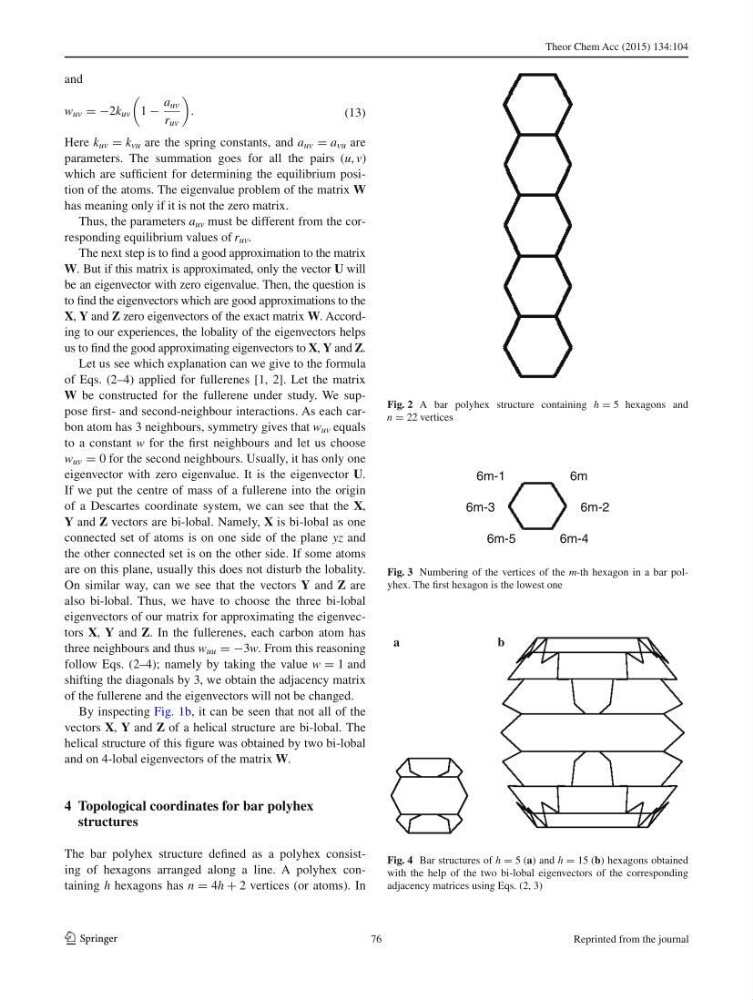
The bar polyhex structure defi ned as a polyhex consisting of hexagons arranged along a line. A polyhex containing h hexagons has n = 4h + 2 vertices (or atoms). In
(13)
w uv = −2k uv
1 −
a uv
r uv
.
Fig. 2 A bar polyhex structure containing h = 5 hexagons and
n = 22 vertices
6m-3
6m-2
6m-5
6m-4
6m-1
6m
Fig. 3 Numbering of the vertices of the m -th hexagon in a bar polyhex. The fi rst hexagon is the lowest one
Fig. 4 Bar structures of h = 5 ( a ) and h = 15 ( b ) hexagons obtained
with the help of the two bi-lobal eigenvectors of the corresponding
adjacency matrices using Eqs. ( 2 , 3 )
76
Reprinted from the journal
1 3
and
Here k uv = k vu are the spring constants, and a uv = a vu are
parameters. The summation goes for all the pairs (u, v)
which are suffi cient for determining the equilibrium position of the atoms. The eigenvalue problem of the matrix W
has meaning only if it is not the zero matrix.
Thus, the parameters a uv must be different from the corresponding equilibrium values of r uv .
The next step is to fi nd a good approximation to the matrix
W . But if this matrix is approximated, only the vector U will
be an eigenvector with zero eigenvalue. Then, the question is
to fi nd the eigenvectors which are good approximations to the
X , Y and Z zero eigenvectors of the exact matrix W . According to our experiences, the lobality of the eigenvectors helps
us to fi nd the good approximating eigenvectors to X , Y and Z .
Let us see which explanation can we give to the formula
of Eqs. ( 2 – 4 ) applied for fullerenes [ 1 , 2 ]. Let the matrix
W be constructed for the fullerene under study. We suppose fi rst- and second-neighbour interactions. As each carbon atom has 3 neighbours, symmetry gives that w uv equals
to a constant w for the fi rst neighbours and let us choose
w uv = 0 for the second neighbours. Usually, it has only one
eigenvector with zero eigenvalue. It is the eigenvector U .
If we put the centre of mass of a fullerene into the origin
of a Descartes coordinate system, we can see that the X ,
Y and Z vectors are bi-lobal. Namely, X is bi-lobal as one
connected set of atoms is on one side of the plane yz and
the other connected set is on the other side. If some atoms
are on this plane, usually this does not disturb the lobality.
On similar way, can we see that the vectors Y and Z are
also bi-lobal. Thus, we have to choose the three bi-lobal
eigenvectors of our matrix for approximating the eigenvectors X , Y and Z . In the fullerenes, each carbon atom has
three neighbours and thus w uu = −3w . From this reasoning
follow Eqs. ( 2 – 4 ); namely by taking the value w = 1 and
shifting the diagonals by 3, we obtain the adjacency matrix
of the fullerene and the eigenvectors will not be changed.
By inspecting Fig. 1 b, it can be seen that not all of the
vectors X , Y and Z of a helical structure are bi-lobal. The
helical structure of this fi gure was obtained by two bi-lobal
and on 4-lobal eigenvectors of the matrix W .
4 Topological coordinates for bar polyhex
structures
The bar polyhex structure defi ned as a polyhex consisting of hexagons arranged along a line. A polyhex containing h hexagons has n = 4h + 2 vertices (or atoms). In
(13)
w uv = −2k uv
1 −
a uv
r uv
.
Fig. 2 A bar polyhex structure containing h = 5 hexagons and
n = 22 vertices
6m-3
6m-2
6m-5
6m-4
6m-1
6m
Fig. 3 Numbering of the vertices of the m -th hexagon in a bar polyhex. The fi rst hexagon is the lowest one
Fig. 4 Bar structures of h = 5 ( a ) and h = 15 ( b ) hexagons obtained
with the help of the two bi-lobal eigenvectors of the corresponding
adjacency matrices using Eqs. ( 2 , 3 )
76
Reprinted from the journal