

Theor Chem Acc (2015) 134:104
1 3
3 Topological coordinates for nonspherical
structures
Under nonspherical structure, we mean a structure where
the position of the atoms is not restricted to any kind of surfaces. That is, there is not a special restriction to the atomic
positions. On the one side, it was presented that there is not
a simple rule based on the bi-lobal eigenvectors of the adjacency matrix for generating the Descartes coordinates of
the carbon atoms in nanotube junctions [ 10 ]. On the other
side, however, we have proved that a matrix (or matrices)
W can be constructed for any atomic arrangement and the
eigenvectors of the null space of W construct the Descartes
coordinates of the atoms [ 11 ]. In general cases, we know
only the existence of such a matrix and it can be constructed with the help of an energy minimization process.
In the next paragraphs, we shall show which way can we
construct good approximations to this matrix without minimizing the total energy. Our method will be shown on the
bar polyhex structures.
First, let us see the construction of the matrix W . We
describe the total energy of the system of n atoms with the
potential function
where r uv is the interatomic distance between the atoms u
and v . The condition that in equilibrium, the forces acting
on the atoms are zero, can be written in the following form:
where
and
Thus, in equilibrium, the Descartes coordinates of the
atom v are (x v , y v , z v ) where x v , y v and z v are the v -th components in order of the vectors X , Y and Z . The matrix elements of the matrix W are calculated at the equilibrium
position of the atoms. If the centre of mass of the molecule
is in the origin and the molecule is directed in such a way
that the eigenvectors of its tensor of inertia are showing to
the directions of the x , y and z axis, then the vectors X , Y
and Z are orthogonal eigenvectors of the matrix W . From
the construction of the w uu , matrix elements follow that
WU = 0 if u v =
1
√
n
. If the centre of mass is the origin of
(8)
E(r) = E(r 12 , . . . r uv , . . .)
(9)
WX = 0, WY = 0, WZ = 0
(10)
w uv = −
∂E(r)
r uv ∂r uv
−
∂E(r)
r vu ∂r vu
(11)
w uu =
n
v =u
∂E(r)
r uv ∂r uv
+
∂E(r)
r vu ∂r vu
= −
n
v =u
w uv .
the coordinate system, U is orthogonal to the vectors X ,
Y and Z . It can be seen very easily that if in the potential
function E(r) = E(r 12 , . . . r uv , . . .) we suppose only fi rstneighbour interactions, the structure cannot be determined
because of the freedom of the bond angles. In most of the
cases, the fi rst and second neighbours completely determine the structure. In some cases, we have to take into
account the third neighbours as well [ 12 , 15 , 16 ].
If we determine in some way the matrix W , and the
underlying graph is suffi ciently rigid, the degeneracy of the
zero eigenvalue is four. We can chose that one of them is
the vector U . As any linear combination of the other three
eigenvectors is also eigenvector of the zero eigenvalue, the
vectors X , Y and Z establish an affi ne transformation of the
molecule. In order to obtain some given realistic interatomic distances, an appropriate scaling can be found. First,
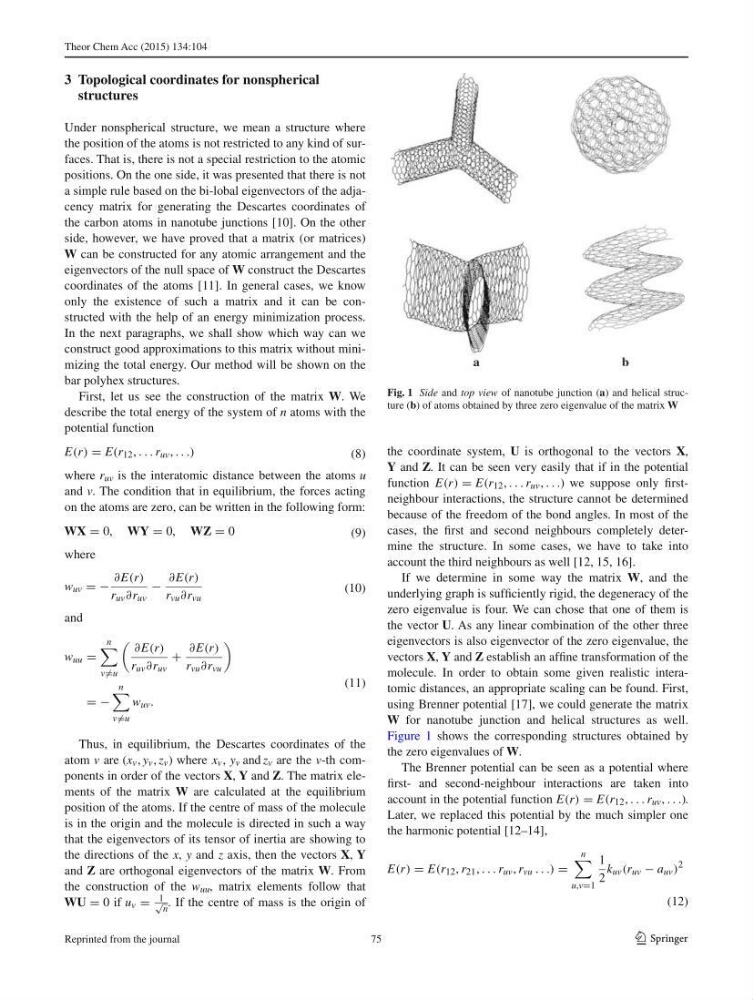
using Brenner potential [ 17 ], we could generate the matrix
W for nanotube junction and helical structures as well.
Figure 1 shows the corresponding structures obtained by
the zero eigenvalues of W .
The Brenner potential can be seen as a potential where
fi rst- and second-neighbour interactions are taken into
account in the potential function E(r) = E(r 12 , . . . r uv , . . .) .
Later, we replaced this potential by the much simpler one
the harmonic potential [ 12 – 14 ],
(12)
E(r) = E(r 12 , r 21 , . . . r uv , r vu . . .) =
n
u,v=1
1
2
k uv (r uv − a uv )
2
Fig. 1 Side and top view of nanotube junction ( a ) and helical structure ( b ) of atoms obtained by three zero eigenvalue of the matrix W
75
Reprinted from the journal
1 3
3 Topological coordinates for nonspherical
structures
Under nonspherical structure, we mean a structure where
the position of the atoms is not restricted to any kind of surfaces. That is, there is not a special restriction to the atomic
positions. On the one side, it was presented that there is not
a simple rule based on the bi-lobal eigenvectors of the adjacency matrix for generating the Descartes coordinates of
the carbon atoms in nanotube junctions [ 10 ]. On the other
side, however, we have proved that a matrix (or matrices)
W can be constructed for any atomic arrangement and the
eigenvectors of the null space of W construct the Descartes
coordinates of the atoms [ 11 ]. In general cases, we know
only the existence of such a matrix and it can be constructed with the help of an energy minimization process.
In the next paragraphs, we shall show which way can we
construct good approximations to this matrix without minimizing the total energy. Our method will be shown on the
bar polyhex structures.
First, let us see the construction of the matrix W . We
describe the total energy of the system of n atoms with the
potential function
where r uv is the interatomic distance between the atoms u
and v . The condition that in equilibrium, the forces acting
on the atoms are zero, can be written in the following form:
where
and
Thus, in equilibrium, the Descartes coordinates of the
atom v are (x v , y v , z v ) where x v , y v and z v are the v -th components in order of the vectors X , Y and Z . The matrix elements of the matrix W are calculated at the equilibrium
position of the atoms. If the centre of mass of the molecule
is in the origin and the molecule is directed in such a way
that the eigenvectors of its tensor of inertia are showing to
the directions of the x , y and z axis, then the vectors X , Y
and Z are orthogonal eigenvectors of the matrix W . From
the construction of the w uu , matrix elements follow that
WU = 0 if u v =
1
√
n
. If the centre of mass is the origin of
(8)
E(r) = E(r 12 , . . . r uv , . . .)
(9)
WX = 0, WY = 0, WZ = 0
(10)
w uv = −
∂E(r)
r uv ∂r uv
−
∂E(r)
r vu ∂r vu
(11)
w uu =
n
v =u
∂E(r)
r uv ∂r uv
+
∂E(r)
r vu ∂r vu
= −
n
v =u
w uv .
the coordinate system, U is orthogonal to the vectors X ,
Y and Z . It can be seen very easily that if in the potential
function E(r) = E(r 12 , . . . r uv , . . .) we suppose only fi rstneighbour interactions, the structure cannot be determined
because of the freedom of the bond angles. In most of the
cases, the fi rst and second neighbours completely determine the structure. In some cases, we have to take into
account the third neighbours as well [ 12 , 15 , 16 ].
If we determine in some way the matrix W , and the
underlying graph is suffi ciently rigid, the degeneracy of the
zero eigenvalue is four. We can chose that one of them is
the vector U . As any linear combination of the other three
eigenvectors is also eigenvector of the zero eigenvalue, the
vectors X , Y and Z establish an affi ne transformation of the
molecule. In order to obtain some given realistic interatomic distances, an appropriate scaling can be found. First,
using Brenner potential [ 17 ], we could generate the matrix
W for nanotube junction and helical structures as well.
Figure 1 shows the corresponding structures obtained by
the zero eigenvalues of W .
The Brenner potential can be seen as a potential where
fi rst- and second-neighbour interactions are taken into
account in the potential function E(r) = E(r 12 , . . . r uv , . . .) .
Later, we replaced this potential by the much simpler one
the harmonic potential [ 12 – 14 ],
(12)
E(r) = E(r 12 , r 21 , . . . r uv , r vu . . .) =
n
u,v=1
1
2
k uv (r uv − a uv )
2
Fig. 1 Side and top view of nanotube junction ( a ) and helical structure ( b ) of atoms obtained by three zero eigenvalue of the matrix W
75
Reprinted from the journal