

Theor Chem Acc (2015) 134:104
1 3
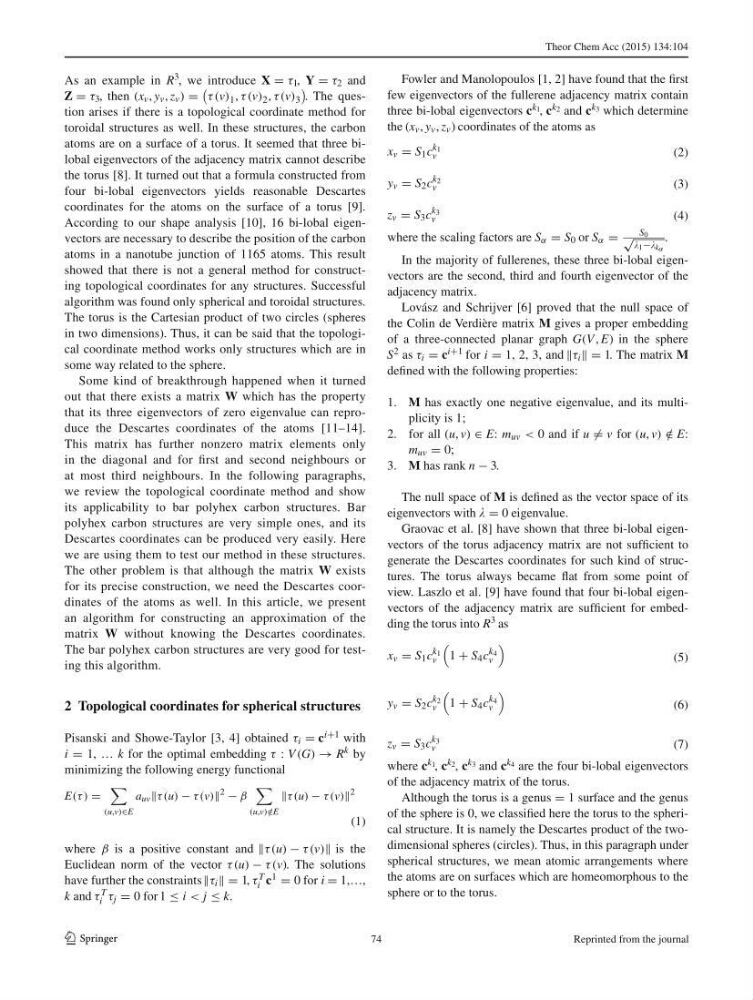
As an example in R 3 , we introduce X = τ 1 , Y = τ 2 and
Z = τ 3 , then (x v , y v , z v ) =
τ (v) 1 , τ (v) 2 , τ (v) 3
. The question arises if there is a topological coordinate method for
toroidal structures as well. In these structures, the carbon
atoms are on a surface of a torus. It seemed that three bilobal eigenvectors of the adjacency matrix cannot describe
the torus [ 8 ]. It turned out that a formula constructed from
four bi-lobal eigenvectors yields reasonable Descartes
coordinates for the atoms on the surface of a torus [ 9 ].
According to our shape analysis [ 10 ], 16 bi-lobal eigenvectors are necessary to describe the position of the carbon
atoms in a nanotube junction of 1165 atoms. This result
showed that there is not a general method for constructing topological coordinates for any structures. Successful
algorithm was found only spherical and toroidal structures.
The torus is the Cartesian product of two circles (spheres
in two dimensions). Thus, it can be said that the topological coordinate method works only structures which are in
some way related to the sphere.
Some kind of breakthrough happened when it turned
out that there exists a matrix W which has the property
that its three eigenvectors of zero eigenvalue can reproduce the Descartes coordinates of the atoms [ 11 – 14 ].
This matrix has further nonzero matrix elements only
in the diagonal and for fi rst and second neighbours or
at most third neighbours. In the following paragraphs,
we review the topological coordinate method and show
its applicability to bar polyhex carbon structures. Bar
polyhex carbon structures are very simple ones, and its
Descartes coordinates can be produced very easily. Here
we are using them to test our method in these structures.
The other problem is that although the matrix W exists
for its precise construction, we need the Descartes coordinates of the atoms as well. In this article, we present
an algorithm for constructing an approximation of the
matrix W without knowing the Descartes coordinates.
The bar polyhex carbon structures are very good for testing this algorithm.
2 Topological coordinates for spherical structures
Pisanski and Showe-Taylor [ 3 , 4 ] obtained τ i = c i+1 with
i = 1, … k for the optimal embedding τ : V (G) → R k by
minimizing the following energy functional
where β is a positive constant and τ (u) − τ (v) is the
Euclidean norm of the vector τ (u) − τ (v) . The solutions
have further the constraints τ i = 1 , τ T
i c 1 = 0 for i = 1,…,
k and τ T
i τ j = 0 for 1 ≤ i < j ≤ k .
(1)
E(τ ) =
(u,v)∈E
a uv τ (u) − τ (v)
2
− β
(u,v) /
∈E
τ (u) − τ (v)
2
Fowler and Manolopoulos [ 1 , 2 ] have found that the fi rst
few eigenvectors of the fullerene adjacency matrix contain
three bi-lobal eigenvectors c k 1 , c k 2 and c k 3 which determine
the (x v , y v , z v ) coordinates of the atoms as
where the scaling factors are S α = S 0 or S α =
S 0
√
1 − kα
.
In the majority of fullerenes, these three bi-lobal eigenvectors are the second, third and fourth eigenvector of the
adjacency matrix.
Lovász and Schrijver [ 6 ] proved that the null space of
the Colin de Verdière matrix M gives a proper embedding
of a three-connected planar graph G(V , E) in the sphere
S 2 as τ i = c i+1 for i = 1, 2, 3, and τ i = 1 . The matrix M
defi ned with the following properties:
1. M has exactly one negative eigenvalue, and its multiplicity is 1;
2. for all (u, v) ∈ E : m uv < 0 and if u = v for (u, v) /
∈ E :
m uv = 0 ;
3. M has rank n − 3 .
The null space of M is defi ned as the vector space of its
eigenvectors with = 0 eigenvalue.
Graovac et al. [ 8 ] have shown that three bi-lobal eigenvectors of the torus adjacency matrix are not suffi cient to
generate the Descartes coordinates for such kind of structures. The torus always became fl at from some point of
view. Laszlo et al. [ 9 ] have found that four bi-lobal eigenvectors of the adjacency matrix are suffi cient for embedding the torus into R 3 as
where c k 1 , c k 2 , c k 3 and c k 4 are the four bi-lobal eigenvectors
of the adjacency matrix of the torus.
Although the torus is a genus = 1 surface and the genus
of the sphere is 0, we classifi ed here the torus to the spherical structure. It is namely the Descartes product of the twodimensional spheres (circles). Thus, in this paragraph under
spherical structures, we mean atomic arrangements where
the atoms are on surfaces which are homeomorphous to the
sphere or to the torus.
(2)
x v = S 1 c
k 1
v
(3)
y v = S 2 c
k 2
v
(4)
z v = S 3 c
k 3
v
(5)
x v = S 1 c
k 1
v
1 + S 4 c
k 4
v
(6)
y v = S 2 c
k 2
v
1 + S 4 c
k 4
v
(7)
z v = S 3 c
k 3
v
74
Reprinted from the journal
1 3
As an example in R 3 , we introduce X = τ 1 , Y = τ 2 and
Z = τ 3 , then (x v , y v , z v ) =
τ (v) 1 , τ (v) 2 , τ (v) 3
. The question arises if there is a topological coordinate method for
toroidal structures as well. In these structures, the carbon
atoms are on a surface of a torus. It seemed that three bilobal eigenvectors of the adjacency matrix cannot describe
the torus [ 8 ]. It turned out that a formula constructed from
four bi-lobal eigenvectors yields reasonable Descartes
coordinates for the atoms on the surface of a torus [ 9 ].
According to our shape analysis [ 10 ], 16 bi-lobal eigenvectors are necessary to describe the position of the carbon
atoms in a nanotube junction of 1165 atoms. This result
showed that there is not a general method for constructing topological coordinates for any structures. Successful
algorithm was found only spherical and toroidal structures.
The torus is the Cartesian product of two circles (spheres
in two dimensions). Thus, it can be said that the topological coordinate method works only structures which are in
some way related to the sphere.
Some kind of breakthrough happened when it turned
out that there exists a matrix W which has the property
that its three eigenvectors of zero eigenvalue can reproduce the Descartes coordinates of the atoms [ 11 – 14 ].
This matrix has further nonzero matrix elements only
in the diagonal and for fi rst and second neighbours or
at most third neighbours. In the following paragraphs,
we review the topological coordinate method and show
its applicability to bar polyhex carbon structures. Bar
polyhex carbon structures are very simple ones, and its
Descartes coordinates can be produced very easily. Here
we are using them to test our method in these structures.
The other problem is that although the matrix W exists
for its precise construction, we need the Descartes coordinates of the atoms as well. In this article, we present
an algorithm for constructing an approximation of the
matrix W without knowing the Descartes coordinates.
The bar polyhex carbon structures are very good for testing this algorithm.
2 Topological coordinates for spherical structures
Pisanski and Showe-Taylor [ 3 , 4 ] obtained τ i = c i+1 with
i = 1, … k for the optimal embedding τ : V (G) → R k by
minimizing the following energy functional
where β is a positive constant and τ (u) − τ (v) is the
Euclidean norm of the vector τ (u) − τ (v) . The solutions
have further the constraints τ i = 1 , τ T
i c 1 = 0 for i = 1,…,
k and τ T
i τ j = 0 for 1 ≤ i < j ≤ k .
(1)
E(τ ) =
(u,v)∈E
a uv τ (u) − τ (v)
2
− β
(u,v) /
∈E
τ (u) − τ (v)
2
Fowler and Manolopoulos [ 1 , 2 ] have found that the fi rst
few eigenvectors of the fullerene adjacency matrix contain
three bi-lobal eigenvectors c k 1 , c k 2 and c k 3 which determine
the (x v , y v , z v ) coordinates of the atoms as
where the scaling factors are S α = S 0 or S α =
S 0
√
1 − kα
.
In the majority of fullerenes, these three bi-lobal eigenvectors are the second, third and fourth eigenvector of the
adjacency matrix.
Lovász and Schrijver [ 6 ] proved that the null space of
the Colin de Verdière matrix M gives a proper embedding
of a three-connected planar graph G(V , E) in the sphere
S 2 as τ i = c i+1 for i = 1, 2, 3, and τ i = 1 . The matrix M
defi ned with the following properties:
1. M has exactly one negative eigenvalue, and its multiplicity is 1;
2. for all (u, v) ∈ E : m uv < 0 and if u = v for (u, v) /
∈ E :
m uv = 0 ;
3. M has rank n − 3 .
The null space of M is defi ned as the vector space of its
eigenvectors with = 0 eigenvalue.
Graovac et al. [ 8 ] have shown that three bi-lobal eigenvectors of the torus adjacency matrix are not suffi cient to
generate the Descartes coordinates for such kind of structures. The torus always became fl at from some point of
view. Laszlo et al. [ 9 ] have found that four bi-lobal eigenvectors of the adjacency matrix are suffi cient for embedding the torus into R 3 as
where c k 1 , c k 2 , c k 3 and c k 4 are the four bi-lobal eigenvectors
of the adjacency matrix of the torus.
Although the torus is a genus = 1 surface and the genus
of the sphere is 0, we classifi ed here the torus to the spherical structure. It is namely the Descartes product of the twodimensional spheres (circles). Thus, in this paragraph under
spherical structures, we mean atomic arrangements where
the atoms are on surfaces which are homeomorphous to the
sphere or to the torus.
(2)
x v = S 1 c
k 1
v
(3)
y v = S 2 c
k 2
v
(4)
z v = S 3 c
k 3
v
(5)
x v = S 1 c
k 1
v
1 + S 4 c
k 4
v
(6)
y v = S 2 c
k 2
v
1 + S 4 c
k 4
v
(7)
z v = S 3 c
k 3
v
74
Reprinted from the journal