

Theor Chem Acc (2015) 134:147
1 3
This population analysis gives a percentage which is
proportional to the presence of the HOMO electrons in a
given region of the space. In Table 7 , the values for the neutral molecule are low, but when there is CT, a non-negligible part of the population (between 10 and 25 %) is located
on the four carbons mentioned in Table 5 in correlation
with the presence of an overlap. In that case, the participation of the inner part of the helix accounts for between 38
and 54 % of the population of the orbital. This is in agreement with the previous presented observations as well as
the presence of overlaps across the helical pitch as pictured
in Figs. 7 , 8 , and 9 .
4 Further systems studied
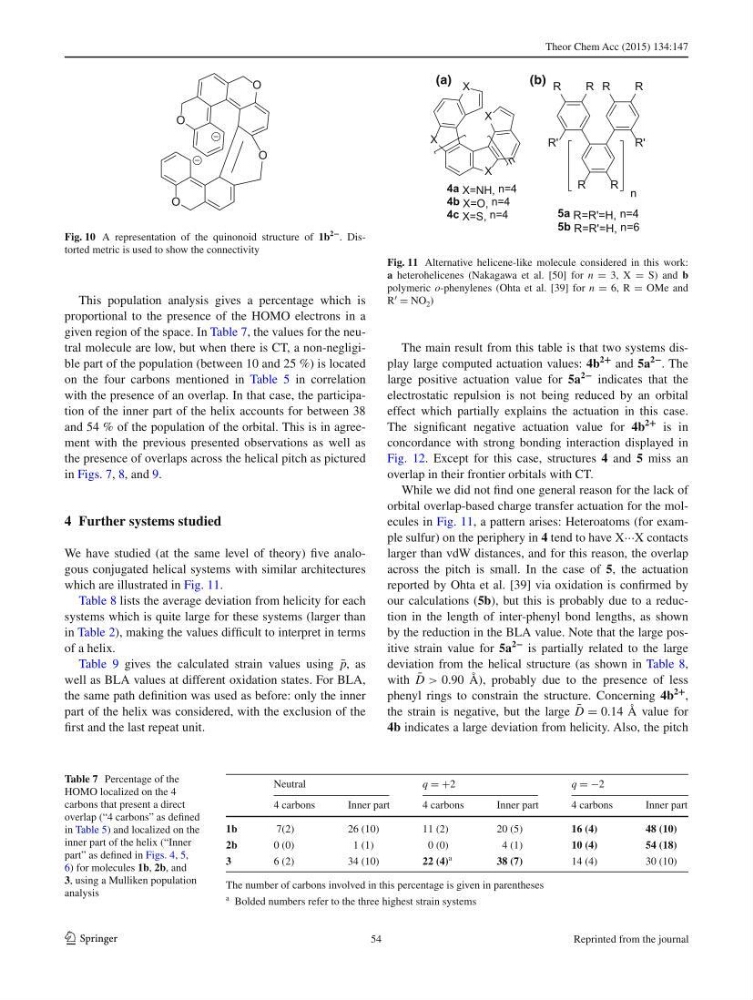
We have studied (at the same level of theory) fi ve analogous conjugated helical systems with similar architectures
which are illustrated in Fig. 11 .
Table 8 lists the average deviation from helicity for each
systems which is quite large for these systems (larger than
in Table 2 ), making the values diffi cult to interpret in terms
of a helix.
Table 9 gives the calculated strain values using ¯
p , as
well as BLA values at different oxidation states. For BLA,
the same path defi nition was used as before: only the inner
part of the helix was considered, with the exclusion of the
fi rst and the last repeat unit.
The main result from this table is that two systems display large computed actuation values: 4b
2+ and 5a
2−
. The
large positive actuation value for 5a
2− indicates that the
electrostatic repulsion is not being reduced by an orbital
effect which partially explains the actuation in this case.
The signifi cant negative actuation value for 4b
2+ is in
concordance with strong bonding interaction displayed in
Fig. 12 . Except for this case, structures 4 and 5 miss an
overlap in their frontier orbitals with CT.
While we did not fi nd one general reason for the lack of
orbital overlap-based charge transfer actuation for the molecules in Fig. 11 , a pattern arises: Heteroatoms (for example sulfur) on the periphery in 4 tend to have X···X contacts
larger than vdW distances, and for this reason, the overlap
across the pitch is small. In the case of 5 , the actuation
reported by Ohta et al. [ 39 ] via oxidation is confi rmed by
our calculations ( 5b ), but this is probably due to a reduction in the length of inter-phenyl bond lengths, as shown
by the reduction in the BLA value. Note that the large positive strain value for 5a
2− is partially related to the large
deviation from the helical structure (as shown in Table 8 ,
with ¯
D > 0.90 Å), probably due to the presence of less
phenyl rings to constrain the structure. Concerning 4b
2+ ,
the strain is negative, but the large ¯
D = 0.14 Å value for
4b indicates a large deviation from helicity. Also, the pitch
O
O
O
O
Fig. 10 A representation of the quinonoid structure of 1b
2− . Distorted metric is used to show the connectivity
Table 7 Percentage of the
HOMO localized on the 4
carbons that present a direct
overlap (“4 carbons” as defi ned
in Table 5 ) and localized on the
inner part of the helix (“Inner
part” as defi ned in Figs. 4 , 5 ,
6 ) for molecules 1b , 2b , and
3 , using a Mulliken population
analysis
The number of carbons involved in this percentage is given in parentheses
a Bolded numbers refer to the three highest strain systems
Neutral
q = +2
q = −2
4 carbons
Inner part
4 carbons
Inner part
4 carbons
Inner part
1b
7(2)
26 (10)
11 (2)
20 (5)
16 (4)
48 (10)
2b
0 (0)
1 (1)
0 (0)
4 (1)
10 (4)
54 (18)
3
6 (2)
34 (10)
22 (4)
a
38 (7)
14 (4)
30 (10)
X
X
n
X
X
4a X=NH, n=4
4b X=O, n=4
4c X=S, n=4
n
R'
R
R
R
R
R
R
R'
5a R=R'=H, n=4
5b R=R'=H, n=6
(a)
(b)
Fig. 11 Alternative helicene-like molecule considered in this work:
a heterohelicenes (Nakagawa et al. [ 50 ] for n = 3, X = S) and b
polymeric o -phenylenes (Ohta et al. [ 39 ] for n = 6, R = OMe and
R′ = NO 2 )
54
Reprinted from the journal
1 3
This population analysis gives a percentage which is
proportional to the presence of the HOMO electrons in a
given region of the space. In Table 7 , the values for the neutral molecule are low, but when there is CT, a non-negligible part of the population (between 10 and 25 %) is located
on the four carbons mentioned in Table 5 in correlation
with the presence of an overlap. In that case, the participation of the inner part of the helix accounts for between 38
and 54 % of the population of the orbital. This is in agreement with the previous presented observations as well as
the presence of overlaps across the helical pitch as pictured
in Figs. 7 , 8 , and 9 .
4 Further systems studied
We have studied (at the same level of theory) fi ve analogous conjugated helical systems with similar architectures
which are illustrated in Fig. 11 .
Table 8 lists the average deviation from helicity for each
systems which is quite large for these systems (larger than
in Table 2 ), making the values diffi cult to interpret in terms
of a helix.
Table 9 gives the calculated strain values using ¯
p , as
well as BLA values at different oxidation states. For BLA,
the same path defi nition was used as before: only the inner
part of the helix was considered, with the exclusion of the
fi rst and the last repeat unit.
The main result from this table is that two systems display large computed actuation values: 4b
2+ and 5a
2−
. The
large positive actuation value for 5a
2− indicates that the
electrostatic repulsion is not being reduced by an orbital
effect which partially explains the actuation in this case.
The signifi cant negative actuation value for 4b
2+ is in
concordance with strong bonding interaction displayed in
Fig. 12 . Except for this case, structures 4 and 5 miss an
overlap in their frontier orbitals with CT.
While we did not fi nd one general reason for the lack of
orbital overlap-based charge transfer actuation for the molecules in Fig. 11 , a pattern arises: Heteroatoms (for example sulfur) on the periphery in 4 tend to have X···X contacts
larger than vdW distances, and for this reason, the overlap
across the pitch is small. In the case of 5 , the actuation
reported by Ohta et al. [ 39 ] via oxidation is confi rmed by
our calculations ( 5b ), but this is probably due to a reduction in the length of inter-phenyl bond lengths, as shown
by the reduction in the BLA value. Note that the large positive strain value for 5a
2− is partially related to the large
deviation from the helical structure (as shown in Table 8 ,
with ¯
D > 0.90 Å), probably due to the presence of less
phenyl rings to constrain the structure. Concerning 4b
2+ ,
the strain is negative, but the large ¯
D = 0.14 Å value for
4b indicates a large deviation from helicity. Also, the pitch
O
O
O
O
Fig. 10 A representation of the quinonoid structure of 1b
2− . Distorted metric is used to show the connectivity
Table 7 Percentage of the
HOMO localized on the 4
carbons that present a direct
overlap (“4 carbons” as defi ned
in Table 5 ) and localized on the
inner part of the helix (“Inner
part” as defi ned in Figs. 4 , 5 ,
6 ) for molecules 1b , 2b , and
3 , using a Mulliken population
analysis
The number of carbons involved in this percentage is given in parentheses
a Bolded numbers refer to the three highest strain systems
Neutral
q = +2
q = −2
4 carbons
Inner part
4 carbons
Inner part
4 carbons
Inner part
1b
7(2)
26 (10)
11 (2)
20 (5)
16 (4)
48 (10)
2b
0 (0)
1 (1)
0 (0)
4 (1)
10 (4)
54 (18)
3
6 (2)
34 (10)
22 (4)
a
38 (7)
14 (4)
30 (10)
X
X
n
X
X
4a X=NH, n=4
4b X=O, n=4
4c X=S, n=4
n
R'
R
R
R
R
R
R
R'
5a R=R'=H, n=4
5b R=R'=H, n=6
(a)
(b)
Fig. 11 Alternative helicene-like molecule considered in this work:
a heterohelicenes (Nakagawa et al. [ 50 ] for n = 3, X = S) and b
polymeric o -phenylenes (Ohta et al. [ 39 ] for n = 6, R = OMe and
R′ = NO 2 )
54
Reprinted from the journal