

Theor Chem Acc (2015) 134:147
1 3
relatively large actuation strains. The number in italics refer
to two cases where the helicity is partially lost upon charge
transfer, and therefore, the three measures indicate signifi -
cant discrepancies as we pointed out in connection with the
data in Table 4 . The large actuation effect is the result of
the antibonding nature of the LUMO for 3 , and due to the
bonding nature of the HOMO for 1b and 2b . The lack of
charge symmetry is also apparent as expected for a quantum mechanical mechanism of CT actuation. Molecule
1b
2− gives the largest strain values, followed by 3
2+ and
2b
2− , if one considers ¯
p as the measure of the elongation of
the molecule. Considering d CC confi rms that 1b
2− is fi rst,
but exchanges the order of strains for 3
2+ and 2b
2− .
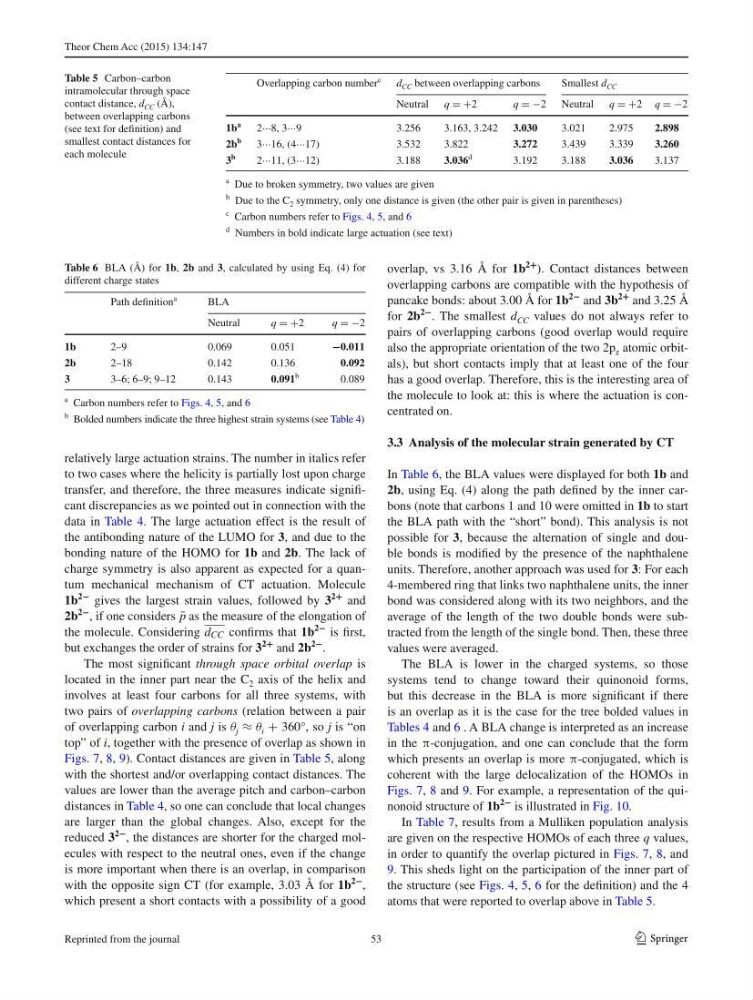
The most signifi cant through space orbital overlap is
located in the inner part near the C 2 axis of the helix and
involves at least four carbons for all three systems, with
two pairs of overlapping carbons (relation between a pair
of overlapping carbon i and j is θ j ≈ θ i + 360°, so j is “on
top” of i , together with the presence of overlap as shown in
Figs. 7 , 8 , 9 ). Contact distances are given in Table 5 , along
with the shortest and/or overlapping contact distances. The
values are lower than the average pitch and carbon–carbon
distances in Table 4 , so one can conclude that local changes
are larger than the global changes. Also, except for the
reduced 3
2−
, the distances are shorter for the charged molecules with respect to the neutral ones, even if the change
is more important when there is an overlap, in comparison
with the opposite sign CT (for example, 3.03 Å for 1b
2−
,
which present a short contacts with a possibility of a good
overlap, vs 3.16 Å for 1b
2+
). Contact distances between
overlapping carbons are compatible with the hypothesis of
pancake bonds: about 3.00 Å for 1b
2− and 3b
2+ and 3.25 Å
for 2b
2− . The smallest d CC values do not always refer to
pairs of overlapping carbons (good overlap would require
also the appropriate orientation of the two 2p z atomic orbitals), but short contacts imply that at least one of the four
has a good overlap. Therefore, this is the interesting area of
the molecule to look at: this is where the actuation is concentrated on.
3.3 Analysis of the molecular strain generated by CT
In Table 6 , the BLA values were displayed for both 1b and
2b , using Eq. ( 4 ) along the path defi ned by the inner carbons (note that carbons 1 and 10 were omitted in 1b to start
the BLA path with the “short” bond). This analysis is not
possible for 3 , because the alternation of single and double bonds is modifi ed by the presence of the naphthalene
units. Therefore, another approach was used for 3 : For each
4-membered ring that links two naphthalene units, the inner
bond was considered along with its two neighbors, and the
average of the length of the two double bonds were subtracted from the length of the single bond. Then, these three
values were averaged.
The BLA is lower in the charged systems, so those
systems tend to change toward their quinonoid forms,
but this decrease in the BLA is more signifi cant if there
is an overlap as it is the case for the tree bolded values in
Tables 4 and 6 . A BLA change is interpreted as an increase
in the π-conjugation, and one can conclude that the form
which presents an overlap is more π-conjugated, which is
coherent with the large delocalization of the HOMOs in
Figs. 7 , 8 and 9 . For example, a representation of the quinonoid structure of 1b
2− is illustrated in Fig. 10 .
In Table 7 , results from a Mulliken population analysis
are given on the respective HOMOs of each three q values,
in order to quantify the overlap pictured in Figs. 7 , 8 , and
9 . This sheds light on the participation of the inner part of
the structure (see Figs. 4 , 5 , 6 for the defi nition) and the 4
atoms that were reported to overlap above in Table 5 .
Table 5 Carbon–carbon
intramolecular through space
contact distance, d CC (Å),
between overlapping carbons
(see text for defi nition) and
smallest contact distances for
each molecule
a Due to broken symmetry, two values are given
b Due to the C 2 symmetry, only one distance is given (the other pair is given in parentheses)
c Carbon numbers refer to Figs. 4 , 5 , and 6
d Numbers in bold indicate large actuation (see text)
Overlapping carbon number
c
d CC between overlapping carbons
Smallest d CC
Neutral q = +2
q = −2 Neutral q = +2 q = −2
1b
a
2···8, 3···9
3.256
3.163, 3.242 3.030
3.021
2.975
2.898
2b
b
3···16, (4···17)
3.532
3.822
3.272
3.439
3.339
3.260
3
b
2···11, (3···12)
3.188
3.036
d
3.192
3.188
3.036
3.137
Table 6 BLA (Å) for 1b , 2b and 3 , calculated by using Eq. ( 4 ) for
different charge states
a Carbon numbers refer to Figs. 4 , 5 , and 6
b Bolded numbers indicate the three highest strain systems (see Table 4 )
Path defi nition
a
BLA
Neutral
q = +2
q = −2
1b
2–9
0.069
0.051
−0.011
2b
2–18
0.142
0.136
0.092
3
3–6; 6–9; 9–12
0.143
0.091
b
0.089
53
Reprinted from the journal
1 3
relatively large actuation strains. The number in italics refer
to two cases where the helicity is partially lost upon charge
transfer, and therefore, the three measures indicate signifi -
cant discrepancies as we pointed out in connection with the
data in Table 4 . The large actuation effect is the result of
the antibonding nature of the LUMO for 3 , and due to the
bonding nature of the HOMO for 1b and 2b . The lack of
charge symmetry is also apparent as expected for a quantum mechanical mechanism of CT actuation. Molecule
1b
2− gives the largest strain values, followed by 3
2+ and
2b
2− , if one considers ¯
p as the measure of the elongation of
the molecule. Considering d CC confi rms that 1b
2− is fi rst,
but exchanges the order of strains for 3
2+ and 2b
2− .
The most signifi cant through space orbital overlap is
located in the inner part near the C 2 axis of the helix and
involves at least four carbons for all three systems, with
two pairs of overlapping carbons (relation between a pair
of overlapping carbon i and j is θ j ≈ θ i + 360°, so j is “on
top” of i , together with the presence of overlap as shown in
Figs. 7 , 8 , 9 ). Contact distances are given in Table 5 , along
with the shortest and/or overlapping contact distances. The
values are lower than the average pitch and carbon–carbon
distances in Table 4 , so one can conclude that local changes
are larger than the global changes. Also, except for the
reduced 3
2−
, the distances are shorter for the charged molecules with respect to the neutral ones, even if the change
is more important when there is an overlap, in comparison
with the opposite sign CT (for example, 3.03 Å for 1b
2−
,
which present a short contacts with a possibility of a good
overlap, vs 3.16 Å for 1b
2+
). Contact distances between
overlapping carbons are compatible with the hypothesis of
pancake bonds: about 3.00 Å for 1b
2− and 3b
2+ and 3.25 Å
for 2b
2− . The smallest d CC values do not always refer to
pairs of overlapping carbons (good overlap would require
also the appropriate orientation of the two 2p z atomic orbitals), but short contacts imply that at least one of the four
has a good overlap. Therefore, this is the interesting area of
the molecule to look at: this is where the actuation is concentrated on.
3.3 Analysis of the molecular strain generated by CT
In Table 6 , the BLA values were displayed for both 1b and
2b , using Eq. ( 4 ) along the path defi ned by the inner carbons (note that carbons 1 and 10 were omitted in 1b to start
the BLA path with the “short” bond). This analysis is not
possible for 3 , because the alternation of single and double bonds is modifi ed by the presence of the naphthalene
units. Therefore, another approach was used for 3 : For each
4-membered ring that links two naphthalene units, the inner
bond was considered along with its two neighbors, and the
average of the length of the two double bonds were subtracted from the length of the single bond. Then, these three
values were averaged.
The BLA is lower in the charged systems, so those
systems tend to change toward their quinonoid forms,
but this decrease in the BLA is more signifi cant if there
is an overlap as it is the case for the tree bolded values in
Tables 4 and 6 . A BLA change is interpreted as an increase
in the π-conjugation, and one can conclude that the form
which presents an overlap is more π-conjugated, which is
coherent with the large delocalization of the HOMOs in
Figs. 7 , 8 and 9 . For example, a representation of the quinonoid structure of 1b
2− is illustrated in Fig. 10 .
In Table 7 , results from a Mulliken population analysis
are given on the respective HOMOs of each three q values,
in order to quantify the overlap pictured in Figs. 7 , 8 , and
9 . This sheds light on the participation of the inner part of
the structure (see Figs. 4 , 5 , 6 for the defi nition) and the 4
atoms that were reported to overlap above in Table 5 .
Table 5 Carbon–carbon
intramolecular through space
contact distance, d CC (Å),
between overlapping carbons
(see text for defi nition) and
smallest contact distances for
each molecule
a Due to broken symmetry, two values are given
b Due to the C 2 symmetry, only one distance is given (the other pair is given in parentheses)
c Carbon numbers refer to Figs. 4 , 5 , and 6
d Numbers in bold indicate large actuation (see text)
Overlapping carbon number
c
d CC between overlapping carbons
Smallest d CC
Neutral q = +2
q = −2 Neutral q = +2 q = −2
1b
a
2···8, 3···9
3.256
3.163, 3.242 3.030
3.021
2.975
2.898
2b
b
3···16, (4···17)
3.532
3.822
3.272
3.439
3.339
3.260
3
b
2···11, (3···12)
3.188
3.036
d
3.192
3.188
3.036
3.137
Table 6 BLA (Å) for 1b , 2b and 3 , calculated by using Eq. ( 4 ) for
different charge states
a Carbon numbers refer to Figs. 4 , 5 , and 6
b Bolded numbers indicate the three highest strain systems (see Table 4 )
Path defi nition
a
BLA
Neutral
q = +2
q = −2
1b
2–9
0.069
0.051
−0.011
2b
2–18
0.142
0.136
0.092
3
3–6; 6–9; 9–12
0.143
0.091
b
0.089
53
Reprinted from the journal