

Theor Chem Acc (2015) 134:147
1 3
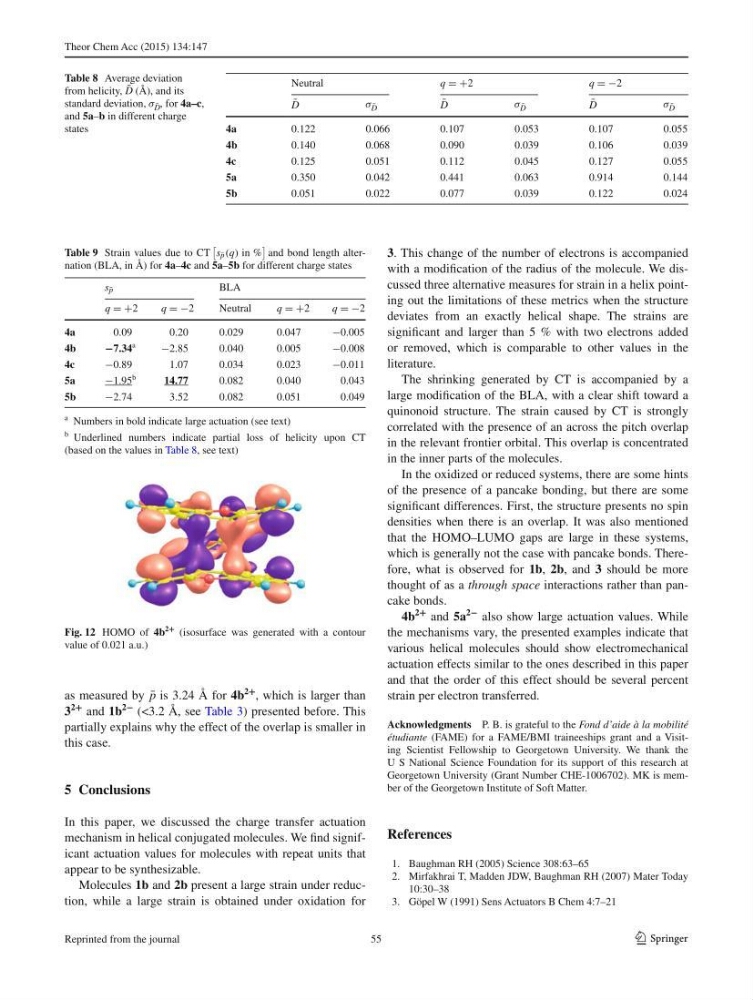
as measured by ¯
p is 3.24 Å for 4b
2+
, which is larger than
3
2+ and 1b
2− ( < 3.2 Å, see Table 3 ) presented before. This
partially explains why the effect of the overlap is smaller in
this case.
5 Conclusions
In this paper, we discussed the charge transfer actuation
mechanism in helical conjugated molecules. We fi nd significant actuation values for molecules with repeat units that
appear to be synthesizable.
Molecules 1b and 2b present a large strain under reduction, while a large strain is obtained under oxidation for
3 . This change of the number of electrons is accompanied
with a modifi cation of the radius of the molecule. We discussed three alternative measures for strain in a helix pointing out the limitations of these metrics when the structure
deviates from an exactly helical shape. The strains are
signifi cant and larger than 5 % with two electrons added
or removed, which is comparable to other values in the
literature.
The shrinking generated by CT is accompanied by a
large modifi cation of the BLA, with a clear shift toward a
quinonoid structure. The strain caused by CT is strongly
correlated with the presence of an across the pitch overlap
in the relevant frontier orbital. This overlap is concentrated
in the inner parts of the molecules.
In the oxidized or reduced systems, there are some hints
of the presence of a pancake bonding, but there are some
signifi cant differences. First, the structure presents no spin
densities when there is an overlap. It was also mentioned
that the HOMO–LUMO gaps are large in these systems,
which is generally not the case with pancake bonds. Therefore, what is observed for 1b , 2b , and 3 should be more
thought of as a through space interactions rather than pancake bonds.
4b
2+ and 5a
2− also show large actuation values. While
the mechanisms vary, the presented examples indicate that
various helical molecules should show electromechanical
actuation effects similar to the ones described in this paper
and that the order of this effect should be several percent
strain per electron transferred.
Acknowledgments P. B. is grateful to the Fond d’aide à la mobilité
étudiante (FAME) for a FAME/BMI traineeships grant and a Visiting Scientist Fellowship to Georgetown University. We thank the
U S National Science Foundation for its support of this research at
Georgetown University (Grant Number CHE-1006702). MK is member of the Georgetown Institute of Soft Matter.
References
1. Baughman RH (2005) Science 308:63–65
2. Mirfakhrai T, Madden JDW, Baughman RH (2007) Mater Today
10:30–38
3. Göpel W (1991) Sens Actuators B Chem 4:7–21
Table 8 Average deviation
from helicity, ¯
D (Å), and its
standard deviation, σ ¯
D , for 4a–c ,
and 5a – b in different charge
states
Neutral
q = +2
q = −2
¯
D
σ ¯
D
¯
D
σ ¯
D
¯
D
σ ¯
D
4a
0.122
0.066
0.107
0.053
0.107
0.055
4b
0.140
0.068
0.090
0.039
0.106
0.039
4c
0.125
0.051
0.112
0.045
0.127
0.055
5a
0.350
0.042
0.441
0.063
0.914
0.144
5b
0.051
0.022
0.077
0.039
0.122
0.024
Table 9 Strain values due to CT
s ¯
p (q) in %
and bond length alternation (BLA, in Å) for 4a – 4c and 5a – 5b for different charge states
a Numbers in bold indicate large actuation (see text)
b Underlined numbers indicate partial loss of helicity upon CT
(based on the values in Table 8 , see text)
s ¯
p
BLA
q = +2
q = −2
Neutral
q = +2
q = −2
4a
0.09
0.20
0.029
0.047
−0.005
4b
−7.34
a
−2.85
0.040
0.005
−0.008
4c
−0.89
1.07
0.034
0.023
−0.011
5a
−1.95
b
14.77
0.082
0.040
0.043
5b
−2.74
3.52
0.082
0.051
0.049
Fig. 12 HOMO of 4b
2+ (isosurface was generated with a contour
value of 0.021 a.u.)
55
Reprinted from the journal
1 3
as measured by ¯
p is 3.24 Å for 4b
2+
, which is larger than
3
2+ and 1b
2− ( < 3.2 Å, see Table 3 ) presented before. This
partially explains why the effect of the overlap is smaller in
this case.
5 Conclusions
In this paper, we discussed the charge transfer actuation
mechanism in helical conjugated molecules. We fi nd significant actuation values for molecules with repeat units that
appear to be synthesizable.
Molecules 1b and 2b present a large strain under reduction, while a large strain is obtained under oxidation for
3 . This change of the number of electrons is accompanied
with a modifi cation of the radius of the molecule. We discussed three alternative measures for strain in a helix pointing out the limitations of these metrics when the structure
deviates from an exactly helical shape. The strains are
signifi cant and larger than 5 % with two electrons added
or removed, which is comparable to other values in the
literature.
The shrinking generated by CT is accompanied by a
large modifi cation of the BLA, with a clear shift toward a
quinonoid structure. The strain caused by CT is strongly
correlated with the presence of an across the pitch overlap
in the relevant frontier orbital. This overlap is concentrated
in the inner parts of the molecules.
In the oxidized or reduced systems, there are some hints
of the presence of a pancake bonding, but there are some
signifi cant differences. First, the structure presents no spin
densities when there is an overlap. It was also mentioned
that the HOMO–LUMO gaps are large in these systems,
which is generally not the case with pancake bonds. Therefore, what is observed for 1b , 2b , and 3 should be more
thought of as a through space interactions rather than pancake bonds.
4b
2+ and 5a
2− also show large actuation values. While
the mechanisms vary, the presented examples indicate that
various helical molecules should show electromechanical
actuation effects similar to the ones described in this paper
and that the order of this effect should be several percent
strain per electron transferred.
Acknowledgments P. B. is grateful to the Fond d’aide à la mobilité
étudiante (FAME) for a FAME/BMI traineeships grant and a Visiting Scientist Fellowship to Georgetown University. We thank the
U S National Science Foundation for its support of this research at
Georgetown University (Grant Number CHE-1006702). MK is member of the Georgetown Institute of Soft Matter.
References
1. Baughman RH (2005) Science 308:63–65
2. Mirfakhrai T, Madden JDW, Baughman RH (2007) Mater Today
10:30–38
3. Göpel W (1991) Sens Actuators B Chem 4:7–21
Table 8 Average deviation
from helicity, ¯
D (Å), and its
standard deviation, σ ¯
D , for 4a–c ,
and 5a – b in different charge
states
Neutral
q = +2
q = −2
¯
D
σ ¯
D
¯
D
σ ¯
D
¯
D
σ ¯
D
4a
0.122
0.066
0.107
0.053
0.107
0.055
4b
0.140
0.068
0.090
0.039
0.106
0.039
4c
0.125
0.051
0.112
0.045
0.127
0.055
5a
0.350
0.042
0.441
0.063
0.914
0.144
5b
0.051
0.022
0.077
0.039
0.122
0.024
Table 9 Strain values due to CT
s ¯
p (q) in %
and bond length alternation (BLA, in Å) for 4a – 4c and 5a – 5b for different charge states
a Numbers in bold indicate large actuation (see text)
b Underlined numbers indicate partial loss of helicity upon CT
(based on the values in Table 8 , see text)
s ¯
p
BLA
q = +2
q = −2
Neutral
q = +2
q = −2
4a
0.09
0.20
0.029
0.047
−0.005
4b
−7.34
a
−2.85
0.040
0.005
−0.008
4c
−0.89
1.07
0.034
0.023
−0.011
5a
−1.95
b
14.77
0.082
0.040
0.043
5b
−2.74
3.52
0.082
0.051
0.049
Fig. 12 HOMO of 4b
2+ (isosurface was generated with a contour
value of 0.021 a.u.)
55
Reprinted from the journal