

Theor Chem Acc (2015) 134:108
1 3
that is, the {κ i }
3N−6
1
basis set is generally not orthogonal
in the ℜ 3N − 6 space. (Nevertheless, it is possible to defi ne
the internal coordinate system as an orthogonal one; this
statement is acceptable on the basis that the Eliashevich–
Wilson-type B -matrix can be regarded as a sparse matrix.)
Note that s = Bδ is valid in linear approximation only,
thus Eq. ( 6 ) is true in the same approximation as well.
Consequently, our proof given above also assumes a linear approximation. If considering higher terms, the basis
{κ i }
3N−6
1
will still not be orthogonal. In a strict sense, the
linear approximation is valid using infi nitesimal displacements, but in practice we can consider it to be effective
using “small enough” displacements in molecular vibration
calculations as well as determination of stationary states
in quantum chemistry. The fi rst (minor) consequence of
this non-orthogonality is that the terminology of internal
coordinates itself is improper according to the rules of the
linear algebra (see, e.g., [ 15 ]): in the case of a non-orthonormal metrics, it is correct to mention components instead
of coordinates. However, we will use the terminology
of “internal coordinates” in the following, as it is widely
accepted.
Let us consider a physical system consisting of N points
of masses representing the nuclei of a molecule. Let us
choose a complete and non-redundant system of the internal coordinates (such coordinates are, e.g., the so-called
natural internal coordinates (NICs) [ 4 , 16 ]) and consider
the linear approximation valid at a given reference point.
Now, let us consider two different vector spaces X and Y ,
both of them being of 3 N − 6 dimensional. Vector space X
possesses the s ’ vectors describing the molecular conformations in terms of the internal coordinates chosen (later the
apostrophe can be left). Vector space Y contains the forces
acting on the nuclei in the same system of internal coordinates, evaluated in the corresponding s ’ points. An X to Y
mapping ˆ
C can be created between the two vector spaces
that connect to each internal coordinate vector of the X
space to the internal force vector of Y space:
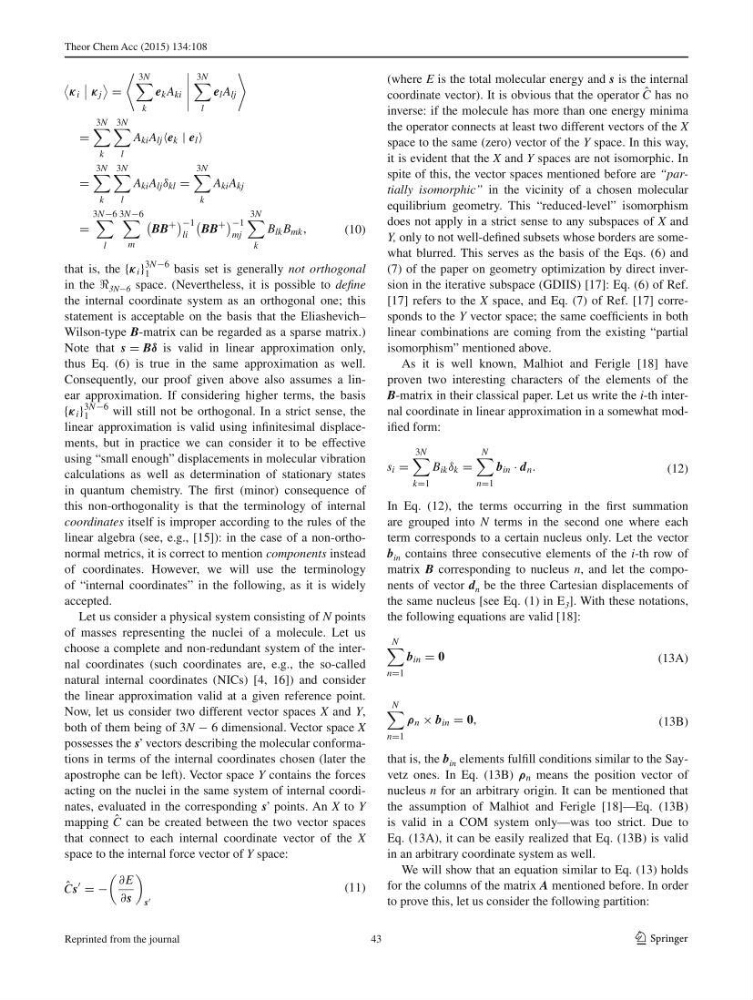
(10)
κ i
κ j
=
3N
k
e k A ki
3N
l
e l A lj
=
3N
k
3N
l
A ki A lj e k | e l
=
3N
k
3N
l
A ki A lj δ kl =
3N
k
A ki A kj
=
3N−6
l
3N−6
m
BB
+
−1
li
BB
+
−1
mj
3N
k
B lk B mk ,
(11)
ˆ
Cs
= −
∂E
∂s
s
(where E is the total molecular energy and s is the internal
coordinate vector). It is obvious that the operator ˆ
C has no
inverse: if the molecule has more than one energy minima
the operator connects at least two different vectors of the X
space to the same (zero) vector of the Y space. In this way,
it is evident that the X and Y spaces are not isomorphic. In
spite of this, the vector spaces mentioned before are “partially isomorphic” in the vicinity of a chosen molecular
equilibrium geometry. This “reduced-level” isomorphism
does not apply in a strict sense to any subspaces of X and
Y, only to not well-defi ned subsets whose borders are somewhat blurred. This serves as the basis of the Eqs. ( 6 ) and
( 7 ) of the paper on geometry optimization by direct inversion in the iterative subspace (GDIIS) [ 17 ]: Eq. ( 6 ) of Ref.
[ 17 ] refers to the X space, and Eq. ( 7 ) of Ref. [ 17 ] corresponds to the Y vector space; the same coeffi cients in both
linear combinations are coming from the existing “partial
isomorphism” mentioned above.
As it is well known, Malhiot and Ferigle [ 18 ] have
proven two interesting characters of the elements of the
B -matrix in their classical paper. Let us write the i -th internal coordinate in linear approximation in a somewhat modifi ed form:
In Eq. ( 12 ), the terms occurring in the fi rst summation
are grouped into N terms in the second one where each
term corresponds to a certain nucleus only. Let the vector
b in contains three consecutive elements of the i -th row of
matrix B corresponding to nucleus n , and let the components of vector d n be the three Cartesian displacements of
the same nucleus [see Eq. ( 1 ) in E 3 ]. With these notations,
the following equations are valid [ 18 ]:
that is, the b in elements fulfi ll conditions similar to the Sayvetz ones. In Eq. ( 13B ) ρ n means the position vector of
nucleus n for an arbitrary origin. It can be mentioned that
the assumption of Malhiot and Ferigle [ 18 ]—Eq. ( 13B )
is valid in a COM system only—was too strict. Due to
Eq. ( 13A ), it can be easily realized that Eq. ( 13B ) is valid
in an arbitrary coordinate system as well.
We will show that an equation similar to Eq. (13) holds
for the columns of the matrix A mentioned before. In order
to prove this, let us consider the following partition:
(12)
s i =
3N
k=1
B ik δ k =
N
n=1
b in · d n .
(13A)
N
n=1
b in = 0
(13B)
N
n=1
ρ n × b in = 0,
43
Reprinted from the journal
1 3
that is, the {κ i }
3N−6
1
basis set is generally not orthogonal
in the ℜ 3N − 6 space. (Nevertheless, it is possible to defi ne
the internal coordinate system as an orthogonal one; this
statement is acceptable on the basis that the Eliashevich–
Wilson-type B -matrix can be regarded as a sparse matrix.)
Note that s = Bδ is valid in linear approximation only,
thus Eq. ( 6 ) is true in the same approximation as well.
Consequently, our proof given above also assumes a linear approximation. If considering higher terms, the basis
{κ i }
3N−6
1
will still not be orthogonal. In a strict sense, the
linear approximation is valid using infi nitesimal displacements, but in practice we can consider it to be effective
using “small enough” displacements in molecular vibration
calculations as well as determination of stationary states
in quantum chemistry. The fi rst (minor) consequence of
this non-orthogonality is that the terminology of internal
coordinates itself is improper according to the rules of the
linear algebra (see, e.g., [ 15 ]): in the case of a non-orthonormal metrics, it is correct to mention components instead
of coordinates. However, we will use the terminology
of “internal coordinates” in the following, as it is widely
accepted.
Let us consider a physical system consisting of N points
of masses representing the nuclei of a molecule. Let us
choose a complete and non-redundant system of the internal coordinates (such coordinates are, e.g., the so-called
natural internal coordinates (NICs) [ 4 , 16 ]) and consider
the linear approximation valid at a given reference point.
Now, let us consider two different vector spaces X and Y ,
both of them being of 3 N − 6 dimensional. Vector space X
possesses the s ’ vectors describing the molecular conformations in terms of the internal coordinates chosen (later the
apostrophe can be left). Vector space Y contains the forces
acting on the nuclei in the same system of internal coordinates, evaluated in the corresponding s ’ points. An X to Y
mapping ˆ
C can be created between the two vector spaces
that connect to each internal coordinate vector of the X
space to the internal force vector of Y space:
(10)
κ i
κ j
=
3N
k
e k A ki
3N
l
e l A lj
=
3N
k
3N
l
A ki A lj e k | e l
=
3N
k
3N
l
A ki A lj δ kl =
3N
k
A ki A kj
=
3N−6
l
3N−6
m
BB
+
−1
li
BB
+
−1
mj
3N
k
B lk B mk ,
(11)
ˆ
Cs
= −
∂E
∂s
s
(where E is the total molecular energy and s is the internal
coordinate vector). It is obvious that the operator ˆ
C has no
inverse: if the molecule has more than one energy minima
the operator connects at least two different vectors of the X
space to the same (zero) vector of the Y space. In this way,
it is evident that the X and Y spaces are not isomorphic. In
spite of this, the vector spaces mentioned before are “partially isomorphic” in the vicinity of a chosen molecular
equilibrium geometry. This “reduced-level” isomorphism
does not apply in a strict sense to any subspaces of X and
Y, only to not well-defi ned subsets whose borders are somewhat blurred. This serves as the basis of the Eqs. ( 6 ) and
( 7 ) of the paper on geometry optimization by direct inversion in the iterative subspace (GDIIS) [ 17 ]: Eq. ( 6 ) of Ref.
[ 17 ] refers to the X space, and Eq. ( 7 ) of Ref. [ 17 ] corresponds to the Y vector space; the same coeffi cients in both
linear combinations are coming from the existing “partial
isomorphism” mentioned above.
As it is well known, Malhiot and Ferigle [ 18 ] have
proven two interesting characters of the elements of the
B -matrix in their classical paper. Let us write the i -th internal coordinate in linear approximation in a somewhat modifi ed form:
In Eq. ( 12 ), the terms occurring in the fi rst summation
are grouped into N terms in the second one where each
term corresponds to a certain nucleus only. Let the vector
b in contains three consecutive elements of the i -th row of
matrix B corresponding to nucleus n , and let the components of vector d n be the three Cartesian displacements of
the same nucleus [see Eq. ( 1 ) in E 3 ]. With these notations,
the following equations are valid [ 18 ]:
that is, the b in elements fulfi ll conditions similar to the Sayvetz ones. In Eq. ( 13B ) ρ n means the position vector of
nucleus n for an arbitrary origin. It can be mentioned that
the assumption of Malhiot and Ferigle [ 18 ]—Eq. ( 13B )
is valid in a COM system only—was too strict. Due to
Eq. ( 13A ), it can be easily realized that Eq. ( 13B ) is valid
in an arbitrary coordinate system as well.
We will show that an equation similar to Eq. (13) holds
for the columns of the matrix A mentioned before. In order
to prove this, let us consider the following partition:
(12)
s i =
3N
k=1
B ik δ k =
N
n=1
b in · d n .
(13A)
N
n=1
b in = 0
(13B)
N
n=1
ρ n × b in = 0,
43
Reprinted from the journal