

Theor Chem Acc (2015) 134:108
1 3
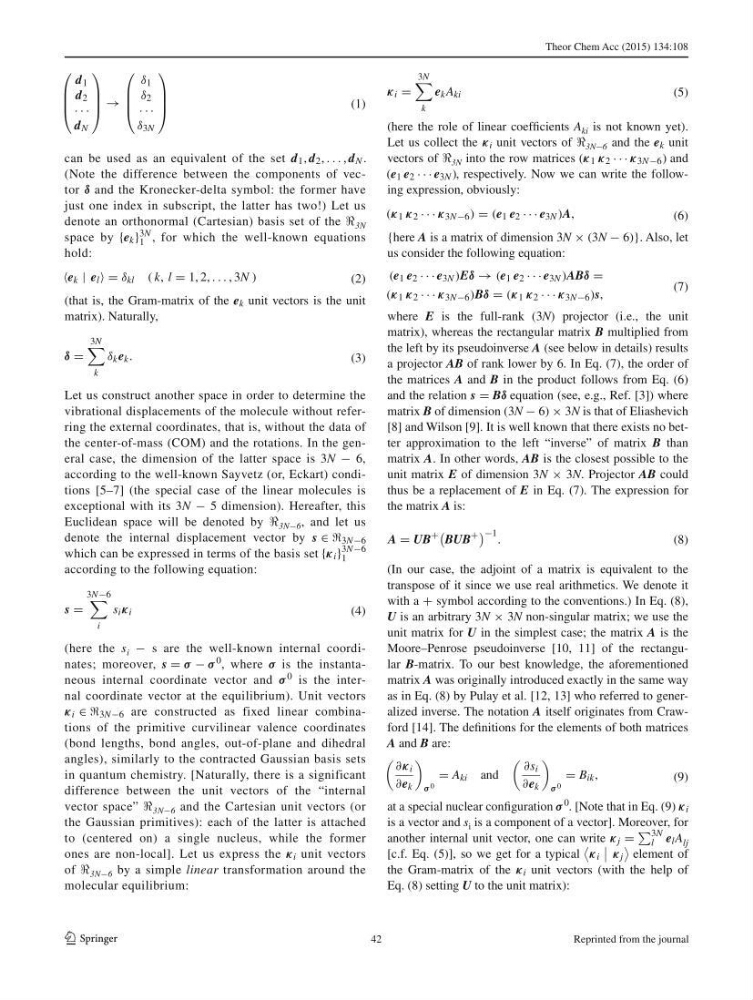
can be used as an equivalent of the set d 1 , d 2 , . . . , d N .
(Note the difference between the components of vector δ and the Kronecker-delta symbol: the former have
just one index in subscript, the latter has two!) Let us
denote an orthonormal (Cartesian) basis set of the ℜ 3N
space by {e k } 3N
1 , for which the well-known equations
hold:
(that is, the Gram-matrix of the e k unit vectors is the unit
matrix). Naturally,
Let us construct another space in order to determine the
vibrational displacements of the molecule without referring the external coordinates, that is, without the data of
the center-of-mass (COM) and the rotations. In the general case, the dimension of the latter space is 3 N − 6,
according to the well-known Sayvetz (or, Eckart) conditions [ 5 – 7 ] (the special case of the linear molecules is
exceptional with its 3 N − 5 dimension). Hereafter, this
Euclidean space will be denoted by ℜ 3N − 6 , and let us
denote the internal displacement vector by s ∈ 3N−6
which can be expressed in terms of the basis set {κ i }
3N−6
1
according to the following equation:
(here the s i − s are the well-known internal coordinates; moreover, s = σ − σ 0 , where σ is the instantaneous internal coordinate vector and σ 0 is the internal coordinate vector at the equilibrium). Unit vectors
κ i ∈ 3N−6 are constructed as fixed linear combinations of the primitive curvilinear valence coordinates
(bond lengths, bond angles, out-of-plane and dihedral
angles), similarly to the contracted Gaussian basis sets
in quantum chemistry. [Naturally, there is a significant
difference between the unit vectors of the “internal
vector space” ℜ 3N − 6 and the Cartesian unit vectors (or
the Gaussian primitives): each of the latter is attached
to (centered on) a single nucleus, while the former
ones are non-local]. Let us express the κ i unit vectors
of ℜ 3N − 6 by a simple linear transformation around the
molecular equilibrium:
(1)
⎛
⎜
⎜
⎝
d 1
d 2
· · ·
d N
⎞
⎟
⎟
⎠ →
⎛
⎜
⎜
⎝
δ 1
δ 2
· · ·
δ 3N
⎞
⎟
⎟
⎠
(2)
e k | e l = δ kl ( k, l = 1, 2, . . . , 3N )
(3)
δ =
3N
k
δ k e k .
(4)
s =
3N−6
i
s i κ i
(here the role of linear coeffi cients A ki is not known yet).
Let us collect the κ i unit vectors of ℜ 3N − 6 and the e k unit
vectors of ℜ 3N into the row matrices (κ 1 κ 2 · · · κ 3N−6 ) and
(e 1 e 2 · · · e 3N ) , respectively. Now we can write the following expression, obviously:
{here A is a matrix of dimension 3 N × (3 N − 6)}. Also, let
us consider the following equation:
where E is the full-rank (3 N ) projector (i.e., the unit
matrix), whereas the rectangular matrix B multiplied from
the left by its pseudoinverse A (see below in details) results
a projector AB of rank lower by 6. In Eq. ( 7 ), the order of
the matrices A and B in the product follows from Eq. ( 6 )
and the relation s = Bδ equation (see, e.g., Ref. [ 3 ]) where
matrix B of dimension (3 N − 6) × 3 N is that of Eliashevich
[ 8 ] and Wilson [ 9 ]. It is well known that there exists no better approximation to the left “inverse” of matrix B than
matrix A . In other words, AB is the closest possible to the
unit matrix E of dimension 3 N × 3 N . Projector AB could
thus be a replacement of E in Eq. ( 7 ). The expression for
the matrix A is:
(In our case, the adjoint of a matrix is equivalent to the
transpose of it since we use real arithmetics. We denote it
with a + symbol according to the conventions.) In Eq. ( 8 ),
U is an arbitrary 3 N × 3 N non-singular matrix; we use the
unit matrix for U in the simplest case; the matrix A is the
Moore–Penrose pseudoinverse [ 10 , 11 ] of the rectangular B -matrix. To our best knowledge, the aforementioned
matrix A was originally introduced exactly in the same way
as in Eq. ( 8 ) by Pulay et al. [ 12 , 13 ] who referred to generalized inverse. The notation A itself originates from Crawford [ 14 ]. The defi nitions for the elements of both matrices
A and B are:
at a special nuclear confi guration σ 0 . [Note that in Eq. ( 9 ) κ i
is a vector and s i is a component of a vector]. Moreover, for
another internal unit vector, one can write κ j =
3N
l e l A lj
[c.f. Eq. ( 5 )], so we get for a typical
κ i
κ j
element of
the Gram-matrix of the κ i unit vectors (with the help of
Eq. ( 8 ) setting U to the unit matrix):
(5)
κ i =
3N
k
e k A ki
(6)
(κ 1 κ 2 · · · κ 3N−6 ) = (e 1 e 2 · · · e 3N )A,
(7)
(e 1 e 2 · · · e 3N )Eδ → (e 1 e 2 · · · e 3N )ABδ =
(κ 1 κ 2 · · · κ 3N−6 )Bδ = (κ 1 κ 2 · · · κ 3N−6 )s,
(8)
A = UB
+
BUB
+
−1 .
(9)
∂κ i
∂e k
σ 0
= A ki and
∂s i
∂e k
σ 0
= B ik ,
42
Reprinted from the journal
1 3
can be used as an equivalent of the set d 1 , d 2 , . . . , d N .
(Note the difference between the components of vector δ and the Kronecker-delta symbol: the former have
just one index in subscript, the latter has two!) Let us
denote an orthonormal (Cartesian) basis set of the ℜ 3N
space by {e k } 3N
1 , for which the well-known equations
hold:
(that is, the Gram-matrix of the e k unit vectors is the unit
matrix). Naturally,
Let us construct another space in order to determine the
vibrational displacements of the molecule without referring the external coordinates, that is, without the data of
the center-of-mass (COM) and the rotations. In the general case, the dimension of the latter space is 3 N − 6,
according to the well-known Sayvetz (or, Eckart) conditions [ 5 – 7 ] (the special case of the linear molecules is
exceptional with its 3 N − 5 dimension). Hereafter, this
Euclidean space will be denoted by ℜ 3N − 6 , and let us
denote the internal displacement vector by s ∈ 3N−6
which can be expressed in terms of the basis set {κ i }
3N−6
1
according to the following equation:
(here the s i − s are the well-known internal coordinates; moreover, s = σ − σ 0 , where σ is the instantaneous internal coordinate vector and σ 0 is the internal coordinate vector at the equilibrium). Unit vectors
κ i ∈ 3N−6 are constructed as fixed linear combinations of the primitive curvilinear valence coordinates
(bond lengths, bond angles, out-of-plane and dihedral
angles), similarly to the contracted Gaussian basis sets
in quantum chemistry. [Naturally, there is a significant
difference between the unit vectors of the “internal
vector space” ℜ 3N − 6 and the Cartesian unit vectors (or
the Gaussian primitives): each of the latter is attached
to (centered on) a single nucleus, while the former
ones are non-local]. Let us express the κ i unit vectors
of ℜ 3N − 6 by a simple linear transformation around the
molecular equilibrium:
(1)
⎛
⎜
⎜
⎝
d 1
d 2
· · ·
d N
⎞
⎟
⎟
⎠ →
⎛
⎜
⎜
⎝
δ 1
δ 2
· · ·
δ 3N
⎞
⎟
⎟
⎠
(2)
e k | e l = δ kl ( k, l = 1, 2, . . . , 3N )
(3)
δ =
3N
k
δ k e k .
(4)
s =
3N−6
i
s i κ i
(here the role of linear coeffi cients A ki is not known yet).
Let us collect the κ i unit vectors of ℜ 3N − 6 and the e k unit
vectors of ℜ 3N into the row matrices (κ 1 κ 2 · · · κ 3N−6 ) and
(e 1 e 2 · · · e 3N ) , respectively. Now we can write the following expression, obviously:
{here A is a matrix of dimension 3 N × (3 N − 6)}. Also, let
us consider the following equation:
where E is the full-rank (3 N ) projector (i.e., the unit
matrix), whereas the rectangular matrix B multiplied from
the left by its pseudoinverse A (see below in details) results
a projector AB of rank lower by 6. In Eq. ( 7 ), the order of
the matrices A and B in the product follows from Eq. ( 6 )
and the relation s = Bδ equation (see, e.g., Ref. [ 3 ]) where
matrix B of dimension (3 N − 6) × 3 N is that of Eliashevich
[ 8 ] and Wilson [ 9 ]. It is well known that there exists no better approximation to the left “inverse” of matrix B than
matrix A . In other words, AB is the closest possible to the
unit matrix E of dimension 3 N × 3 N . Projector AB could
thus be a replacement of E in Eq. ( 7 ). The expression for
the matrix A is:
(In our case, the adjoint of a matrix is equivalent to the
transpose of it since we use real arithmetics. We denote it
with a + symbol according to the conventions.) In Eq. ( 8 ),
U is an arbitrary 3 N × 3 N non-singular matrix; we use the
unit matrix for U in the simplest case; the matrix A is the
Moore–Penrose pseudoinverse [ 10 , 11 ] of the rectangular B -matrix. To our best knowledge, the aforementioned
matrix A was originally introduced exactly in the same way
as in Eq. ( 8 ) by Pulay et al. [ 12 , 13 ] who referred to generalized inverse. The notation A itself originates from Crawford [ 14 ]. The defi nitions for the elements of both matrices
A and B are:
at a special nuclear confi guration σ 0 . [Note that in Eq. ( 9 ) κ i
is a vector and s i is a component of a vector]. Moreover, for
another internal unit vector, one can write κ j =
3N
l e l A lj
[c.f. Eq. ( 5 )], so we get for a typical
κ i
κ j
element of
the Gram-matrix of the κ i unit vectors (with the help of
Eq. ( 8 ) setting U to the unit matrix):
(5)
κ i =
3N
k
e k A ki
(6)
(κ 1 κ 2 · · · κ 3N−6 ) = (e 1 e 2 · · · e 3N )A,
(7)
(e 1 e 2 · · · e 3N )Eδ → (e 1 e 2 · · · e 3N )ABδ =
(κ 1 κ 2 · · · κ 3N−6 )Bδ = (κ 1 κ 2 · · · κ 3N−6 )s,
(8)
A = UB
+
BUB
+
−1 .
(9)
∂κ i
∂e k
σ 0
= A ki and
∂s i
∂e k
σ 0
= B ik ,
42
Reprinted from the journal