

Theor Chem Acc (2015) 134:108
1 3
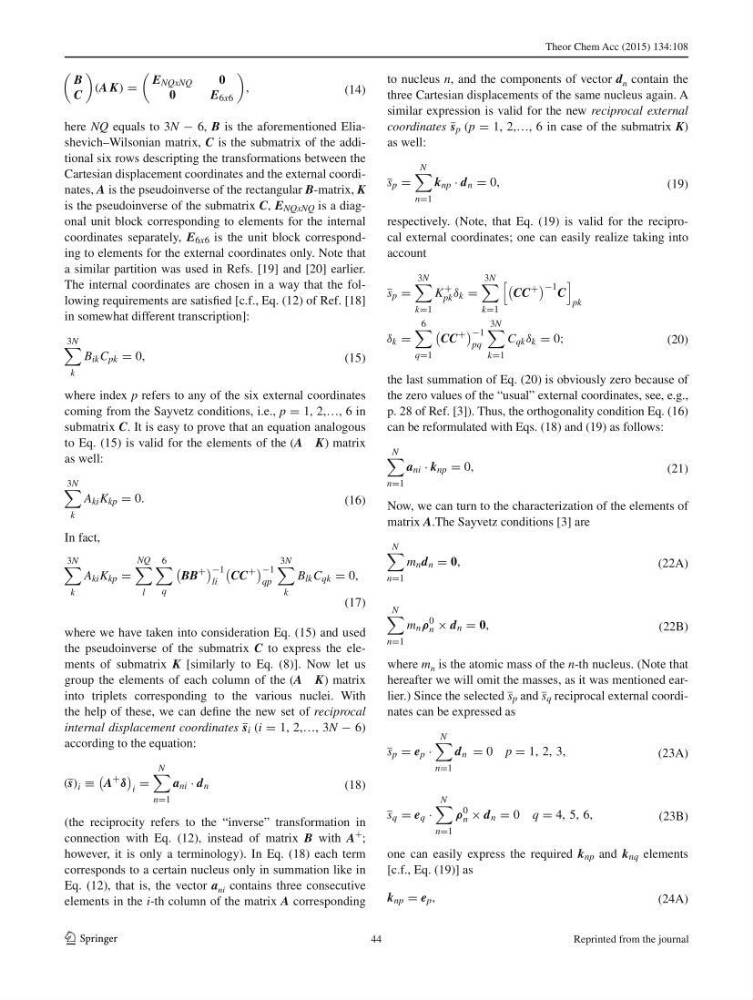
here NQ equals to 3 N − 6, B is the aforementioned Eliashevich–Wilsonian matrix, C is the submatrix of the additional six rows descripting the transformations between the
Cartesian displacement coordinates and the external coordinates, A is the pseudoinverse of the rectangular B -matrix, K
is the pseudoinverse of the submatrix C , E NQxNQ is a diagonal unit block corresponding to elements for the internal
coordinates separately, E 6x6 is the unit block corresponding to elements for the external coordinates only. Note that
a similar partition was used in Refs. [ 19 ] and [ 20 ] earlier.
The internal coordinates are chosen in a way that the following requirements are satisfi ed [c.f., Eq. (12) of Ref. [ 18 ]
in somewhat different transcription]:
where index p refers to any of the six external coordinates
coming from the Sayvetz conditions, i.e., p = 1, 2,…, 6 in
submatrix C . It is easy to prove that an equation analogous
to Eq. ( 15 ) is valid for the elements of the (A K) matrix
as well:
In fact,
where we have taken into consideration Eq. ( 15 ) and used
the pseudoinverse of the submatrix C to express the elements of submatrix K [similarly to Eq. ( 8 )]. Now let us
group the elements of each column of the (A K) matrix
into triplets corresponding to the various nuclei. With
the help of these, we can defi ne the new set of reciprocal
internal displacement coordinates s i ( i = 1, 2,…, 3 N − 6)
according to the equation:
(the reciprocity refers to the “inverse” transformation in
connection with Eq. ( 12 ), instead of matrix B with A
+
;
however, it is only a terminology). In Eq. ( 18 ) each term
corresponds to a certain nucleus only in summation like in
Eq. ( 12 ), that is, the vector a ni contains three consecutive
elements in the i -th column of the matrix A corresponding
(14)
B
C
(A K) =
E NQxNQ
0
0
E 6x6
,
(15)
3N
k
B ik C pk = 0,
(16)
3N
k
A ki K kp = 0.
(17)
3N
k
A ki K kp =
NQ
l
6
q
BB
+
−1
li
CC
+
−1
qp
3N
k
B lk C qk = 0,
(18)
(s) i ≡
A
+
δ
i
=
N
n=1
a ni · d n
to nucleus n , and the components of vector d n contain the
three Cartesian displacements of the same nucleus again. A
similar expression is valid for the new reciprocal external
coordinates s p ( p = 1, 2,…, 6 in case of the submatrix K )
as well:
respectively. (Note, that Eq. ( 19 ) is valid for the reciprocal external coordinates; one can easily realize taking into
account
the last summation of Eq. ( 20 ) is obviously zero because of
the zero values of the “usual” external coordinates, see, e.g.,
p. 28 of Ref. [ 3 ]). Thus, the orthogonality condition Eq. ( 16 )
can be reformulated with Eqs. ( 18 ) and ( 19 ) as follows:
Now, we can turn to the characterization of the elements of
matrix A .The Sayvetz conditions [ 3 ] are
where m n is the atomic mass of the n -th nucleus. (Note that
hereafter we will omit the masses, as it was mentioned earlier.) Since the selected s p and s q reciprocal external coordinates can be expressed as
one can easily express the required k np and k nq elements
[c.f., Eq. ( 19 )] as
(19)
s p =
N
n=1
k np · d n = 0,
(20)
s p =
3N
k=1
K
+
pk δ k =
3N
k=1
CC
+
−1 C
pk
δ k =
6
q=1
CC
+
−1
pq
3N
k=1
C qk δ k = 0;
(21)
N
n=1
a ni · k np = 0,
(22A)
N
n=1
m n d n = 0,
(22B)
N
n=1
m n ρ
0
n × d n = 0,
(23A)
s p = e p ·
N
n=1
d n = 0 p = 1, 2, 3,
(23B)
s q = e q ·
N
n=1
ρ
0
n × d n = 0 q = 4, 5, 6,
(24A)
k np = e p ,
44
Reprinted from the journal
1 3
here NQ equals to 3 N − 6, B is the aforementioned Eliashevich–Wilsonian matrix, C is the submatrix of the additional six rows descripting the transformations between the
Cartesian displacement coordinates and the external coordinates, A is the pseudoinverse of the rectangular B -matrix, K
is the pseudoinverse of the submatrix C , E NQxNQ is a diagonal unit block corresponding to elements for the internal
coordinates separately, E 6x6 is the unit block corresponding to elements for the external coordinates only. Note that
a similar partition was used in Refs. [ 19 ] and [ 20 ] earlier.
The internal coordinates are chosen in a way that the following requirements are satisfi ed [c.f., Eq. (12) of Ref. [ 18 ]
in somewhat different transcription]:
where index p refers to any of the six external coordinates
coming from the Sayvetz conditions, i.e., p = 1, 2,…, 6 in
submatrix C . It is easy to prove that an equation analogous
to Eq. ( 15 ) is valid for the elements of the (A K) matrix
as well:
In fact,
where we have taken into consideration Eq. ( 15 ) and used
the pseudoinverse of the submatrix C to express the elements of submatrix K [similarly to Eq. ( 8 )]. Now let us
group the elements of each column of the (A K) matrix
into triplets corresponding to the various nuclei. With
the help of these, we can defi ne the new set of reciprocal
internal displacement coordinates s i ( i = 1, 2,…, 3 N − 6)
according to the equation:
(the reciprocity refers to the “inverse” transformation in
connection with Eq. ( 12 ), instead of matrix B with A
+
;
however, it is only a terminology). In Eq. ( 18 ) each term
corresponds to a certain nucleus only in summation like in
Eq. ( 12 ), that is, the vector a ni contains three consecutive
elements in the i -th column of the matrix A corresponding
(14)
B
C
(A K) =
E NQxNQ
0
0
E 6x6
,
(15)
3N
k
B ik C pk = 0,
(16)
3N
k
A ki K kp = 0.
(17)
3N
k
A ki K kp =
NQ
l
6
q
BB
+
−1
li
CC
+
−1
qp
3N
k
B lk C qk = 0,
(18)
(s) i ≡
A
+
δ
i
=
N
n=1
a ni · d n
to nucleus n , and the components of vector d n contain the
three Cartesian displacements of the same nucleus again. A
similar expression is valid for the new reciprocal external
coordinates s p ( p = 1, 2,…, 6 in case of the submatrix K )
as well:
respectively. (Note, that Eq. ( 19 ) is valid for the reciprocal external coordinates; one can easily realize taking into
account
the last summation of Eq. ( 20 ) is obviously zero because of
the zero values of the “usual” external coordinates, see, e.g.,
p. 28 of Ref. [ 3 ]). Thus, the orthogonality condition Eq. ( 16 )
can be reformulated with Eqs. ( 18 ) and ( 19 ) as follows:
Now, we can turn to the characterization of the elements of
matrix A .The Sayvetz conditions [ 3 ] are
where m n is the atomic mass of the n -th nucleus. (Note that
hereafter we will omit the masses, as it was mentioned earlier.) Since the selected s p and s q reciprocal external coordinates can be expressed as
one can easily express the required k np and k nq elements
[c.f., Eq. ( 19 )] as
(19)
s p =
N
n=1
k np · d n = 0,
(20)
s p =
3N
k=1
K
+
pk δ k =
3N
k=1
CC
+
−1 C
pk
δ k =
6
q=1
CC
+
−1
pq
3N
k=1
C qk δ k = 0;
(21)
N
n=1
a ni · k np = 0,
(22A)
N
n=1
m n d n = 0,
(22B)
N
n=1
m n ρ
0
n × d n = 0,
(23A)
s p = e p ·
N
n=1
d n = 0 p = 1, 2, 3,
(23B)
s q = e q ·
N
n=1
ρ
0
n × d n = 0 q = 4, 5, 6,
(24A)
k np = e p ,
44
Reprinted from the journal