

Theor Chem Acc (2015) 134:86
1 3
The possibility to write down an (even if approximate)
Hermitian Hamiltonian representing the sum of monoatomic
and diatomic terms has a signifi cant conceptual importance,
in particular because the expectation values of these terms of
the Hamiltonian reproduce the one- and two-center energy
components in the CECA analysis [ 9 ]. We hope that this
way of writing the Hamiltonian will permit to accomplish
some a priori approaches to molecular structure problems,
and not only a posteriori ones like the energy decomposition.
In the next section, we shall consider the application of our
approach at the SCF level of theory; it is not utilizing explicitly the detailed form ( 32 )–( 34 ) of the Hamiltonian.
5 SCF equations
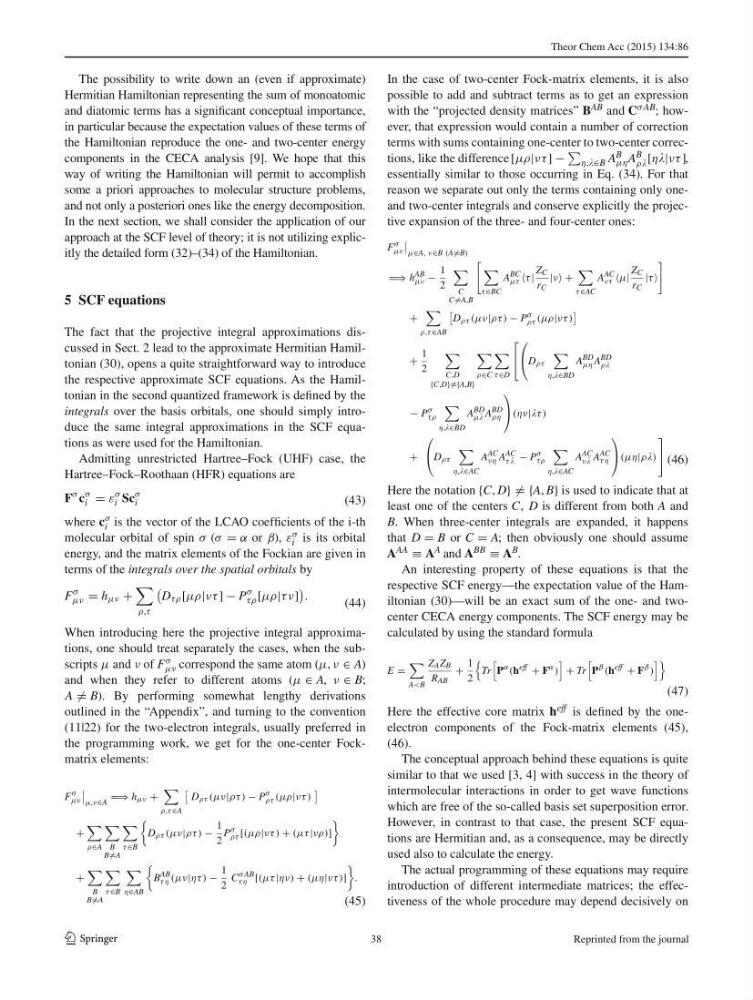
The fact that the projective integral approximations discussed in Sect. 2 lead to the approximate Hermitian Hamiltonian ( 30 ), opens a quite straightforward way to introduce
the respective approximate SCF equations. As the Hamiltonian in the second quantized framework is defi ned by the
integrals over the basis orbitals, one should simply introduce the same integral approximations in the SCF equations as were used for the Hamiltonian.
Admitting unrestricted Hartree–Fock (UHF) case, the
Hartree–Fock–Roothaan (HFR) equations are
where c σ
i is the vector of the LCAO coeffi cients of the i-th
molecular orbital of spin σ ( σ = α or β ), ε σ
i is its orbital
energy, and the matrix elements of the Fockian are given in
terms of the integrals over the spatial orbitals by
When introducing here the projective integral approximations, one should treat separately the cases, when the subscripts μ and ν of F σ
μν correspond the same atom ( μ, ν ∈ A )
and when they refer to different atoms ( μ ∈ A , ν ∈ B ;
A = B ). By performing somewhat lengthy derivations
outlined in the “ Appendix ”, and turning to the convention
(11|22) for the two-electron integrals, usually preferred in
the programming work, we get for the one-center Fockmatrix elements:
(43)
F
σ c
σ
i = ε
σ
i Sc
σ
i
(44)
F
σ
μν = h μν +
ρ,τ
D τρ [μρ|ντ ] − P
σ
τρ [μρ|τ ν]
.
(45)
F
σ
μν
μ,ν∈A =⇒ h μν +
ρ,τ ∈A
D ρτ (μν|ρτ ) − P
σ
ρτ (μρ|ντ )
+
ρ∈A
B
B =A
τ ∈B
D ρτ (μν|ρτ ) −
1
2
P
σ
ρτ [(μρ|ντ ) + (μτ |νρ)]
+
B
B =A
τ ∈B
η∈AB
B
AB
τ η (μν|ητ ) −
1
2
C
σ AB
τ η [(μτ |ην) + (μη|ντ )]
.
In the case of two-center Fock-matrix elements, it is also
possible to add and subtract terms as to get an expression
with the “projected density matrices” B AB and C σ AB ; however, that expression would contain a number of correction
terms with sums containing one-center to two-center corrections, like the difference [μρ|ντ ] −
η,∈B A B
μη A B
ρ [η|ντ ] ,
essentially similar to those occurring in Eq. ( 34 ). For that
reason we separate out only the terms containing only oneand two-center integrals and conserve explicitly the projective expansion of the three- and four-center ones:
Here the notation {C, D} = {A, B} is used to indicate that at
least one of the centers C, D is different from both A and
B . When three-center integrals are expanded, it happens
that D = B or C = A ; then obviously one should assume
A AA ≡ A A and A BB ≡ A B .
An interesting property of these equations is that the
respective SCF energy—the expectation value of the Hamiltonian ( 30 )—will be an exact sum of the one- and twocenter CECA energy components. The SCF energy may be
calculated by using the standard formula
Here the effective core matrix h eff is defi ned by the oneelectron components of the Fock-matrix elements ( 45 ),
( 46 ).
The conceptual approach behind these equations is quite
similar to that we used [ 3 , 4 ] with success in the theory of
intermolecular interactions in order to get wave functions
which are free of the so-called basis set superposition error.
However, in contrast to that case, the present SCF equations are Hermitian and, as a consequence, may be directly
used also to calculate the energy.
The actual programming of these equations may require
introduction of different intermediate matrices; the effectiveness of the whole procedure may depend decisively on
(46)
F
σ
μν
μ∈A, ν∈B (A =B)
=⇒ h
AB
μν −
1
2
C
C =A,B
τ ∈BC
A
BC
μτ τ |
Z C
r C
|ν +
τ ∈AC
A
AC
ντ μ|
Z C
r C
|τ
+
ρ,τ ∈AB
D ρτ (μν|ρτ ) − P
σ
ρτ (μρ|ντ )
+
1
2
C,D
{C,D} ={A,B}
ρ∈C
τ ∈D
⎡
⎣
⎛
⎝ D ρτ
η,∈BD
A
BD
μη A
BD
ρ
− P
σ
τρ
η,∈BD
A
BD
μ A
BD
ρη
⎞
⎠ (ην|τ )
+
⎛
⎝ D ρτ
η,∈AC
A
AC
νη A
AC
τ − P
σ
τρ
η,∈AC
A
AC
ν A
AC
τ η
⎞
⎠ (μη|ρ)
⎤
⎦
(47)
E =
A
R AB
+
1
2
Tr
P
α (h
eff + F
α )
+ Tr
P
β (h
eff + F
β )
38
Reprinted from the journal
1 3
The possibility to write down an (even if approximate)
Hermitian Hamiltonian representing the sum of monoatomic
and diatomic terms has a signifi cant conceptual importance,
in particular because the expectation values of these terms of
the Hamiltonian reproduce the one- and two-center energy
components in the CECA analysis [ 9 ]. We hope that this
way of writing the Hamiltonian will permit to accomplish
some a priori approaches to molecular structure problems,
and not only a posteriori ones like the energy decomposition.
In the next section, we shall consider the application of our
approach at the SCF level of theory; it is not utilizing explicitly the detailed form ( 32 )–( 34 ) of the Hamiltonian.
5 SCF equations
The fact that the projective integral approximations discussed in Sect. 2 lead to the approximate Hermitian Hamiltonian ( 30 ), opens a quite straightforward way to introduce
the respective approximate SCF equations. As the Hamiltonian in the second quantized framework is defi ned by the
integrals over the basis orbitals, one should simply introduce the same integral approximations in the SCF equations as were used for the Hamiltonian.
Admitting unrestricted Hartree–Fock (UHF) case, the
Hartree–Fock–Roothaan (HFR) equations are
where c σ
i is the vector of the LCAO coeffi cients of the i-th
molecular orbital of spin σ ( σ = α or β ), ε σ
i is its orbital
energy, and the matrix elements of the Fockian are given in
terms of the integrals over the spatial orbitals by
When introducing here the projective integral approximations, one should treat separately the cases, when the subscripts μ and ν of F σ
μν correspond the same atom ( μ, ν ∈ A )
and when they refer to different atoms ( μ ∈ A , ν ∈ B ;
A = B ). By performing somewhat lengthy derivations
outlined in the “ Appendix ”, and turning to the convention
(11|22) for the two-electron integrals, usually preferred in
the programming work, we get for the one-center Fockmatrix elements:
(43)
F
σ c
σ
i = ε
σ
i Sc
σ
i
(44)
F
σ
μν = h μν +
ρ,τ
D τρ [μρ|ντ ] − P
σ
τρ [μρ|τ ν]
.
(45)
F
σ
μν
μ,ν∈A =⇒ h μν +
ρ,τ ∈A
D ρτ (μν|ρτ ) − P
σ
ρτ (μρ|ντ )
+
ρ∈A
B
B =A
τ ∈B
D ρτ (μν|ρτ ) −
1
2
P
σ
ρτ [(μρ|ντ ) + (μτ |νρ)]
+
B
B =A
τ ∈B
η∈AB
B
AB
τ η (μν|ητ ) −
1
2
C
σ AB
τ η [(μτ |ην) + (μη|ντ )]
.
In the case of two-center Fock-matrix elements, it is also
possible to add and subtract terms as to get an expression
with the “projected density matrices” B AB and C σ AB ; however, that expression would contain a number of correction
terms with sums containing one-center to two-center corrections, like the difference [μρ|ντ ] −
η,∈B A B
μη A B
ρ [η|ντ ] ,
essentially similar to those occurring in Eq. ( 34 ). For that
reason we separate out only the terms containing only oneand two-center integrals and conserve explicitly the projective expansion of the three- and four-center ones:
Here the notation {C, D} = {A, B} is used to indicate that at
least one of the centers C, D is different from both A and
B . When three-center integrals are expanded, it happens
that D = B or C = A ; then obviously one should assume
A AA ≡ A A and A BB ≡ A B .
An interesting property of these equations is that the
respective SCF energy—the expectation value of the Hamiltonian ( 30 )—will be an exact sum of the one- and twocenter CECA energy components. The SCF energy may be
calculated by using the standard formula
Here the effective core matrix h eff is defi ned by the oneelectron components of the Fock-matrix elements ( 45 ),
( 46 ).
The conceptual approach behind these equations is quite
similar to that we used [ 3 , 4 ] with success in the theory of
intermolecular interactions in order to get wave functions
which are free of the so-called basis set superposition error.
However, in contrast to that case, the present SCF equations are Hermitian and, as a consequence, may be directly
used also to calculate the energy.
The actual programming of these equations may require
introduction of different intermediate matrices; the effectiveness of the whole procedure may depend decisively on
(46)
F
σ
μν
μ∈A, ν∈B (A =B)
=⇒ h
AB
μν −
1
2
C
C =A,B
τ ∈BC
A
BC
μτ τ |
Z C
r C
|ν +
τ ∈AC
A
AC
ντ μ|
Z C
r C
|τ
+
ρ,τ ∈AB
D ρτ (μν|ρτ ) − P
σ
ρτ (μρ|ντ )
+
1
2
C,D
{C,D} ={A,B}
ρ∈C
τ ∈D
⎡
⎣
⎛
⎝ D ρτ
η,∈BD
A
BD
μη A
BD
ρ
− P
σ
τρ
η,∈BD
A
BD
μ A
BD
ρη
⎞
⎠ (ην|τ )
+
⎛
⎝ D ρτ
η,∈AC
A
AC
νη A
AC
τ − P
σ
τρ
η,∈AC
A
AC
ν A
AC
τ η
⎞
⎠ (μη|ρ)
⎤
⎦
(47)
E =
A
R AB
+
1
2
Tr
P
α (h
eff + F
α )
+ Tr
P
β (h
eff + F
β )
38
Reprinted from the journal