

Theor Chem Acc (2015) 134:86
1 3
what quantities may be stored in the computer’s memory.
However, we think that the exclusion of the explicit appearance of the three- and four-center integrals will worth of
these complications. A promising special applications of
these equations may be their use as a special intermediate
layer in the ONIOM-type approaches between the parts
used with full ab initio and those treated at the semiempirical level.
6 Conclusions
An attempt is made to develop a new scheme of nonempirical SCF-LCAO-MO calculations, which may
represent an alternative for both the “orthodox” ab initio scheme and the semiempirical theories (it may also
be a useful intermediate layer in the ONIOM-type
approaches). For that reason it is suggested to treat all
the one- and two-center integrals in a strict ab initio manner and to use approximate projective expansions for the
three- and four-center ones—the same as were used in
the CECA energy decomposition scheme [ 9 ]. These projective integral expansions permit to express the leading
“physical” components of the three- and four-center integrals through one- center and two-center integrals and
the overlap ones. These expansions are utilized to rewrite
the second quantized Born–Oppenheimer LCAO Hamiltonian in an approximate form not containing any threeand four-center integrals and to write down a Hermitian
version of the “Chemical Hamiltonian” [ 1 ], containing
only mono- and diatomic terms. Incorporating these projective integral approximations in the HFR equations,
one obtains some modifi ed SCF equations. The calculations will require only one- and two-center integrals and
some quantities calculated by using the overlap matrix.
Nevertheless, for large basis sets, this method should
converge to the usual Hartree–Fock limit. The approach
is in the spirit of the CHA–SCF equations [ 3 , 4 ] used
with success to exclude basis set superposition error in
the theory of intermolecular interactions, but here the
Fockian is Hermitian and can also directly be applied to
calculate energy.
Appendix: Derivation of Eq. ( 45 )
When considering the integral approximations, we should
stick to the [12|12] convention for the integrals permitting to distinguish the terms originating from the “bra”-s
and “ket”-s, respectively; in the fi nal formulae we have
turned to the (11|22) convention more convenient in
programming.
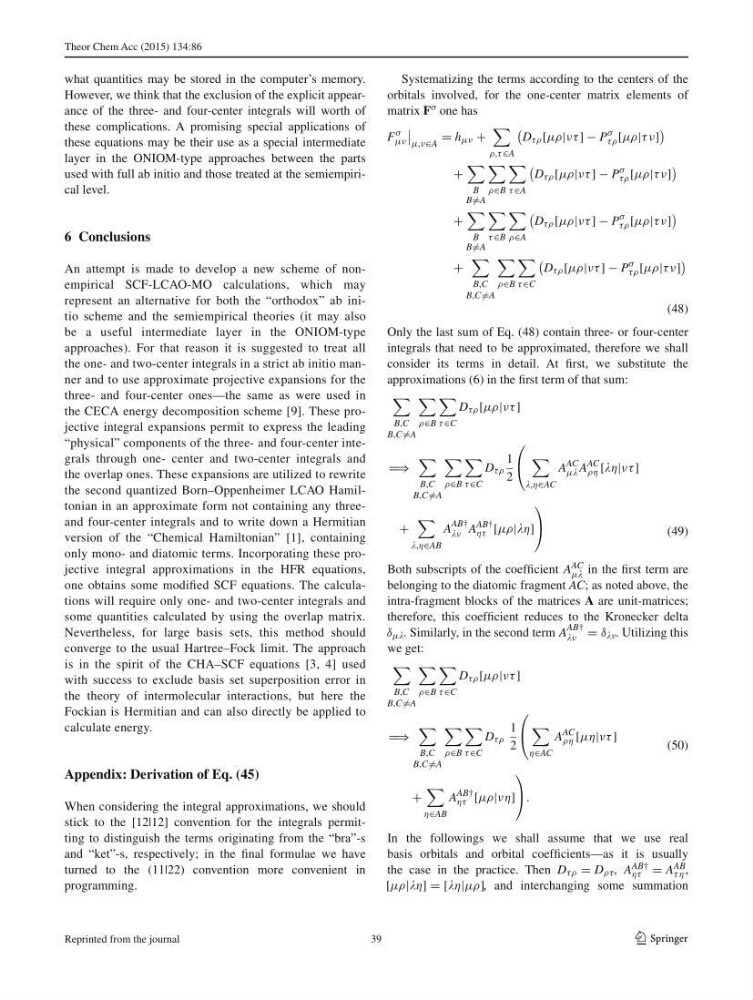
Systematizing the terms according to the centers of the
orbitals involved, for the one-center matrix elements of
matrix F σ one has
Only the last sum of Eq. ( 48 ) contain three- or four-center
integrals that need to be approximated, therefore we shall
consider its terms in detail. At fi rst, we substitute the
approximations ( 6 ) in the fi rst term of that sum:
Both subscripts of the coeffi cient A
AC
μ in the fi rst term are
belonging to the diatomic fragment AC ; as noted above, the
intra-fragment blocks of the matrices A are unit-matrices;
therefore, this coeffi cient reduces to the Kronecker delta
δ μ . Similarly, in the second term A
AB†
ν = δ ν . Utilizing this
we get:
In the followings we shall assume that we use real
basis orbitals and orbital coeffi cients—as it is usually
the case in the practice. Then D τρ = D ρτ , A AB†
ητ = A AB
τ η ,
[μρ|η] = [η|μρ] , and interchanging some summation
(48)
F
σ
μν
μ,ν∈A = h μν +
ρ,τ ∈A
D τρ [μρ|ντ ] − P
σ
τρ [μρ|τ ν]
+
B
B =A
ρ∈B
τ ∈A
D τρ [μρ|ντ ] − P
σ
τρ [μρ|τ ν]
+
B
B =A
τ ∈B
ρ∈A
D τρ [μρ|ντ ] − P
σ
τρ [μρ|τ ν]
+
B,C
B,C =A
ρ∈B
τ ∈C
D τρ [μρ|ντ ] − P
σ
τρ [μρ|τ ν]
(49)
B,C
B,C =A
ρ∈B
τ ∈C
D τρ [μρ|ντ ]
=⇒
B,C
B,C =A
ρ∈B
τ ∈C
D τρ
1
2
⎛
⎝
,η∈AC
A
AC
μ A
AC
ρη [η|ντ ]
+
,η∈AB
A
AB†
ν A
AB†
ητ [μρ|η]
⎞
⎠
(50)
B,C
B,C =A
ρ∈B
τ ∈C
D τρ [μρ|ντ ]
=⇒
B,C
B,C =A
ρ∈B
τ ∈C
D τρ
1
2
⎛
⎝
η∈AC
A
AC
ρη [μη|ντ ]
+
η∈AB
A
AB†
ητ [μρ|νη]
⎞
⎠ .
39
Reprinted from the journal
1 3
what quantities may be stored in the computer’s memory.
However, we think that the exclusion of the explicit appearance of the three- and four-center integrals will worth of
these complications. A promising special applications of
these equations may be their use as a special intermediate
layer in the ONIOM-type approaches between the parts
used with full ab initio and those treated at the semiempirical level.
6 Conclusions
An attempt is made to develop a new scheme of nonempirical SCF-LCAO-MO calculations, which may
represent an alternative for both the “orthodox” ab initio scheme and the semiempirical theories (it may also
be a useful intermediate layer in the ONIOM-type
approaches). For that reason it is suggested to treat all
the one- and two-center integrals in a strict ab initio manner and to use approximate projective expansions for the
three- and four-center ones—the same as were used in
the CECA energy decomposition scheme [ 9 ]. These projective integral expansions permit to express the leading
“physical” components of the three- and four-center integrals through one- center and two-center integrals and
the overlap ones. These expansions are utilized to rewrite
the second quantized Born–Oppenheimer LCAO Hamiltonian in an approximate form not containing any threeand four-center integrals and to write down a Hermitian
version of the “Chemical Hamiltonian” [ 1 ], containing
only mono- and diatomic terms. Incorporating these projective integral approximations in the HFR equations,
one obtains some modifi ed SCF equations. The calculations will require only one- and two-center integrals and
some quantities calculated by using the overlap matrix.
Nevertheless, for large basis sets, this method should
converge to the usual Hartree–Fock limit. The approach
is in the spirit of the CHA–SCF equations [ 3 , 4 ] used
with success to exclude basis set superposition error in
the theory of intermolecular interactions, but here the
Fockian is Hermitian and can also directly be applied to
calculate energy.
Appendix: Derivation of Eq. ( 45 )
When considering the integral approximations, we should
stick to the [12|12] convention for the integrals permitting to distinguish the terms originating from the “bra”-s
and “ket”-s, respectively; in the fi nal formulae we have
turned to the (11|22) convention more convenient in
programming.
Systematizing the terms according to the centers of the
orbitals involved, for the one-center matrix elements of
matrix F σ one has
Only the last sum of Eq. ( 48 ) contain three- or four-center
integrals that need to be approximated, therefore we shall
consider its terms in detail. At fi rst, we substitute the
approximations ( 6 ) in the fi rst term of that sum:
Both subscripts of the coeffi cient A
AC
μ in the fi rst term are
belonging to the diatomic fragment AC ; as noted above, the
intra-fragment blocks of the matrices A are unit-matrices;
therefore, this coeffi cient reduces to the Kronecker delta
δ μ . Similarly, in the second term A
AB†
ν = δ ν . Utilizing this
we get:
In the followings we shall assume that we use real
basis orbitals and orbital coeffi cients—as it is usually
the case in the practice. Then D τρ = D ρτ , A AB†
ητ = A AB
τ η ,
[μρ|η] = [η|μρ] , and interchanging some summation
(48)
F
σ
μν
μ,ν∈A = h μν +
ρ,τ ∈A
D τρ [μρ|ντ ] − P
σ
τρ [μρ|τ ν]
+
B
B =A
ρ∈B
τ ∈A
D τρ [μρ|ντ ] − P
σ
τρ [μρ|τ ν]
+
B
B =A
τ ∈B
ρ∈A
D τρ [μρ|ντ ] − P
σ
τρ [μρ|τ ν]
+
B,C
B,C =A
ρ∈B
τ ∈C
D τρ [μρ|ντ ] − P
σ
τρ [μρ|τ ν]
(49)
B,C
B,C =A
ρ∈B
τ ∈C
D τρ [μρ|ντ ]
=⇒
B,C
B,C =A
ρ∈B
τ ∈C
D τρ
1
2
⎛
⎝
,η∈AC
A
AC
μ A
AC
ρη [η|ντ ]
+
,η∈AB
A
AB†
ν A
AB†
ητ [μρ|η]
⎞
⎠
(50)
B,C
B,C =A
ρ∈B
τ ∈C
D τρ [μρ|ντ ]
=⇒
B,C
B,C =A
ρ∈B
τ ∈C
D τρ
1
2
⎛
⎝
η∈AC
A
AC
ρη [μη|ντ ]
+
η∈AB
A
AB†
ητ [μρ|νη]
⎞
⎠ .
39
Reprinted from the journal