

Theor Chem Acc (2015) 134:86
1 3
In this presentation, the monoatomic terms of the Hamiltonian contain only one-center integrals and the diatomic
terms contain one- and two-center ones. While the fi rst
few terms in Eq. ( 34 ) describe direct diatomic interactions
(electron-nuclear and electron-electron), most of the terms
contain differences between a two-center integral related
to intra atomic interactions and its approximation by onecenter integrals and projection-related matrices A X , like the
term
These terms account for the effects of the basis extension
from the atomic description to the diatomic fragments.
Their role should diminish as the basis set increases, and in
Ref. [ 1 ] terms of this type were assigned to the fi nite basis
correction ones. Here they are conserved as to provide that
the diatomics (diatomic fragments) are treated without any
approximations.
Contrary to the integrals, a part of the creation and annihilation operators run over the whole basis, so there occur
operator strings involving three and four centers. When the
energy is calculated as the expectation value of the Hamiltonian, the expectation values of the operator strings give
the density matrix elements according to Eqs. ( 23 )–( 25 ).
Combined with the elements of the matrices A X , in the
single-determinant case they lead to the projected density
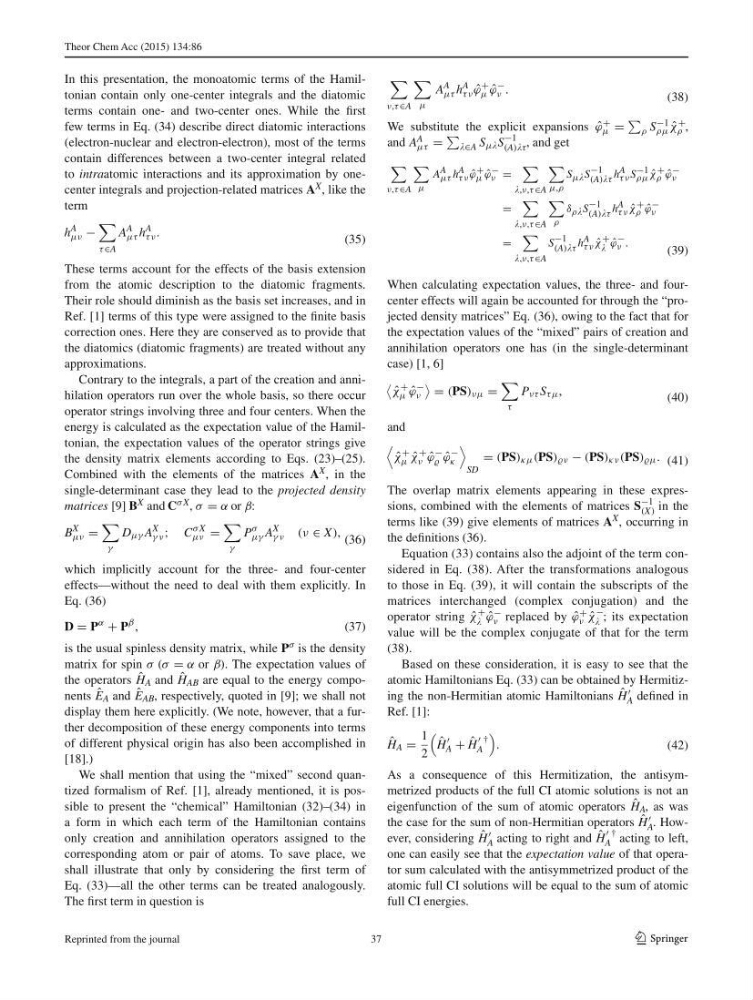
matrices [ 9 ] B X and C σ X , σ = α or β :
which implicitly account for the three- and four-center
effects—without the need to deal with them explicitly. In
Eq. ( 36 )
is the usual spinless density matrix, while P σ is the density
matrix for spin σ ( σ = α or β ). The expectation values of
the operators ˆ
H A and ˆ
H AB are equal to the energy components ˆ
E A and ˆ
E AB , respectively, quoted in [ 9 ]; we shall not
display them here explicitly. (We note, however, that a further decomposition of these energy components into terms
of different physical origin has also been accomplished in
[ 18 ].)
We shall mention that using the “mixed” second quantized formalism of Ref. [ 1 ], already mentioned, it is possible to present the “chemical” Hamiltonian ( 32 )–( 34 ) in
a form in which each term of the Hamiltonian contains
only creation and annihilation operators assigned to the
corresponding atom or pair of atoms. To save place, we
shall illustrate that only by considering the fi rst term of
Eq. ( 33 )—all the other terms can be treated analogously.
The fi rst term in question is
(35)
h
A
μν −
τ ∈A
A
A
μτ h
A
τ ν .
(36)
B
X
μν =
γ
D μγ A
X
γ ν ; C
σ X
μν =
γ
P
σ
μγ A
X
γ ν (ν ∈ X),
(37)
D = P
α
+ P
β ,
We substitute the explicit expansions ˆ
ϕ +
μ =
ρ S −1
ρμ ˆ
χ +
ρ ,
and A A
μτ =
∈A S μ S
−1
(A)τ , and get
When calculating expectation values, the three- and fourcenter effects will again be accounted for through the “projected density matrices” Eq. ( 36 ), owing to the fact that for
the expectation values of the “mixed” pairs of creation and
annihilation operators one has (in the single-determinant
case) [ 1 , 6 ]
and
The overlap matrix elements appearing in these expressions, combined with the elements of matrices S
−1
(X) in the
terms like ( 39 ) give elements of matrices A X , occurring in
the defi nitions ( 36 ).
Equation ( 33 ) contains also the adjoint of the term considered in Eq. ( 38 ). After the transformations analogous
to those in Eq. ( 39 ), it will contain the subscripts of the
matrices interchanged (complex conjugation) and the
operator string ˆ
χ
+
ˆ
ϕ −
ν replaced by ˆ
ϕ +
ν ˆ
χ
−
; its expectation
value will be the complex conjugate of that for the term
( 38 ).
Based on these consideration, it is easy to see that the
atomic Hamiltonians Eq. ( 33 ) can be obtained by Hermitizing the non-Hermitian atomic Hamiltonians ˆ
H
A defi ned in
Ref. [ 1 ]:
As a consequence of this Hermitization, the antisymmetrized products of the full CI atomic solutions is not an
eigenfunction of the sum of atomic operators ˆ
H A , as was
the case for the sum of non-Hermitian operators ˆ
H
A . However, considering ˆ
H
A acting to right and ˆ
H
†
A acting to left,
one can easily see that the expectation value of that operator sum calculated with the antisymmetrized product of the
atomic full CI solutions will be equal to the sum of atomic
full CI energies.
(38)
ν,τ ∈A
μ
A
A
μτ h
A
τ ν ˆ
ϕ
+
μ ˆ
ϕ
−
ν .
(39)
ν,τ ∈A
μ
A A
μτ h A
τ ν ˆ
ϕ +
μ ˆ
ϕ −
ν =
,ν,τ ∈A
μ,ρ
S μ S
−1
(A)τ h A
τ ν S −1
ρμ ˆ
χ +
ρ ˆ
ϕ −
ν
=
,ν,τ ∈A
ρ
δ ρ S
−1
(A)τ h A
τ ν ˆ
χ +
ρ ˆ
ϕ −
ν
=
,ν,τ ∈A
S
−1
(A)τ h A
τ ν ˆ
χ
+
ˆ
ϕ −
ν .
(40)
ˆ
χ
+
μ ˆ
ϕ
−
ν
= (PS) νμ =
τ
P ντ S τ μ ,
(41)
ˆ
χ
+
μ ˆ
χ
+
ν ˆ
ϕ
−
ˆ
ϕ
−
κ
SD
= (PS) κμ (PS) ν − (PS) κν (PS) μ .
(42)
ˆ
H A =
1
2
ˆ
H
A + ˆ
H
†
A
.
37
Reprinted from the journal
1 3
In this presentation, the monoatomic terms of the Hamiltonian contain only one-center integrals and the diatomic
terms contain one- and two-center ones. While the fi rst
few terms in Eq. ( 34 ) describe direct diatomic interactions
(electron-nuclear and electron-electron), most of the terms
contain differences between a two-center integral related
to intra atomic interactions and its approximation by onecenter integrals and projection-related matrices A X , like the
term
These terms account for the effects of the basis extension
from the atomic description to the diatomic fragments.
Their role should diminish as the basis set increases, and in
Ref. [ 1 ] terms of this type were assigned to the fi nite basis
correction ones. Here they are conserved as to provide that
the diatomics (diatomic fragments) are treated without any
approximations.
Contrary to the integrals, a part of the creation and annihilation operators run over the whole basis, so there occur
operator strings involving three and four centers. When the
energy is calculated as the expectation value of the Hamiltonian, the expectation values of the operator strings give
the density matrix elements according to Eqs. ( 23 )–( 25 ).
Combined with the elements of the matrices A X , in the
single-determinant case they lead to the projected density
matrices [ 9 ] B X and C σ X , σ = α or β :
which implicitly account for the three- and four-center
effects—without the need to deal with them explicitly. In
Eq. ( 36 )
is the usual spinless density matrix, while P σ is the density
matrix for spin σ ( σ = α or β ). The expectation values of
the operators ˆ
H A and ˆ
H AB are equal to the energy components ˆ
E A and ˆ
E AB , respectively, quoted in [ 9 ]; we shall not
display them here explicitly. (We note, however, that a further decomposition of these energy components into terms
of different physical origin has also been accomplished in
[ 18 ].)
We shall mention that using the “mixed” second quantized formalism of Ref. [ 1 ], already mentioned, it is possible to present the “chemical” Hamiltonian ( 32 )–( 34 ) in
a form in which each term of the Hamiltonian contains
only creation and annihilation operators assigned to the
corresponding atom or pair of atoms. To save place, we
shall illustrate that only by considering the fi rst term of
Eq. ( 33 )—all the other terms can be treated analogously.
The fi rst term in question is
(35)
h
A
μν −
τ ∈A
A
A
μτ h
A
τ ν .
(36)
B
X
μν =
γ
D μγ A
X
γ ν ; C
σ X
μν =
γ
P
σ
μγ A
X
γ ν (ν ∈ X),
(37)
D = P
α
+ P
β ,
We substitute the explicit expansions ˆ
ϕ +
μ =
ρ S −1
ρμ ˆ
χ +
ρ ,
and A A
μτ =
∈A S μ S
−1
(A)τ , and get
When calculating expectation values, the three- and fourcenter effects will again be accounted for through the “projected density matrices” Eq. ( 36 ), owing to the fact that for
the expectation values of the “mixed” pairs of creation and
annihilation operators one has (in the single-determinant
case) [ 1 , 6 ]
and
The overlap matrix elements appearing in these expressions, combined with the elements of matrices S
−1
(X) in the
terms like ( 39 ) give elements of matrices A X , occurring in
the defi nitions ( 36 ).
Equation ( 33 ) contains also the adjoint of the term considered in Eq. ( 38 ). After the transformations analogous
to those in Eq. ( 39 ), it will contain the subscripts of the
matrices interchanged (complex conjugation) and the
operator string ˆ
χ
+
ˆ
ϕ −
ν replaced by ˆ
ϕ +
ν ˆ
χ
−
; its expectation
value will be the complex conjugate of that for the term
( 38 ).
Based on these consideration, it is easy to see that the
atomic Hamiltonians Eq. ( 33 ) can be obtained by Hermitizing the non-Hermitian atomic Hamiltonians ˆ
H
A defi ned in
Ref. [ 1 ]:
As a consequence of this Hermitization, the antisymmetrized products of the full CI atomic solutions is not an
eigenfunction of the sum of atomic operators ˆ
H A , as was
the case for the sum of non-Hermitian operators ˆ
H
A . However, considering ˆ
H
A acting to right and ˆ
H
†
A acting to left,
one can easily see that the expectation value of that operator sum calculated with the antisymmetrized product of the
atomic full CI solutions will be equal to the sum of atomic
full CI energies.
(38)
ν,τ ∈A
μ
A
A
μτ h
A
τ ν ˆ
ϕ
+
μ ˆ
ϕ
−
ν .
(39)
ν,τ ∈A
μ
A A
μτ h A
τ ν ˆ
ϕ +
μ ˆ
ϕ −
ν =
,ν,τ ∈A
μ,ρ
S μ S
−1
(A)τ h A
τ ν S −1
ρμ ˆ
χ +
ρ ˆ
ϕ −
ν
=
,ν,τ ∈A
ρ
δ ρ S
−1
(A)τ h A
τ ν ˆ
χ +
ρ ˆ
ϕ −
ν
=
,ν,τ ∈A
S
−1
(A)τ h A
τ ν ˆ
χ
+
ˆ
ϕ −
ν .
(40)
ˆ
χ
+
μ ˆ
ϕ
−
ν
= (PS) νμ =
τ
P ντ S τ μ ,
(41)
ˆ
χ
+
μ ˆ
χ
+
ν ˆ
ϕ
−
ˆ
ϕ
−
κ
SD
= (PS) κμ (PS) ν − (PS) κν (PS) μ .
(42)
ˆ
H A =
1
2
ˆ
H
A + ˆ
H
†
A
.
37
Reprinted from the journal