

Theor Chem Acc (2015) 134:107
1 3
occupation DC-MP2 are given together for comparison.
The buffer size was fi xed to n HF
b = n MP2
b
= 6. Even for
this delocalized system, the numbers for β ≥ 200 a.u. are
close to those for the integer occupation DC-MP2 method.
Therefore, in case of large β, the additional computational
costs for the FT-MP2 treatment are tiny, although the
energy improvement shown in Fig. 3 is considerable. N α
occ
and N α
vir gradually increases as the temperature increases.
It was concluded that the use of low temperature is important in DC-MP2 calculation not only to improve the accuracy but also to reduce the computational demands for the
FT-MP2 treatment. Although the use of high temperature
often improves the self-consistent fi eld convergence in
DC-HF calculation, so-called annealing technique can be
adopted to lower the fi nal temperature [ 52 ].
Up to this point, as discussed in Sect. 2.3 , the Fermi
level determined in the DC-HF calculation was also used
for Eqs. ( 54 ) and ( 55 ). If the Fermi level is redetermined
using the subsystem MOs constructed for the DC-MP2
calculation and is used for Eqs. ( 54 ) and ( 55 ), the result
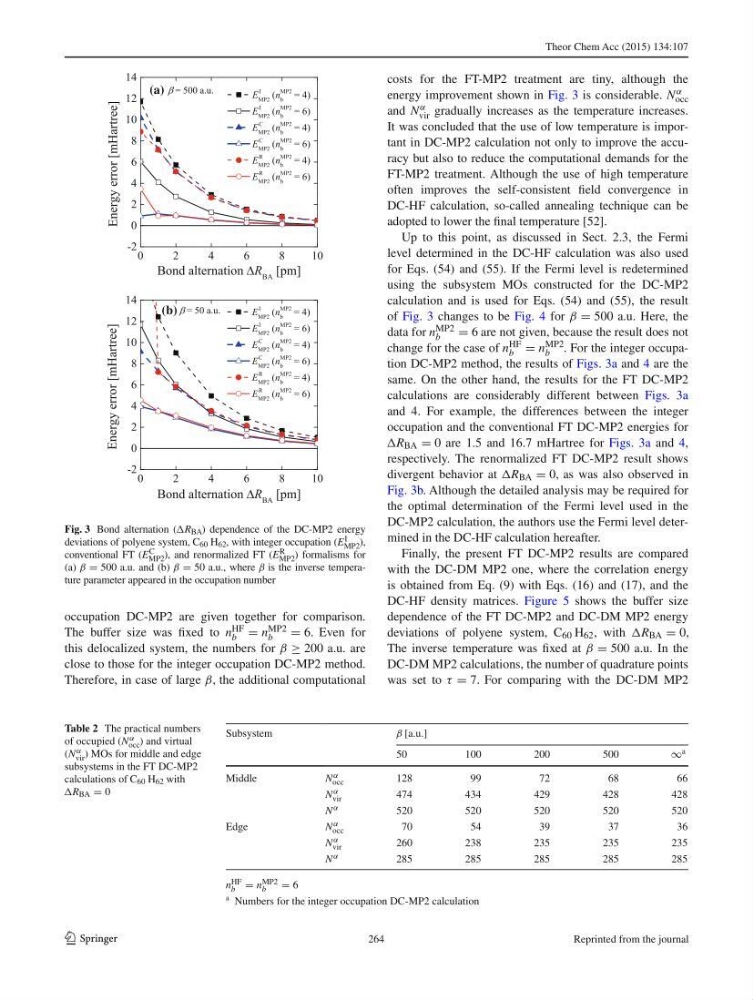
of Fig. 3 changes to be Fig. 4 for β = 500 a.u. Here, the
data for n MP2
b
= 6 are not given, because the result does not
change for the case of n HF
b = n MP2
b . For the integer occupation DC-MP2 method, the results of Figs. 3 a and 4 are the
same. On the other hand, the results for the FT DC-MP2
calculations are considerably different between Figs. 3 a
and 4 . For example, the differences between the integer
occupation and the conventional FT DC-MP2 energies for
R BA = 0 are 1.5 and 16.7 mHartree for Figs. 3 a and 4 ,
respectively. The renormalized FT DC-MP2 result shows
divergent behavior at R BA = 0, as was also observed in
Fig. 3 b. Although the detailed analysis may be required for
the optimal determination of the Fermi level used in the
DC-MP2 calculation, the authors use the Fermi level determined in the DC-HF calculation hereafter.
Finally, the present FT DC-MP2 results are compared
with the DC-DM MP2 one, where the correlation energy
is obtained from Eq. ( 9 ) with Eqs. ( 16 ) and ( 17 ), and the
DC-HF density matrices. Figure 5 shows the buffer size
dependence of the FT DC-MP2 and DC-DM MP2 energy
deviations of polyene system, C 60 H 62 , with R BA = 0,
The inverse temperature was fi xed at β = 500 a.u. In the
DC-DM MP2 calculations, the number of quadrature points
was set to τ = 7. For comparing with the DC-DM MP2
(a)
(b)
Fig. 3 Bond alternation ( R BA ) dependence of the DC-MP2 energy
deviations of polyene system, C 60 H 62 , with integer occupation ( E I
MP2 ),
conventional FT ( E C
MP2 ), and renormalized FT ( E R
MP2 ) formalisms for
(a) β = 500 a.u. and (b) β = 50 a.u., where β is the inverse temperature parameter appeared in the occupation number
Table 2 The practical numbers
of occupied ( N α
occ ) and virtual
( N α
vir ) MOs for middle and edge
subsystems in the FT DC-MP2
calculations of C 60 H 62 with
R BA = 0
n HF
b = n MP2
b
= 6
a Numbers for the integer occupation DC-MP2 calculation
Subsystem
β [a.u.]
50
100
200
500
∞ a
Middle
N α
occ
128
99
72
68
66
N α
vir
474
434
429
428
428
N α
520
520
520
520
520
Edge
N α
occ
70
54
39
37
36
N α
vir
260
238
235
235
235
N α
285
285
285
285
285
264
Reprinted from the journal
1 3
occupation DC-MP2 are given together for comparison.
The buffer size was fi xed to n HF
b = n MP2
b
= 6. Even for
this delocalized system, the numbers for β ≥ 200 a.u. are
close to those for the integer occupation DC-MP2 method.
Therefore, in case of large β, the additional computational
costs for the FT-MP2 treatment are tiny, although the
energy improvement shown in Fig. 3 is considerable. N α
occ
and N α
vir gradually increases as the temperature increases.
It was concluded that the use of low temperature is important in DC-MP2 calculation not only to improve the accuracy but also to reduce the computational demands for the
FT-MP2 treatment. Although the use of high temperature
often improves the self-consistent fi eld convergence in
DC-HF calculation, so-called annealing technique can be
adopted to lower the fi nal temperature [ 52 ].
Up to this point, as discussed in Sect. 2.3 , the Fermi
level determined in the DC-HF calculation was also used
for Eqs. ( 54 ) and ( 55 ). If the Fermi level is redetermined
using the subsystem MOs constructed for the DC-MP2
calculation and is used for Eqs. ( 54 ) and ( 55 ), the result
of Fig. 3 changes to be Fig. 4 for β = 500 a.u. Here, the
data for n MP2
b
= 6 are not given, because the result does not
change for the case of n HF
b = n MP2
b . For the integer occupation DC-MP2 method, the results of Figs. 3 a and 4 are the
same. On the other hand, the results for the FT DC-MP2
calculations are considerably different between Figs. 3 a
and 4 . For example, the differences between the integer
occupation and the conventional FT DC-MP2 energies for
R BA = 0 are 1.5 and 16.7 mHartree for Figs. 3 a and 4 ,
respectively. The renormalized FT DC-MP2 result shows
divergent behavior at R BA = 0, as was also observed in
Fig. 3 b. Although the detailed analysis may be required for
the optimal determination of the Fermi level used in the
DC-MP2 calculation, the authors use the Fermi level determined in the DC-HF calculation hereafter.
Finally, the present FT DC-MP2 results are compared
with the DC-DM MP2 one, where the correlation energy
is obtained from Eq. ( 9 ) with Eqs. ( 16 ) and ( 17 ), and the
DC-HF density matrices. Figure 5 shows the buffer size
dependence of the FT DC-MP2 and DC-DM MP2 energy
deviations of polyene system, C 60 H 62 , with R BA = 0,
The inverse temperature was fi xed at β = 500 a.u. In the
DC-DM MP2 calculations, the number of quadrature points
was set to τ = 7. For comparing with the DC-DM MP2
(a)
(b)
Fig. 3 Bond alternation ( R BA ) dependence of the DC-MP2 energy
deviations of polyene system, C 60 H 62 , with integer occupation ( E I
MP2 ),
conventional FT ( E C
MP2 ), and renormalized FT ( E R
MP2 ) formalisms for
(a) β = 500 a.u. and (b) β = 50 a.u., where β is the inverse temperature parameter appeared in the occupation number
Table 2 The practical numbers
of occupied ( N α
occ ) and virtual
( N α
vir ) MOs for middle and edge
subsystems in the FT DC-MP2
calculations of C 60 H 62 with
R BA = 0
n HF
b = n MP2
b
= 6
a Numbers for the integer occupation DC-MP2 calculation
Subsystem
β [a.u.]
50
100
200
500
∞ a
Middle
N α
occ
128
99
72
68
66
N α
vir
474
434
429
428
428
N α
520
520
520
520
520
Edge
N α
occ
70
54
39
37
36
N α
vir
260
238
235
235
235
N α
285
285
285
285
285
264
Reprinted from the journal