

Theor Chem Acc (2015) 134:107
1 3
DM-MP2 result with DF formula agrees well with the
renormalized FT-MP2 one: The difference between these
two results comes from the numerical quadrature error of
Eq. ( 27 ). The DM-MP2 result with S −1 F formula shows
divergent behavior as β decreases due to the divergent
terms of Eq. ( 22 ). As described in Sect. 2.2 , these divergent terms are not taken into account in the conventional
FT-MP2 calculations. Although the conventional FT-MP2
result shows good agreement with the renormalized
FT-MP2 one up to β = 15 a.u., the difference between two
FT-MP2 results increases as β decreases. In addition, this
result numerically supports the reason for the divergence of
DM-MP2 with S −1 F formula when the density matrix is
approximately obtained.
Table 1 shows the dependence of FT DM-MP2 energies
of benzene on the number of numerical quadrature points,
τ . Here, the results for β = 15 a.u., where two DM-MP2
energies in Fig. 1 show large discrepancy, are given. The
energy with the DF formula smoothly converges to the
renormalized FT-MP2 energy, E R
MP2 , as τ increases. The
energy with τ = 7, adopted in Fig. 1 , only differs by 0.1
mHartree from the renormalized FT-MP2 energy. On the
contrary, the result with the S −1 F formula shows divergent
behavior as τ increases. This divergence may be a correct
behavior because the FT DM-MP2 energy with S −1 F formula includes the divergent terms, which are avoided when
evaluating E C
MP2 .
3.2 Polyene system with bond alternation
Next, we assessed the FT DC-MP2 method in calculations
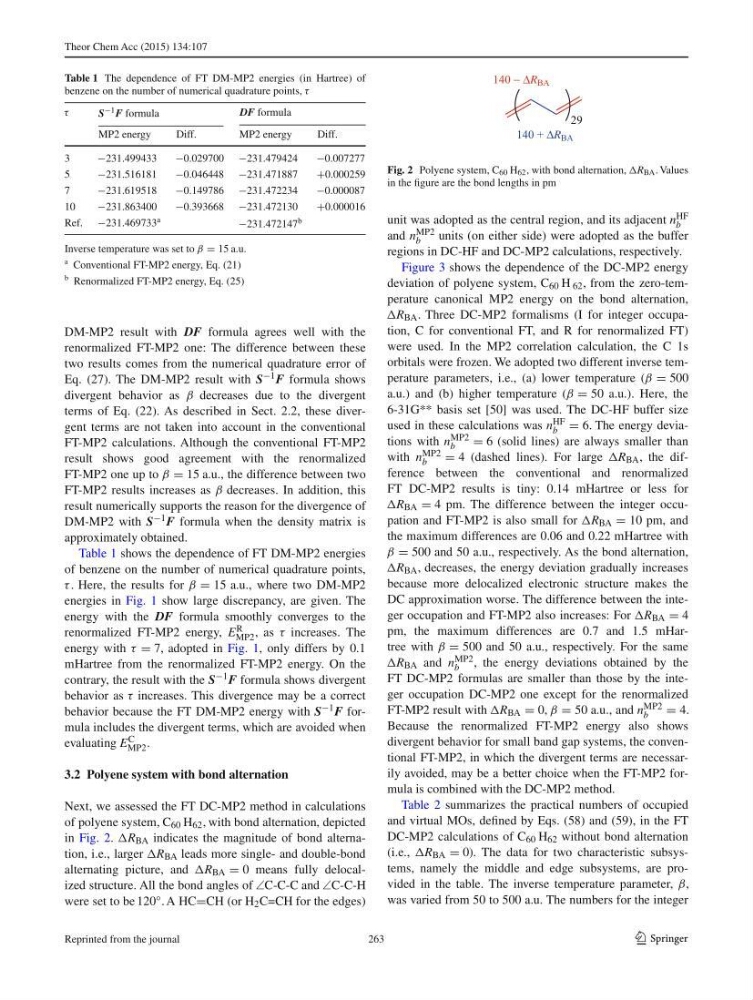
of polyene system, C 60 H 62 , with bond alternation, depicted
in Fig. 2 . R BA indicates the magnitude of bond alternation, i.e., larger R BA leads more single- and double-bond
alternating picture, and R BA = 0 means fully delocalized structure. All the bond angles of ∠C-C-C and ∠C-C-H
were set to be 120 ◦ . A HC=CH (or H 2 C=CH for the edges)
unit was adopted as the central region, and its adjacent n HF
b
and n MP2
b
units (on either side) were adopted as the buffer
regions in DC-HF and DC-MP2 calculations, respectively.
Figure 3 shows the dependence of the DC-MP2 energy
deviation of polyene system, C 60 H 62 , from the zero-temperature canonical MP2 energy on the bond alternation,
R BA . Three DC-MP2 formalisms (I for integer occupation, C for conventional FT, and R for renormalized FT)
were used. In the MP2 correlation calculation, the C 1s
orbitals were frozen. We adopted two different inverse temperature parameters, i.e., (a) lower temperature ( β = 500
a.u.) and (b) higher temperature ( β = 50 a.u.). Here, the
6-31G** basis set [ 50 ] was used. The DC-HF buffer size
used in these calculations was n HF
b = 6. The energy deviations with n MP2
b
= 6 (solid lines) are always smaller than
with n MP2
b
= 4 (dashed lines). For large R BA , the difference between the conventional and renormalized
FT DC-MP2 results is tiny: 0.14 mHartree or less for
R BA = 4 pm. The difference between the integer occupation and FT-MP2 is also small for R BA = 10 pm, and
the maximum differences are 0.06 and 0.22 mHartree with
β = 500 and 50 a.u., respectively. As the bond alternation,
R BA , decreases, the energy deviation gradually increases
because more delocalized electronic structure makes the
DC approximation worse. The difference between the integer occupation and FT-MP2 also increases: For R BA = 4
pm, the maximum differences are 0.7 and 1.5 mHartree with β = 500 and 50 a.u., respectively. For the same
R BA and n MP2
b
, the energy deviations obtained by the
FT DC-MP2 formulas are smaller than those by the integer occupation DC-MP2 one except for the renormalized
FT-MP2 result with R BA = 0, β = 50 a.u., and n MP2
b
= 4.
Because the renormalized FT-MP2 energy also shows
divergent behavior for small band gap systems, the conventional FT-MP2, in which the divergent terms are necessarily avoided, may be a better choice when the FT-MP2 formula is combined with the DC-MP2 method.
Table 2 summarizes the practical numbers of occupied
and virtual MOs, defi ned by Eqs. ( 58 ) and ( 59 ), in the FT
DC-MP2 calculations of C 60 H 62 without bond alternation
(i.e., R BA = 0 ). The data for two characteristic subsystems, namely the middle and edge subsystems, are provided in the table. The inverse temperature parameter, β,
was varied from 50 to 500 a.u. The numbers for the integer
Table 1 The dependence of FT DM-MP2 energies (in Hartree) of
benzene on the number of numerical quadrature points, τ
Inverse temperature was set to β = 15 a.u.
a Conventional FT-MP2 energy, Eq. ( 21 )
b Renormalized FT-MP2 energy, Eq. ( 25 )
τ
S −1 F formula
DF formula
MP2 energy
Diff.
MP2 energy
Diff.
3
−231.499433
−0.029700 −231.479424
−0.007277
5
−231.516181
−0.046448 −231.471887
+0.000259
7
−231.619518
−0.149786 −231.472234
−0.000087
10
−231.863400
−0.393668 −231.472130
+0.000016
Ref. −231.469733 a
−231.472147 b
29
140 − ΔR BA
140 + ΔR BA
Fig. 2 Polyene system, C 60 H 62 , with bond alternation, R BA . Values
in the fi gure are the bond lengths in pm
263
Reprinted from the journal
1 3
DM-MP2 result with DF formula agrees well with the
renormalized FT-MP2 one: The difference between these
two results comes from the numerical quadrature error of
Eq. ( 27 ). The DM-MP2 result with S −1 F formula shows
divergent behavior as β decreases due to the divergent
terms of Eq. ( 22 ). As described in Sect. 2.2 , these divergent terms are not taken into account in the conventional
FT-MP2 calculations. Although the conventional FT-MP2
result shows good agreement with the renormalized
FT-MP2 one up to β = 15 a.u., the difference between two
FT-MP2 results increases as β decreases. In addition, this
result numerically supports the reason for the divergence of
DM-MP2 with S −1 F formula when the density matrix is
approximately obtained.
Table 1 shows the dependence of FT DM-MP2 energies
of benzene on the number of numerical quadrature points,
τ . Here, the results for β = 15 a.u., where two DM-MP2
energies in Fig. 1 show large discrepancy, are given. The
energy with the DF formula smoothly converges to the
renormalized FT-MP2 energy, E R
MP2 , as τ increases. The
energy with τ = 7, adopted in Fig. 1 , only differs by 0.1
mHartree from the renormalized FT-MP2 energy. On the
contrary, the result with the S −1 F formula shows divergent
behavior as τ increases. This divergence may be a correct
behavior because the FT DM-MP2 energy with S −1 F formula includes the divergent terms, which are avoided when
evaluating E C
MP2 .
3.2 Polyene system with bond alternation
Next, we assessed the FT DC-MP2 method in calculations
of polyene system, C 60 H 62 , with bond alternation, depicted
in Fig. 2 . R BA indicates the magnitude of bond alternation, i.e., larger R BA leads more single- and double-bond
alternating picture, and R BA = 0 means fully delocalized structure. All the bond angles of ∠C-C-C and ∠C-C-H
were set to be 120 ◦ . A HC=CH (or H 2 C=CH for the edges)
unit was adopted as the central region, and its adjacent n HF
b
and n MP2
b
units (on either side) were adopted as the buffer
regions in DC-HF and DC-MP2 calculations, respectively.
Figure 3 shows the dependence of the DC-MP2 energy
deviation of polyene system, C 60 H 62 , from the zero-temperature canonical MP2 energy on the bond alternation,
R BA . Three DC-MP2 formalisms (I for integer occupation, C for conventional FT, and R for renormalized FT)
were used. In the MP2 correlation calculation, the C 1s
orbitals were frozen. We adopted two different inverse temperature parameters, i.e., (a) lower temperature ( β = 500
a.u.) and (b) higher temperature ( β = 50 a.u.). Here, the
6-31G** basis set [ 50 ] was used. The DC-HF buffer size
used in these calculations was n HF
b = 6. The energy deviations with n MP2
b
= 6 (solid lines) are always smaller than
with n MP2
b
= 4 (dashed lines). For large R BA , the difference between the conventional and renormalized
FT DC-MP2 results is tiny: 0.14 mHartree or less for
R BA = 4 pm. The difference between the integer occupation and FT-MP2 is also small for R BA = 10 pm, and
the maximum differences are 0.06 and 0.22 mHartree with
β = 500 and 50 a.u., respectively. As the bond alternation,
R BA , decreases, the energy deviation gradually increases
because more delocalized electronic structure makes the
DC approximation worse. The difference between the integer occupation and FT-MP2 also increases: For R BA = 4
pm, the maximum differences are 0.7 and 1.5 mHartree with β = 500 and 50 a.u., respectively. For the same
R BA and n MP2
b
, the energy deviations obtained by the
FT DC-MP2 formulas are smaller than those by the integer occupation DC-MP2 one except for the renormalized
FT-MP2 result with R BA = 0, β = 50 a.u., and n MP2
b
= 4.
Because the renormalized FT-MP2 energy also shows
divergent behavior for small band gap systems, the conventional FT-MP2, in which the divergent terms are necessarily avoided, may be a better choice when the FT-MP2 formula is combined with the DC-MP2 method.
Table 2 summarizes the practical numbers of occupied
and virtual MOs, defi ned by Eqs. ( 58 ) and ( 59 ), in the FT
DC-MP2 calculations of C 60 H 62 without bond alternation
(i.e., R BA = 0 ). The data for two characteristic subsystems, namely the middle and edge subsystems, are provided in the table. The inverse temperature parameter, β,
was varied from 50 to 500 a.u. The numbers for the integer
Table 1 The dependence of FT DM-MP2 energies (in Hartree) of
benzene on the number of numerical quadrature points, τ
Inverse temperature was set to β = 15 a.u.
a Conventional FT-MP2 energy, Eq. ( 21 )
b Renormalized FT-MP2 energy, Eq. ( 25 )
τ
S −1 F formula
DF formula
MP2 energy
Diff.
MP2 energy
Diff.
3
−231.499433
−0.029700 −231.479424
−0.007277
5
−231.516181
−0.046448 −231.471887
+0.000259
7
−231.619518
−0.149786 −231.472234
−0.000087
10
−231.863400
−0.393668 −231.472130
+0.000016
Ref. −231.469733 a
−231.472147 b
29
140 − ΔR BA
140 + ΔR BA
Fig. 2 Polyene system, C 60 H 62 , with bond alternation, R BA . Values
in the fi gure are the bond lengths in pm
263
Reprinted from the journal