

Theor Chem Acc (2015) 134:107
1 3
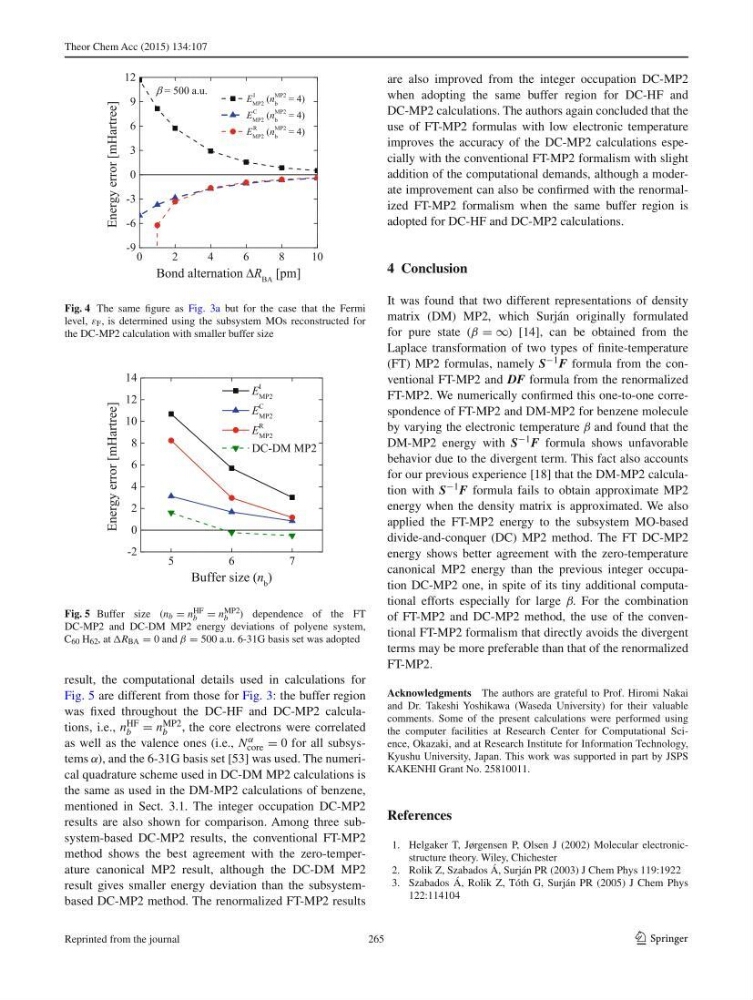
result, the computational details used in calculations for
Fig. 5 are different from those for Fig. 3 : the buffer region
was fi xed throughout the DC-HF and DC-MP2 calculations, i.e., n HF
b = n MP2
b
, the core electrons were correlated
as well as the valence ones (i.e., N α
core = 0 for all subsystems α ), and the 6-31G basis set [ 53 ] was used. The numerical quadrature scheme used in DC-DM MP2 calculations is
the same as used in the DM-MP2 calculations of benzene,
mentioned in Sect. 3.1 . The integer occupation DC-MP2
results are also shown for comparison. Among three subsystem-based DC-MP2 results, the conventional FT-MP2
method shows the best agreement with the zero-temperature canonical MP2 result, although the DC-DM MP2
result gives smaller energy deviation than the subsystembased DC-MP2 method. The renormalized FT-MP2 results
are also improved from the integer occupation DC-MP2
when adopting the same buffer region for DC-HF and
DC-MP2 calculations. The authors again concluded that the
use of FT-MP2 formulas with low electronic temperature
improves the accuracy of the DC-MP2 calculations especially with the conventional FT-MP2 formalism with slight
addition of the computational demands, although a moderate improvement can also be confi rmed with the renormalized FT-MP2 formalism when the same buffer region is
adopted for DC-HF and DC-MP2 calculations.
4 Conclusion
It was found that two different representations of density
matrix (DM) MP2, which Surján originally formulated
for pure state ( β = ∞ ) [ 14 ], can be obtained from the
Laplace transformation of two types of fi nite-temperature
(FT) MP2 formulas, namely S −1 F formula from the conventional FT-MP2 and DF formula from the renormalized
FT-MP2. We numerically confi rmed this one-to-one correspondence of FT-MP2 and DM-MP2 for benzene molecule
by varying the electronic temperature β and found that the
DM-MP2 energy with S −1 F formula shows unfavorable
behavior due to the divergent term. This fact also accounts
for our previous experience [ 18 ] that the DM-MP2 calculation with S −1 F formula fails to obtain approximate MP2
energy when the density matrix is approximated. We also
applied the FT-MP2 energy to the subsystem MO-based
divide-and-conquer (DC) MP2 method. The FT DC-MP2
energy shows better agreement with the zero-temperature
canonical MP2 energy than the previous integer occupation DC-MP2 one, in spite of its tiny additional computational efforts especially for large β . For the combination
of FT-MP2 and DC-MP2 method, the use of the conventional FT-MP2 formalism that directly avoids the divergent
terms may be more preferable than that of the renormalized
FT-MP2.
Acknowledgments The authors are grateful to Prof. Hiromi Nakai
and Dr. Takeshi Yoshikawa (Waseda University) for their valuable
comments. Some of the present calculations were performed using
the computer facilities at Research Center for Computational Science, Okazaki, and at Research Institute for Information Technology,
Kyushu University, Japan. This work was supported in part by JSPS
KAKENHI Grant No. 25810011.
References
1. Helgaker T, Jørgensen P, Olsen J (2002) Molecular electronicstructure theory. Wiley, Chichester
2. Rolik Z, Szabados Á, Surján PR (2003) J Chem Phys 119:1922
3. Szabados Á, Rolik Z, Tóth G, Surján PR (2005) J Chem Phys
122:114104
Fig. 4 The same fi gure as Fig. 3 a but for the case that the Fermi
level, ε F , is determined using the subsystem MOs reconstructed for
the DC-MP2 calculation with smaller buffer size
Fig. 5 Buffer size ( n b = n HF
b = n MP2
b ) dependence of the FT
DC-MP2 and DC-DM MP2 energy deviations of polyene system,
C 60 H 62 , at R BA = 0 and β = 500 a.u. 6-31G basis set was adopted
265
Reprinted from the journal
1 3
result, the computational details used in calculations for
Fig. 5 are different from those for Fig. 3 : the buffer region
was fi xed throughout the DC-HF and DC-MP2 calculations, i.e., n HF
b = n MP2
b
, the core electrons were correlated
as well as the valence ones (i.e., N α
core = 0 for all subsystems α ), and the 6-31G basis set [ 53 ] was used. The numerical quadrature scheme used in DC-DM MP2 calculations is
the same as used in the DM-MP2 calculations of benzene,
mentioned in Sect. 3.1 . The integer occupation DC-MP2
results are also shown for comparison. Among three subsystem-based DC-MP2 results, the conventional FT-MP2
method shows the best agreement with the zero-temperature canonical MP2 result, although the DC-DM MP2
result gives smaller energy deviation than the subsystembased DC-MP2 method. The renormalized FT-MP2 results
are also improved from the integer occupation DC-MP2
when adopting the same buffer region for DC-HF and
DC-MP2 calculations. The authors again concluded that the
use of FT-MP2 formulas with low electronic temperature
improves the accuracy of the DC-MP2 calculations especially with the conventional FT-MP2 formalism with slight
addition of the computational demands, although a moderate improvement can also be confi rmed with the renormalized FT-MP2 formalism when the same buffer region is
adopted for DC-HF and DC-MP2 calculations.
4 Conclusion
It was found that two different representations of density
matrix (DM) MP2, which Surján originally formulated
for pure state ( β = ∞ ) [ 14 ], can be obtained from the
Laplace transformation of two types of fi nite-temperature
(FT) MP2 formulas, namely S −1 F formula from the conventional FT-MP2 and DF formula from the renormalized
FT-MP2. We numerically confi rmed this one-to-one correspondence of FT-MP2 and DM-MP2 for benzene molecule
by varying the electronic temperature β and found that the
DM-MP2 energy with S −1 F formula shows unfavorable
behavior due to the divergent term. This fact also accounts
for our previous experience [ 18 ] that the DM-MP2 calculation with S −1 F formula fails to obtain approximate MP2
energy when the density matrix is approximated. We also
applied the FT-MP2 energy to the subsystem MO-based
divide-and-conquer (DC) MP2 method. The FT DC-MP2
energy shows better agreement with the zero-temperature
canonical MP2 energy than the previous integer occupation DC-MP2 one, in spite of its tiny additional computational efforts especially for large β . For the combination
of FT-MP2 and DC-MP2 method, the use of the conventional FT-MP2 formalism that directly avoids the divergent
terms may be more preferable than that of the renormalized
FT-MP2.
Acknowledgments The authors are grateful to Prof. Hiromi Nakai
and Dr. Takeshi Yoshikawa (Waseda University) for their valuable
comments. Some of the present calculations were performed using
the computer facilities at Research Center for Computational Science, Okazaki, and at Research Institute for Information Technology,
Kyushu University, Japan. This work was supported in part by JSPS
KAKENHI Grant No. 25810011.
References
1. Helgaker T, Jørgensen P, Olsen J (2002) Molecular electronicstructure theory. Wiley, Chichester
2. Rolik Z, Szabados Á, Surján PR (2003) J Chem Phys 119:1922
3. Szabados Á, Rolik Z, Tóth G, Surján PR (2005) J Chem Phys
122:114104
Fig. 4 The same fi gure as Fig. 3 a but for the case that the Fermi
level, ε F , is determined using the subsystem MOs reconstructed for
the DC-MP2 calculation with smaller buffer size
Fig. 5 Buffer size ( n b = n HF
b = n MP2
b ) dependence of the FT
DC-MP2 and DC-DM MP2 energy deviations of polyene system,
C 60 H 62 , at R BA = 0 and β = 500 a.u. 6-31G basis set was adopted
265
Reprinted from the journal