

Theor Chem Acc (2016) 135:13
1 3
mol based on calculations presented in Table S1 of Andreou
et al. [ 17 ], resulting in an overall barrier below 15 kcal/mol.
The dihydroborated D8 product species affords a bicyclic
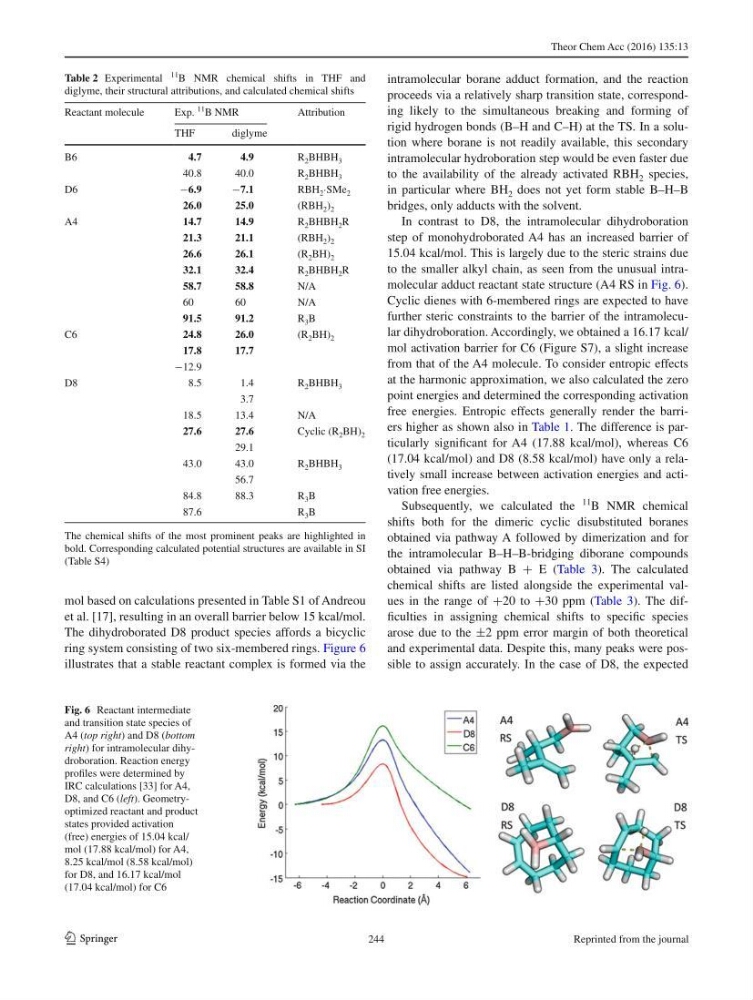
ring system consisting of two six-membered rings. Figure 6
illustrates that a stable reactant complex is formed via the
intramolecular borane adduct formation, and the reaction
proceeds via a relatively sharp transition state, corresponding likely to the simultaneous breaking and forming of
rigid hydrogen bonds (B–H and C–H) at the TS. In a solution where borane is not readily available, this secondary
intramolecular hydroboration step would be even faster due
to the availability of the already activated RBH 2 species,
in particular where BH 2 does not yet form stable B–H–B
bridges, only adducts with the solvent.
In contrast to D8, the intramolecular dihydroboration
step of monohydroborated A4 has an increased barrier of
15.04 kcal/mol. This is largely due to the steric strains due
to the smaller alkyl chain, as seen from the unusual intramolecular adduct reactant state structure (A4 RS in Fig. 6 ).
Cyclic dienes with 6-membered rings are expected to have
further steric constraints to the barrier of the intramolecular dihydroboration. Accordingly, we obtained a 16.17 kcal/
mol activation barrier for C6 (Figure S7), a slight increase
from that of the A4 molecule. To consider entropic effects
at the harmonic approximation, we also calculated the zero
point energies and determined the corresponding activation
free energies. Entropic effects generally render the barriers higher as shown also in Table 1 . The difference is particularly signifi cant for A4 (17.88 kcal/mol), whereas C6
(17.04 kcal/mol) and D8 (8.58 kcal/mol) have only a relatively small increase between activation energies and activation free energies.
Subsequently, we calculated the
11 B NMR chemical
shifts both for the dimeric cyclic disubstituted boranes
obtained via pathway A followed by dimerization and for
the intramolecular B–H–B-bridging diborane compounds
obtained via pathway B + E (Table 3 ). The calculated
chemical shifts are listed alongside the experimental values in the range of +20 to +30 ppm (Table 3 ). The diffi culties in assigning chemical shifts to specifi c species
arose due to the ±2 ppm error margin of both theoretical
and experimental data. Despite this, many peaks were possible to assign accurately. In the case of D8, the expected
Table 2 Experimental
11
B NMR chemical shifts in THF and
diglyme, their structural attributions, and calculated chemical shifts
The chemical shifts of the most prominent peaks are highlighted in
bold. Corresponding calculated potential structures are available in SI
(Table S4)
Reactant molecule
Exp.
11
B NMR
Attribution
THF
diglyme
B6
4.7
4.9
R 2 BHBH 3
40.8
40.0
R 2 BHBH 3
D6
− 6.9
− 7.1
RBH 2 ·SMe 2
26.0
25.0
(RBH 2 ) 2
A4
14.7
14.9
R 2 BHBH 2 R
21.3
21.1
(RBH 2 ) 2
26.6
26.1
(R 2 BH) 2
32.1
32.4
R 2 BHBH 2 R
58.7
58.8
N/A
60
60
N/A
91.5
91.2
R 3 B
C6
24.8
26.0
(R 2 BH) 2
17.8
17.7
−12.9
D8
8.5
1.4
R 2 BHBH 3
3.7
18.5
13.4
N/A
27.6
27.6
Cyclic (R 2 BH) 2
29.1
43.0
43.0
R 2 BHBH 3
56.7
84.8
88.3
R 3 B
87.6
R 3 B
Fig. 6 Reactant intermediate
and transition state species of
A4 ( top right ) and D8 ( bottom
right ) for intramolecular dihydroboration. Reaction energy
profi les were determined by
IRC calculations [ 33 ] for A4,
D8, and C6 ( left ). Geometryoptimized reactant and product
states provided activation
(free) energies of 15.04 kcal/
mol (17.88 kcal/mol) for A4,
8.25 kcal/mol (8.58 kcal/mol)
for D8, and 16.17 kcal/mol
(17.04 kcal/mol) for C6
244
Reprinted from the journal
1 3
mol based on calculations presented in Table S1 of Andreou
et al. [ 17 ], resulting in an overall barrier below 15 kcal/mol.
The dihydroborated D8 product species affords a bicyclic
ring system consisting of two six-membered rings. Figure 6
illustrates that a stable reactant complex is formed via the
intramolecular borane adduct formation, and the reaction
proceeds via a relatively sharp transition state, corresponding likely to the simultaneous breaking and forming of
rigid hydrogen bonds (B–H and C–H) at the TS. In a solution where borane is not readily available, this secondary
intramolecular hydroboration step would be even faster due
to the availability of the already activated RBH 2 species,
in particular where BH 2 does not yet form stable B–H–B
bridges, only adducts with the solvent.
In contrast to D8, the intramolecular dihydroboration
step of monohydroborated A4 has an increased barrier of
15.04 kcal/mol. This is largely due to the steric strains due
to the smaller alkyl chain, as seen from the unusual intramolecular adduct reactant state structure (A4 RS in Fig. 6 ).
Cyclic dienes with 6-membered rings are expected to have
further steric constraints to the barrier of the intramolecular dihydroboration. Accordingly, we obtained a 16.17 kcal/
mol activation barrier for C6 (Figure S7), a slight increase
from that of the A4 molecule. To consider entropic effects
at the harmonic approximation, we also calculated the zero
point energies and determined the corresponding activation
free energies. Entropic effects generally render the barriers higher as shown also in Table 1 . The difference is particularly signifi cant for A4 (17.88 kcal/mol), whereas C6
(17.04 kcal/mol) and D8 (8.58 kcal/mol) have only a relatively small increase between activation energies and activation free energies.
Subsequently, we calculated the
11 B NMR chemical
shifts both for the dimeric cyclic disubstituted boranes
obtained via pathway A followed by dimerization and for
the intramolecular B–H–B-bridging diborane compounds
obtained via pathway B + E (Table 3 ). The calculated
chemical shifts are listed alongside the experimental values in the range of +20 to +30 ppm (Table 3 ). The diffi culties in assigning chemical shifts to specifi c species
arose due to the ±2 ppm error margin of both theoretical
and experimental data. Despite this, many peaks were possible to assign accurately. In the case of D8, the expected
Table 2 Experimental
11
B NMR chemical shifts in THF and
diglyme, their structural attributions, and calculated chemical shifts
The chemical shifts of the most prominent peaks are highlighted in
bold. Corresponding calculated potential structures are available in SI
(Table S4)
Reactant molecule
Exp.
11
B NMR
Attribution
THF
diglyme
B6
4.7
4.9
R 2 BHBH 3
40.8
40.0
R 2 BHBH 3
D6
− 6.9
− 7.1
RBH 2 ·SMe 2
26.0
25.0
(RBH 2 ) 2
A4
14.7
14.9
R 2 BHBH 2 R
21.3
21.1
(RBH 2 ) 2
26.6
26.1
(R 2 BH) 2
32.1
32.4
R 2 BHBH 2 R
58.7
58.8
N/A
60
60
N/A
91.5
91.2
R 3 B
C6
24.8
26.0
(R 2 BH) 2
17.8
17.7
−12.9
D8
8.5
1.4
R 2 BHBH 3
3.7
18.5
13.4
N/A
27.6
27.6
Cyclic (R 2 BH) 2
29.1
43.0
43.0
R 2 BHBH 3
56.7
84.8
88.3
R 3 B
87.6
R 3 B
Fig. 6 Reactant intermediate
and transition state species of
A4 ( top right ) and D8 ( bottom
right ) for intramolecular dihydroboration. Reaction energy
profi les were determined by
IRC calculations [ 33 ] for A4,
D8, and C6 ( left ). Geometryoptimized reactant and product
states provided activation
(free) energies of 15.04 kcal/
mol (17.88 kcal/mol) for A4,
8.25 kcal/mol (8.58 kcal/mol)
for D8, and 16.17 kcal/mol
(17.04 kcal/mol) for C6
244
Reprinted from the journal