

Theor Chem Acc (2016) 135:13
1 3
The competing reaction pathways during hydroboration
have very different rates depending on the chemical structure of the diene, thus resulting in entirely different outcomes. Previous work by Brown and Bhat [ 18 ] suggested
that monohydroboration was prevalent in six-membered
rings, which were thought to be relatively inert to dihydroboration. Our recent work has shown that with suffi cient
excess borane using either B 2 H 6 or BH 3 ·SMe 2 , all cyclic
dienes undergo complete hydroboration of all double bonds
[ 17 ].
As evident, a large number of
11 B NMR peaks in Table 2
for the fi rst hydroboration products can be attributed to the
formation of intermolecular B–H–B-bridged compounds,
such as R 2 BHBH 3 . Interestingly, however, in the characterization of the direct products of diene hydroboration, the
possibility of intermolecular hydroboration via RBH 2 species and the role of pathway C are often omitted in theoretical calculations. In Table 1 , we also focused on the reactions with BH 3 as the hydroboration agent; however, we
note that to quantitatively account for the selectivity, subsequent reactions also need to be taken into account where
RBH 2 species serve as hydroboration agents. Toward this
aim, here we investigate a second, intramolecular dihydroboration step of pathway A, leading to bridged bicyclic
rings.
Pathway A with intramolecular hydroboration is favored
for dienes where the double bonds are farther apart, hence
the rapid dihydroboration of the 1,5-cyclooctadiene [ 19 ].
On the other hand, molecules such as 1,3-cyclooctadiene
and 1,3-cycloheptadiene were seen to polymerize following pathway B or C, and only the 1,5-cyclooctadiene was
observed to yield clear solution. Therefore, with six-membered or larger rings, the intramolecular hydroboration will
occur dominantly when the double bonds are not in proximity to each another [ 18 ]; otherwise, steric constraints
take precedence and the cyclic product does not rapidly
form. With smaller rings, the energy barrier to form cyclic
products is higher, and pathways A and B can be in competition with one another.
To better understand the structures and energetics of
the mechanism for reaction pathway A, we performed initial reaction coordinate scanning using the B–C bond distance as the reaction coordinate with ORCA and calculated
the energy profi les for A4 and D8 molecules (Figure S7,
top). Subsequently, we optimized the TS geometries using
Gaussian 09 (Fig. 6 , and Figure S7, bottom). To ensure that
the correct saddle point was identifi ed, we calculated the
minimum energy reaction pathway using the intrinsic reaction coordinate (IRC) [ 33 ] with Gaussian 09 (Fig. 6 , left).
The calculated energy barrier starting with the monohydroborated D8 1,5-cyclooctadiene was 8.25 kcal/mol,
which is easily overcome in room temperature, and therefore, a rapid reaction is expected. Note, however, that to
determine the actual activation energies, the relative energy
of the reactant states also needs to be accounted for, as
B-H-B bridges are generally more stable than the interacting intramolecular π-bond–borane adduct [ 17 ]. We have
not calculated this here, but estimate it to be below 7 kcal/
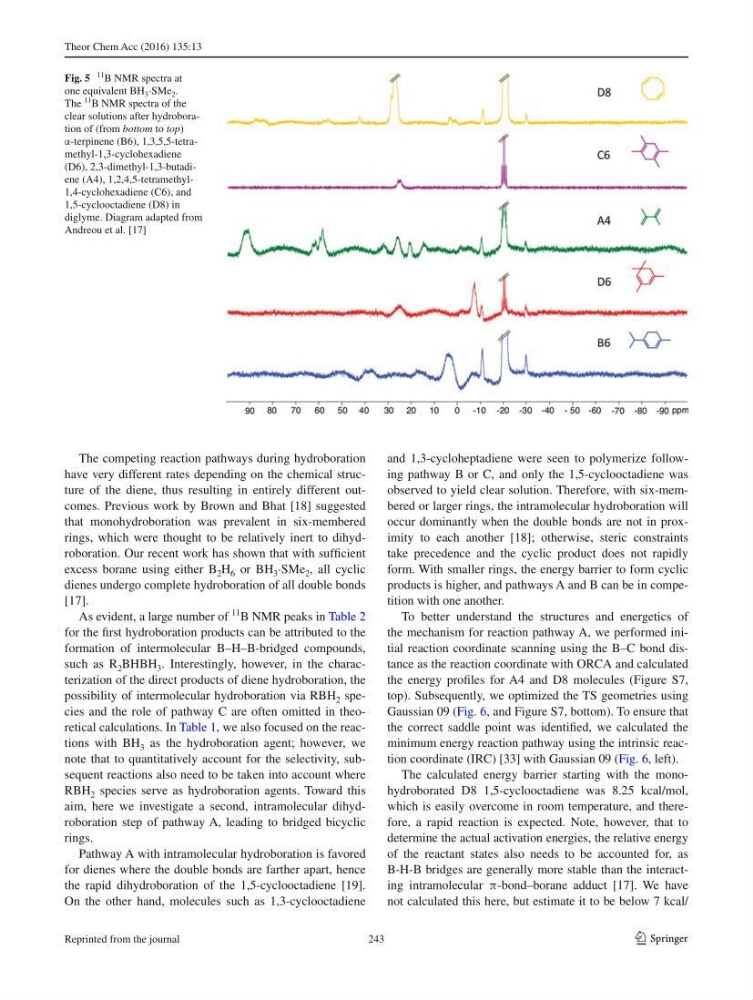
Fig. 5
11 B NMR spectra at
one equivalent BH 3 · SMe 2 .
The
11 B NMR spectra of the
clear solutions after hydroboration of (from bottom to top )
α-terpinene (B6), 1,3,5,5-tetramethyl-1,3-cyclohexadiene
(D6), 2,3-dimethyl-1,3-butadiene (A4), 1,2,4,5-tetramethyl1,4-cyclohexadiene (C6), and
1,5-cyclooctadiene (D8) in
diglyme. Diagram adapted from
Andreou et al. [ 17 ]
243
Reprinted from the journal
1 3
The competing reaction pathways during hydroboration
have very different rates depending on the chemical structure of the diene, thus resulting in entirely different outcomes. Previous work by Brown and Bhat [ 18 ] suggested
that monohydroboration was prevalent in six-membered
rings, which were thought to be relatively inert to dihydroboration. Our recent work has shown that with suffi cient
excess borane using either B 2 H 6 or BH 3 ·SMe 2 , all cyclic
dienes undergo complete hydroboration of all double bonds
[ 17 ].
As evident, a large number of
11 B NMR peaks in Table 2
for the fi rst hydroboration products can be attributed to the
formation of intermolecular B–H–B-bridged compounds,
such as R 2 BHBH 3 . Interestingly, however, in the characterization of the direct products of diene hydroboration, the
possibility of intermolecular hydroboration via RBH 2 species and the role of pathway C are often omitted in theoretical calculations. In Table 1 , we also focused on the reactions with BH 3 as the hydroboration agent; however, we
note that to quantitatively account for the selectivity, subsequent reactions also need to be taken into account where
RBH 2 species serve as hydroboration agents. Toward this
aim, here we investigate a second, intramolecular dihydroboration step of pathway A, leading to bridged bicyclic
rings.
Pathway A with intramolecular hydroboration is favored
for dienes where the double bonds are farther apart, hence
the rapid dihydroboration of the 1,5-cyclooctadiene [ 19 ].
On the other hand, molecules such as 1,3-cyclooctadiene
and 1,3-cycloheptadiene were seen to polymerize following pathway B or C, and only the 1,5-cyclooctadiene was
observed to yield clear solution. Therefore, with six-membered or larger rings, the intramolecular hydroboration will
occur dominantly when the double bonds are not in proximity to each another [ 18 ]; otherwise, steric constraints
take precedence and the cyclic product does not rapidly
form. With smaller rings, the energy barrier to form cyclic
products is higher, and pathways A and B can be in competition with one another.
To better understand the structures and energetics of
the mechanism for reaction pathway A, we performed initial reaction coordinate scanning using the B–C bond distance as the reaction coordinate with ORCA and calculated
the energy profi les for A4 and D8 molecules (Figure S7,
top). Subsequently, we optimized the TS geometries using
Gaussian 09 (Fig. 6 , and Figure S7, bottom). To ensure that
the correct saddle point was identifi ed, we calculated the
minimum energy reaction pathway using the intrinsic reaction coordinate (IRC) [ 33 ] with Gaussian 09 (Fig. 6 , left).
The calculated energy barrier starting with the monohydroborated D8 1,5-cyclooctadiene was 8.25 kcal/mol,
which is easily overcome in room temperature, and therefore, a rapid reaction is expected. Note, however, that to
determine the actual activation energies, the relative energy
of the reactant states also needs to be accounted for, as
B-H-B bridges are generally more stable than the interacting intramolecular π-bond–borane adduct [ 17 ]. We have
not calculated this here, but estimate it to be below 7 kcal/
Fig. 5
11 B NMR spectra at
one equivalent BH 3 · SMe 2 .
The
11 B NMR spectra of the
clear solutions after hydroboration of (from bottom to top )
α-terpinene (B6), 1,3,5,5-tetramethyl-1,3-cyclohexadiene
(D6), 2,3-dimethyl-1,3-butadiene (A4), 1,2,4,5-tetramethyl1,4-cyclohexadiene (C6), and
1,5-cyclooctadiene (D8) in
diglyme. Diagram adapted from
Andreou et al. [ 17 ]
243
Reprinted from the journal