

Theor Chem Acc (2016) 135:13
1 3
cyclic products are formed at the calculated +26.7 ppm,
and the diborane species are not observed. On the other
hand, A4 appears to have both kinds of molecules. The
diborane species at +19.5 ppm matches the experimental
value of +21.3 ppm well. The assignment of the cyclic
products at the calculated +28.7 ppm, however, is less certain considering other potential species that might account
for the observed peak at +26.6 ppm. In general, the chemical shifts of the diborane and cyclic dimer species are very
similar for B6, C6, and D6, and their assignment cannot be
done without ambiguity. Interestingly, all molecules exhibit
strong peaks at the +20 to +30 ppm region and likely contain at least one of the species considered in Table 3 , except
for B6. The NMR spectrum of B6 is signifi cantly different
from all other species, and the predicted R 2 BH species in
the R 2 BHBH 3 remains elusive.
Experimentally, monosubstituted and unbridged disubstituted products are commonly accepted, and the formation of cyclic disubstituted products is thought to be more
limited to larger cyclic dienes or longer alkyl chains [ 18 ].
The explanation underpinning this can be partly due to the
strained geometries of the cyclic transition states, such as
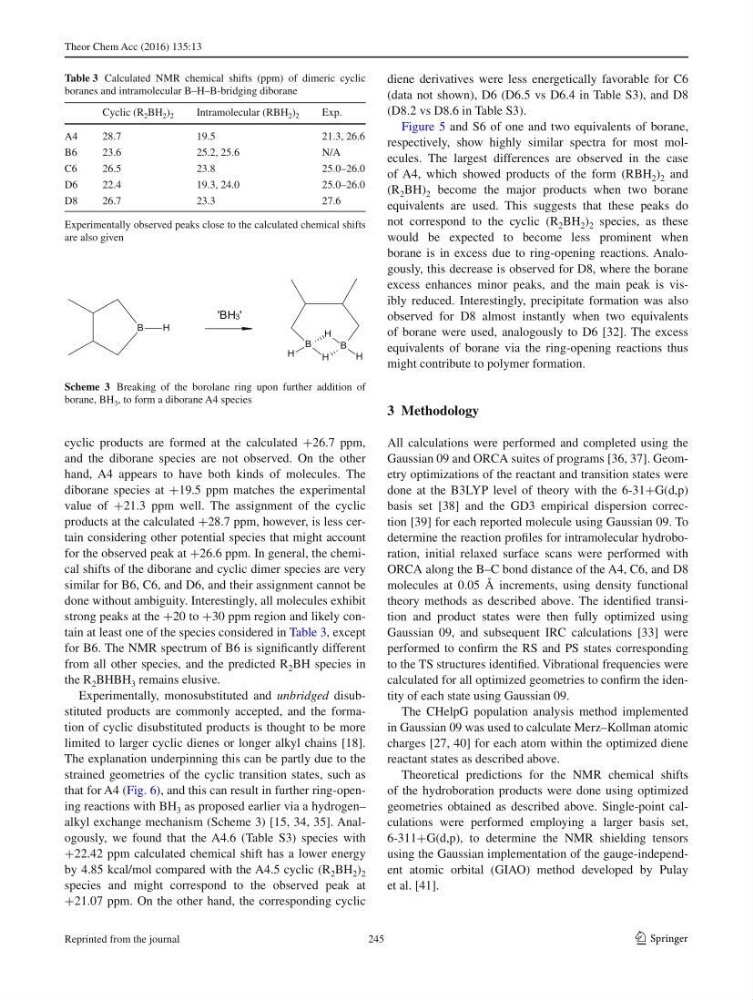
that for A4 (Fig. 6 ), and this can result in further ring-opening reactions with BH 3 as proposed earlier via a hydrogen–
alkyl exchange mechanism (Scheme 3 ) [ 15 , 34 , 35 ]. Analogously, we found that the A4.6 (Table S3) species with
+22.42 ppm calculated chemical shift has a lower energy
by 4.85 kcal/mol compared with the A4.5 cyclic (R 2 BH 2 ) 2
species and might correspond to the observed peak at
+21.07 ppm. On the other hand, the corresponding cyclic
diene derivatives were less energetically favorable for C6
(data not shown), D6 (D6.5 vs D6.4 in Table S3), and D8
(D8.2 vs D8.6 in Table S3).
Figure 5 and S6 of one and two equivalents of borane,
respectively, show highly similar spectra for most molecules. The largest differences are observed in the case
of A4, which showed products of the form (RBH 2 ) 2 and
(R 2 BH) 2 become the major products when two borane
equivalents are used. This suggests that these peaks do
not correspond to the cyclic (R 2 BH 2 ) 2 species, as these
would be expected to become less prominent when
borane is in excess due to ring-opening reactions. Analogously, this decrease is observed for D8, where the borane
excess enhances minor peaks, and the main peak is visibly reduced. Interestingly, precipitate formation was also
observed for D8 almost instantly when two equivalents
of borane were used, analogously to D6 [ 32 ]. The excess
equivalents of borane via the ring-opening reactions thus
might contribute to polymer formation.
3 Methodology
All calculations were performed and completed using the
Gaussian 09 and ORCA suites of programs [ 36 , 37 ]. Geometry optimizations of the reactant and transition states were
done at the B3LYP level of theory with the 6-31+G(d,p)
basis set [ 38 ] and the GD3 empirical dispersion correction [ 39 ] for each reported molecule using Gaussian 09. To
determine the reaction profi les for intramolecular hydroboration, initial relaxed surface scans were performed with
ORCA along the B–C bond distance of the A4, C6, and D8
molecules at 0.05 Å increments, using density functional
theory methods as described above. The identifi ed transition and product states were then fully optimized using
Gaussian 09, and subsequent IRC calculations [ 33 ] were
performed to confi rm the RS and PS states corresponding
to the TS structures identifi ed. Vibrational frequencies were
calculated for all optimized geometries to confi rm the identity of each state using Gaussian 09.
The CHelpG population analysis method implemented
in Gaussian 09 was used to calculate Merz–Kollman atomic
charges [ 27 , 40 ] for each atom within the optimized diene
reactant states as described above.
Theoretical predictions for the NMR chemical shifts
of the hydroboration products were done using optimized
geometries obtained as described above. Single-point calculations were performed employing a larger basis set,
6-311+G(d,p), to determine the NMR shielding tensors
using the Gaussian implementation of the gauge-independent atomic orbital (GIAO) method developed by Pulay
et al. [ 41 ].
Table 3 Calculated NMR chemical shifts (ppm) of dimeric cyclic
boranes and intramolecular B–H–B-bridging diborane
Experimentally observed peaks close to the calculated chemical shifts
are also given
Cyclic (R 2 BH 2 ) 2
Intramolecular (RBH 2 ) 2
Exp.
A4
28.7
19.5
21.3, 26.6
B6
23.6
25.2, 25.6
N/A
C6
26.5
23.8
25.0–26.0
D6
22.4
19.3, 24.0
25.0–26.0
D8
26.7
23.3
27.6
'BH3'
Scheme 3 Breaking of the borolane ring upon further addition of
borane, BH 3 , to form a diborane A4 species
245
Reprinted from the journal
1 3
cyclic products are formed at the calculated +26.7 ppm,
and the diborane species are not observed. On the other
hand, A4 appears to have both kinds of molecules. The
diborane species at +19.5 ppm matches the experimental
value of +21.3 ppm well. The assignment of the cyclic
products at the calculated +28.7 ppm, however, is less certain considering other potential species that might account
for the observed peak at +26.6 ppm. In general, the chemical shifts of the diborane and cyclic dimer species are very
similar for B6, C6, and D6, and their assignment cannot be
done without ambiguity. Interestingly, all molecules exhibit
strong peaks at the +20 to +30 ppm region and likely contain at least one of the species considered in Table 3 , except
for B6. The NMR spectrum of B6 is signifi cantly different
from all other species, and the predicted R 2 BH species in
the R 2 BHBH 3 remains elusive.
Experimentally, monosubstituted and unbridged disubstituted products are commonly accepted, and the formation of cyclic disubstituted products is thought to be more
limited to larger cyclic dienes or longer alkyl chains [ 18 ].
The explanation underpinning this can be partly due to the
strained geometries of the cyclic transition states, such as
that for A4 (Fig. 6 ), and this can result in further ring-opening reactions with BH 3 as proposed earlier via a hydrogen–
alkyl exchange mechanism (Scheme 3 ) [ 15 , 34 , 35 ]. Analogously, we found that the A4.6 (Table S3) species with
+22.42 ppm calculated chemical shift has a lower energy
by 4.85 kcal/mol compared with the A4.5 cyclic (R 2 BH 2 ) 2
species and might correspond to the observed peak at
+21.07 ppm. On the other hand, the corresponding cyclic
diene derivatives were less energetically favorable for C6
(data not shown), D6 (D6.5 vs D6.4 in Table S3), and D8
(D8.2 vs D8.6 in Table S3).
Figure 5 and S6 of one and two equivalents of borane,
respectively, show highly similar spectra for most molecules. The largest differences are observed in the case
of A4, which showed products of the form (RBH 2 ) 2 and
(R 2 BH) 2 become the major products when two borane
equivalents are used. This suggests that these peaks do
not correspond to the cyclic (R 2 BH 2 ) 2 species, as these
would be expected to become less prominent when
borane is in excess due to ring-opening reactions. Analogously, this decrease is observed for D8, where the borane
excess enhances minor peaks, and the main peak is visibly reduced. Interestingly, precipitate formation was also
observed for D8 almost instantly when two equivalents
of borane were used, analogously to D6 [ 32 ]. The excess
equivalents of borane via the ring-opening reactions thus
might contribute to polymer formation.
3 Methodology
All calculations were performed and completed using the
Gaussian 09 and ORCA suites of programs [ 36 , 37 ]. Geometry optimizations of the reactant and transition states were
done at the B3LYP level of theory with the 6-31+G(d,p)
basis set [ 38 ] and the GD3 empirical dispersion correction [ 39 ] for each reported molecule using Gaussian 09. To
determine the reaction profi les for intramolecular hydroboration, initial relaxed surface scans were performed with
ORCA along the B–C bond distance of the A4, C6, and D8
molecules at 0.05 Å increments, using density functional
theory methods as described above. The identifi ed transition and product states were then fully optimized using
Gaussian 09, and subsequent IRC calculations [ 33 ] were
performed to confi rm the RS and PS states corresponding
to the TS structures identifi ed. Vibrational frequencies were
calculated for all optimized geometries to confi rm the identity of each state using Gaussian 09.
The CHelpG population analysis method implemented
in Gaussian 09 was used to calculate Merz–Kollman atomic
charges [ 27 , 40 ] for each atom within the optimized diene
reactant states as described above.
Theoretical predictions for the NMR chemical shifts
of the hydroboration products were done using optimized
geometries obtained as described above. Single-point calculations were performed employing a larger basis set,
6-311+G(d,p), to determine the NMR shielding tensors
using the Gaussian implementation of the gauge-independent atomic orbital (GIAO) method developed by Pulay
et al. [ 41 ].
Table 3 Calculated NMR chemical shifts (ppm) of dimeric cyclic
boranes and intramolecular B–H–B-bridging diborane
Experimentally observed peaks close to the calculated chemical shifts
are also given
Cyclic (R 2 BH 2 ) 2
Intramolecular (RBH 2 ) 2
Exp.
A4
28.7
19.5
21.3, 26.6
B6
23.6
25.2, 25.6
N/A
C6
26.5
23.8
25.0–26.0
D6
22.4
19.3, 24.0
25.0–26.0
D8
26.7
23.3
27.6
'BH3'
Scheme 3 Breaking of the borolane ring upon further addition of
borane, BH 3 , to form a diborane A4 species
245
Reprinted from the journal