

Theor Chem Acc (2016) 135:13
1 3
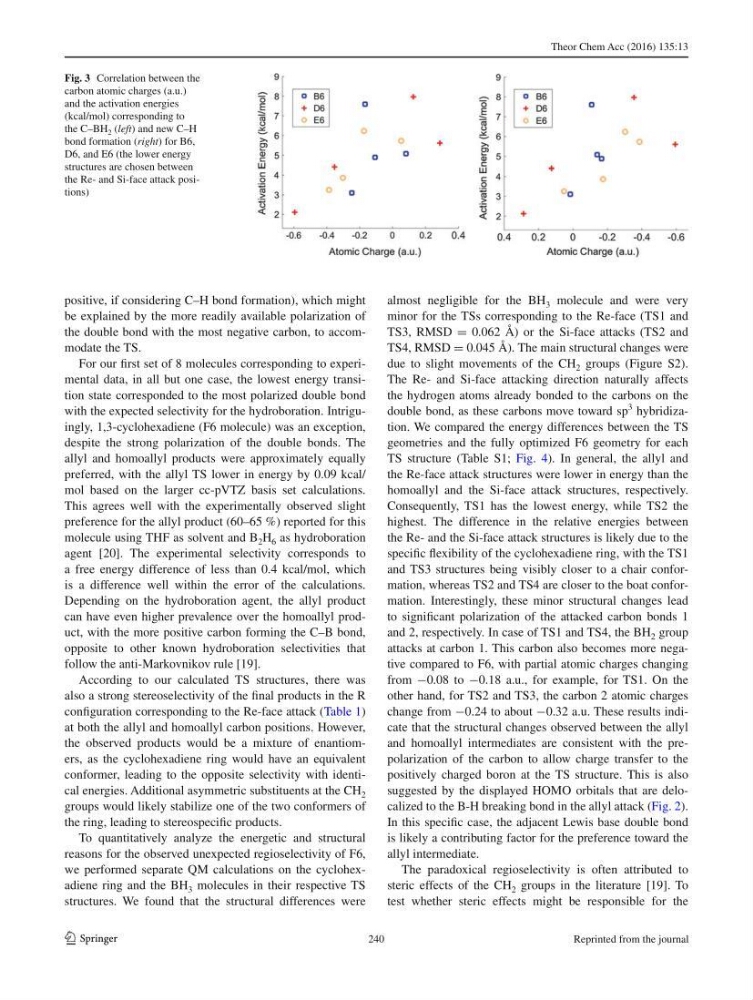
positive, if considering C–H bond formation), which might
be explained by the more readily available polarization of
the double bond with the most negative carbon, to accommodate the TS.
For our fi rst set of 8 molecules corresponding to experimental data, in all but one case, the lowest energy transition state corresponded to the most polarized double bond
with the expected selectivity for the hydroboration. Intriguingly, 1,3-cyclohexadiene (F6 molecule) was an exception,
despite the strong polarization of the double bonds. The
allyl and homoallyl products were approximately equally
preferred, with the allyl TS lower in energy by 0.09 kcal/
mol based on the larger cc-pVTZ basis set calculations.
This agrees well with the experimentally observed slight
preference for the allyl product (60–65 %) reported for this
molecule using THF as solvent and B 2 H 6 as hydroboration
agent [ 20 ]. The experimental selectivity corresponds to
a free energy difference of less than 0.4 kcal/mol, which
is a difference well within the error of the calculations.
Depending on the hydroboration agent, the allyl product
can have even higher prevalence over the homoallyl product, with the more positive carbon forming the C–B bond,
opposite to other known hydroboration selectivities that
follow the anti-Markovnikov rule [ 19 ].
According to our calculated TS structures, there was
also a strong stereoselectivity of the fi nal products in the R
confi guration corresponding to the Re-face attack (Table 1 )
at both the allyl and homoallyl carbon positions. However,
the observed products would be a mixture of enantiomers, as the cyclohexadiene ring would have an equivalent
conformer, leading to the opposite selectivity with identical energies. Additional asymmetric substituents at the CH 2
groups would likely stabilize one of the two conformers of
the ring, leading to stereospecifi c products.
To quantitatively analyze the energetic and structural
reasons for the observed unexpected regioselectivity of F6,
we performed separate QM calculations on the cyclohexadiene ring and the BH 3 molecules in their respective TS
structures. We found that the structural differences were
almost negligible for the BH 3 molecule and were very
minor for the TSs corresponding to the Re-face (TS1 and
TS3, RMSD = 0.062 Å) or the Si-face attacks (TS2 and
TS4, RMSD = 0.045 Å). The main structural changes were
due to slight movements of the CH 2 groups (Figure S2).
The Re- and Si-face attacking direction naturally affects
the hydrogen atoms already bonded to the carbons on the
double bond, as these carbons move toward sp
3 hybridization. We compared the energy differences between the TS
geometries and the fully optimized F6 geometry for each
TS structure (Table S1; Fig. 4 ). In general, the allyl and
the Re-face attack structures were lower in energy than the
homoallyl and the Si-face attack structures, respectively.
Consequently, TS1 has the lowest energy, while TS2 the
highest. The difference in the relative energies between
the Re- and the Si-face attack structures is likely due to the
specifi c fl exibility of the cyclohexadiene ring, with the TS1
and TS3 structures being visibly closer to a chair conformation, whereas TS2 and TS4 are closer to the boat conformation. Interestingly, these minor structural changes lead
to signifi cant polarization of the attacked carbon bonds 1
and 2, respectively. In case of TS1 and TS4, the BH 2 group
attacks at carbon 1. This carbon also becomes more negative compared to F6, with partial atomic charges changing
from −0.08 to −0.18 a.u., for example, for TS1. On the
other hand, for TS2 and TS3, the carbon 2 atomic charges
change from −0.24 to about −0.32 a.u. These results indicate that the structural changes observed between the allyl
and homoallyl intermediates are consistent with the prepolarization of the carbon to allow charge transfer to the
positively charged boron at the TS structure. This is also
suggested by the displayed HOMO orbitals that are delocalized to the B-H breaking bond in the allyl attack (Fig. 2 ).
In this specifi c case, the adjacent Lewis base double bond
is likely a contributing factor for the preference toward the
allyl intermediate.
The paradoxical regioselectivity is often attributed to
steric effects of the CH 2 groups in the literature [ 19 ]. To
test whether steric effects might be responsible for the
Fig. 3 Correlation between the
carbon atomic charges (a.u.)
and the activation energies
(kcal/mol) corresponding to
the C–BH 2 ( left ) and new C–H
bond formation ( right ) for B6,
D6, and E6 (the lower energy
structures are chosen between
the Re- and Si-face attack positions)
240
Reprinted from the journal
1 3
positive, if considering C–H bond formation), which might
be explained by the more readily available polarization of
the double bond with the most negative carbon, to accommodate the TS.
For our fi rst set of 8 molecules corresponding to experimental data, in all but one case, the lowest energy transition state corresponded to the most polarized double bond
with the expected selectivity for the hydroboration. Intriguingly, 1,3-cyclohexadiene (F6 molecule) was an exception,
despite the strong polarization of the double bonds. The
allyl and homoallyl products were approximately equally
preferred, with the allyl TS lower in energy by 0.09 kcal/
mol based on the larger cc-pVTZ basis set calculations.
This agrees well with the experimentally observed slight
preference for the allyl product (60–65 %) reported for this
molecule using THF as solvent and B 2 H 6 as hydroboration
agent [ 20 ]. The experimental selectivity corresponds to
a free energy difference of less than 0.4 kcal/mol, which
is a difference well within the error of the calculations.
Depending on the hydroboration agent, the allyl product
can have even higher prevalence over the homoallyl product, with the more positive carbon forming the C–B bond,
opposite to other known hydroboration selectivities that
follow the anti-Markovnikov rule [ 19 ].
According to our calculated TS structures, there was
also a strong stereoselectivity of the fi nal products in the R
confi guration corresponding to the Re-face attack (Table 1 )
at both the allyl and homoallyl carbon positions. However,
the observed products would be a mixture of enantiomers, as the cyclohexadiene ring would have an equivalent
conformer, leading to the opposite selectivity with identical energies. Additional asymmetric substituents at the CH 2
groups would likely stabilize one of the two conformers of
the ring, leading to stereospecifi c products.
To quantitatively analyze the energetic and structural
reasons for the observed unexpected regioselectivity of F6,
we performed separate QM calculations on the cyclohexadiene ring and the BH 3 molecules in their respective TS
structures. We found that the structural differences were
almost negligible for the BH 3 molecule and were very
minor for the TSs corresponding to the Re-face (TS1 and
TS3, RMSD = 0.062 Å) or the Si-face attacks (TS2 and
TS4, RMSD = 0.045 Å). The main structural changes were
due to slight movements of the CH 2 groups (Figure S2).
The Re- and Si-face attacking direction naturally affects
the hydrogen atoms already bonded to the carbons on the
double bond, as these carbons move toward sp
3 hybridization. We compared the energy differences between the TS
geometries and the fully optimized F6 geometry for each
TS structure (Table S1; Fig. 4 ). In general, the allyl and
the Re-face attack structures were lower in energy than the
homoallyl and the Si-face attack structures, respectively.
Consequently, TS1 has the lowest energy, while TS2 the
highest. The difference in the relative energies between
the Re- and the Si-face attack structures is likely due to the
specifi c fl exibility of the cyclohexadiene ring, with the TS1
and TS3 structures being visibly closer to a chair conformation, whereas TS2 and TS4 are closer to the boat conformation. Interestingly, these minor structural changes lead
to signifi cant polarization of the attacked carbon bonds 1
and 2, respectively. In case of TS1 and TS4, the BH 2 group
attacks at carbon 1. This carbon also becomes more negative compared to F6, with partial atomic charges changing
from −0.08 to −0.18 a.u., for example, for TS1. On the
other hand, for TS2 and TS3, the carbon 2 atomic charges
change from −0.24 to about −0.32 a.u. These results indicate that the structural changes observed between the allyl
and homoallyl intermediates are consistent with the prepolarization of the carbon to allow charge transfer to the
positively charged boron at the TS structure. This is also
suggested by the displayed HOMO orbitals that are delocalized to the B-H breaking bond in the allyl attack (Fig. 2 ).
In this specifi c case, the adjacent Lewis base double bond
is likely a contributing factor for the preference toward the
allyl intermediate.
The paradoxical regioselectivity is often attributed to
steric effects of the CH 2 groups in the literature [ 19 ]. To
test whether steric effects might be responsible for the
Fig. 3 Correlation between the
carbon atomic charges (a.u.)
and the activation energies
(kcal/mol) corresponding to
the C–BH 2 ( left ) and new C–H
bond formation ( right ) for B6,
D6, and E6 (the lower energy
structures are chosen between
the Re- and Si-face attack positions)
240
Reprinted from the journal