

Theor Chem Acc (2016) 135:13
1 3
observed energy differences, we analyzed the TS structures
with respect to the closest CH 2 –BH 3 distances (Figure S3).
For TS2 and TS4, these distances are as short as 2.30 Å.
However, there are no signifi cant steric effects between
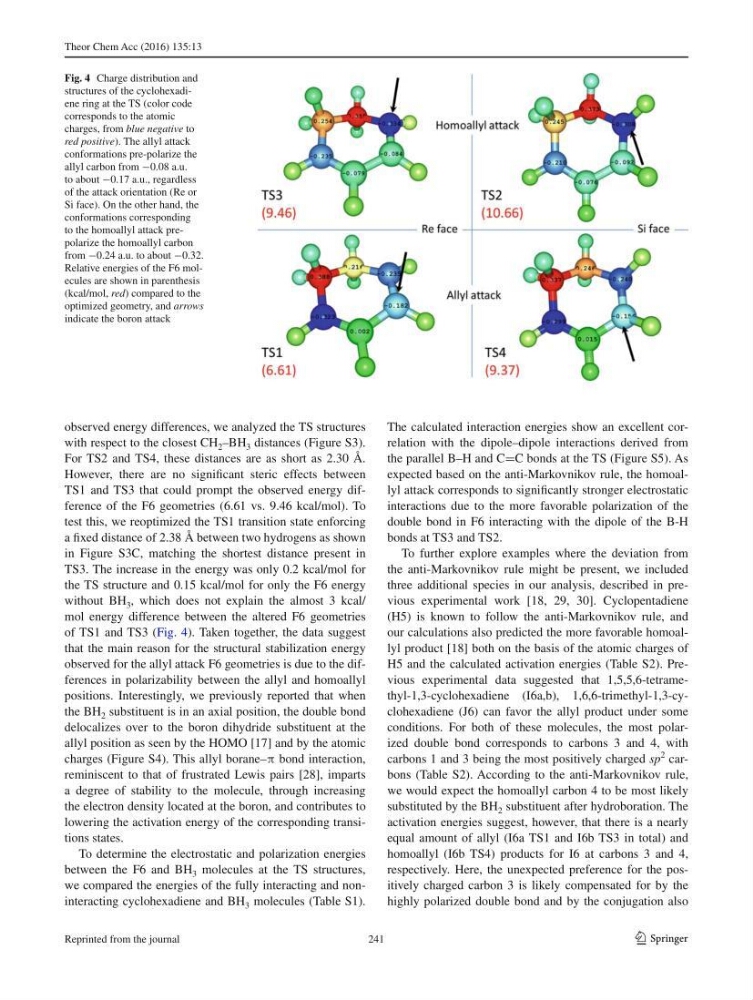
TS1 and TS3 that could prompt the observed energy difference of the F6 geometries (6.61 vs. 9.46 kcal/mol). To
test this, we reoptimized the TS1 transition state enforcing
a fi xed distance of 2.38 Å between two hydrogens as shown
in Figure S3C, matching the shortest distance present in
TS3. The increase in the energy was only 0.2 kcal/mol for
the TS structure and 0.15 kcal/mol for only the F6 energy
without BH 3 , which does not explain the almost 3 kcal/
mol energy difference between the altered F6 geometries
of TS1 and TS3 (Fig. 4 ). Taken together, the data suggest
that the main reason for the structural stabilization energy
observed for the allyl attack F6 geometries is due to the differences in polarizability between the allyl and homoallyl
positions. Interestingly, we previously reported that when
the BH 2 substituent is in an axial position, the double bond
delocalizes over to the boron dihydride substituent at the
allyl position as seen by the HOMO [ 17 ] and by the atomic
charges (Figure S4). This allyl borane–π bond interaction,
reminiscent to that of frustrated Lewis pairs [ 28 ], imparts
a degree of stability to the molecule, through increasing
the electron density located at the boron, and contributes to
lowering the activation energy of the corresponding transitions states.
To determine the electrostatic and polarization energies
between the F6 and BH 3 molecules at the TS structures,
we compared the energies of the fully interacting and noninteracting cyclohexadiene and BH 3 molecules (Table S1).
The calculated interaction energies show an excellent correlation with the dipole–dipole interactions derived from
the parallel B–H and C=C bonds at the TS (Figure S5). As
expected based on the anti-Markovnikov rule, the homoallyl attack corresponds to signifi cantly stronger electrostatic
interactions due to the more favorable polarization of the
double bond in F6 interacting with the dipole of the B-H
bonds at TS3 and TS2.
To further explore examples where the deviation from
the anti-Markovnikov rule might be present, we included
three additional species in our analysis, described in previous experimental work [ 18 , 29 , 30 ]. Cyclopentadiene
(H5) is known to follow the anti-Markovnikov rule, and
our calculations also predicted the more favorable homoallyl product [ 18 ] both on the basis of the atomic charges of
H5 and the calculated activation energies (Table S2). Previous experimental data suggested that 1,5,5,6-tetramethyl-1,3-cyclohexadiene (I6a,b), 1,6,6-trimethyl-1,3-cyclohexadiene (J6) can favor the allyl product under some
conditions. For both of these molecules, the most polarized double bond corresponds to carbons 3 and 4, with
carbons 1 and 3 being the most positively charged sp
2 carbons (Table S2). According to the anti-Markovnikov rule,
we would expect the homoallyl carbon 4 to be most likely
substituted by the BH 2 substituent after hydroboration. The
activation energies suggest, however, that there is a nearly
equal amount of allyl (I6a TS1 and I6b TS3 in total) and
homoallyl (I6b TS4) products for I6 at carbons 3 and 4,
respectively. Here, the unexpected preference for the positively charged carbon 3 is likely compensated for by the
highly polarized double bond and by the conjugation also
Fig. 4 Charge distribution and
structures of the cyclohexadiene ring at the TS (color code
corresponds to the atomic
charges, from blue negative to
red positive ). The allyl attack
conformations pre-polarize the
allyl carbon from −0.08 a.u.
to about −0.17 a.u., regardless
of the attack orientation (Re or
Si face). On the other hand, the
conformations corresponding
to the homoallyl attack prepolarize the homoallyl carbon
from −0.24 a.u. to about −0.32.
Relative energies of the F6 molecules are shown in parenthesis
(kcal/mol, red ) compared to the
optimized geometry, and arrows
indicate the boron attack
241
Reprinted from the journal
1 3
observed energy differences, we analyzed the TS structures
with respect to the closest CH 2 –BH 3 distances (Figure S3).
For TS2 and TS4, these distances are as short as 2.30 Å.
However, there are no signifi cant steric effects between
TS1 and TS3 that could prompt the observed energy difference of the F6 geometries (6.61 vs. 9.46 kcal/mol). To
test this, we reoptimized the TS1 transition state enforcing
a fi xed distance of 2.38 Å between two hydrogens as shown
in Figure S3C, matching the shortest distance present in
TS3. The increase in the energy was only 0.2 kcal/mol for
the TS structure and 0.15 kcal/mol for only the F6 energy
without BH 3 , which does not explain the almost 3 kcal/
mol energy difference between the altered F6 geometries
of TS1 and TS3 (Fig. 4 ). Taken together, the data suggest
that the main reason for the structural stabilization energy
observed for the allyl attack F6 geometries is due to the differences in polarizability between the allyl and homoallyl
positions. Interestingly, we previously reported that when
the BH 2 substituent is in an axial position, the double bond
delocalizes over to the boron dihydride substituent at the
allyl position as seen by the HOMO [ 17 ] and by the atomic
charges (Figure S4). This allyl borane–π bond interaction,
reminiscent to that of frustrated Lewis pairs [ 28 ], imparts
a degree of stability to the molecule, through increasing
the electron density located at the boron, and contributes to
lowering the activation energy of the corresponding transitions states.
To determine the electrostatic and polarization energies
between the F6 and BH 3 molecules at the TS structures,
we compared the energies of the fully interacting and noninteracting cyclohexadiene and BH 3 molecules (Table S1).
The calculated interaction energies show an excellent correlation with the dipole–dipole interactions derived from
the parallel B–H and C=C bonds at the TS (Figure S5). As
expected based on the anti-Markovnikov rule, the homoallyl attack corresponds to signifi cantly stronger electrostatic
interactions due to the more favorable polarization of the
double bond in F6 interacting with the dipole of the B-H
bonds at TS3 and TS2.
To further explore examples where the deviation from
the anti-Markovnikov rule might be present, we included
three additional species in our analysis, described in previous experimental work [ 18 , 29 , 30 ]. Cyclopentadiene
(H5) is known to follow the anti-Markovnikov rule, and
our calculations also predicted the more favorable homoallyl product [ 18 ] both on the basis of the atomic charges of
H5 and the calculated activation energies (Table S2). Previous experimental data suggested that 1,5,5,6-tetramethyl-1,3-cyclohexadiene (I6a,b), 1,6,6-trimethyl-1,3-cyclohexadiene (J6) can favor the allyl product under some
conditions. For both of these molecules, the most polarized double bond corresponds to carbons 3 and 4, with
carbons 1 and 3 being the most positively charged sp
2 carbons (Table S2). According to the anti-Markovnikov rule,
we would expect the homoallyl carbon 4 to be most likely
substituted by the BH 2 substituent after hydroboration. The
activation energies suggest, however, that there is a nearly
equal amount of allyl (I6a TS1 and I6b TS3 in total) and
homoallyl (I6b TS4) products for I6 at carbons 3 and 4,
respectively. Here, the unexpected preference for the positively charged carbon 3 is likely compensated for by the
highly polarized double bond and by the conjugation also
Fig. 4 Charge distribution and
structures of the cyclohexadiene ring at the TS (color code
corresponds to the atomic
charges, from blue negative to
red positive ). The allyl attack
conformations pre-polarize the
allyl carbon from −0.08 a.u.
to about −0.17 a.u., regardless
of the attack orientation (Re or
Si face). On the other hand, the
conformations corresponding
to the homoallyl attack prepolarize the homoallyl carbon
from −0.24 a.u. to about −0.32.
Relative energies of the F6 molecules are shown in parenthesis
(kcal/mol, red ) compared to the
optimized geometry, and arrows
indicate the boron attack
241
Reprinted from the journal