

Theor Chem Acc (2016) 135:13
1 3
and assuming a kinetically controlled mechanism, we can
predict the most favorable isomers computationally [ 21 ,
22 ]. Previous computational studies have also pointed out
the fact that the fi nal thermodynamically favored products
might not refl ect the selectivity of the kinetically favored
hydroboration reactions [ 23 ] and emphasized the importance of dynamical effects beyond transition state theory
[ 24 – 26 ].
The regioselectivity of hydroboration reactions is generally dominated by the anti-Markovnikov product, where
boron adds to the least substituted carbon. However, in
cyclic dienes, especially those which are symmetrical, the
regioselectivity is not immediately obvious owing to the
equal number of hydrogens on both sides of the carbon–
carbon double bond. A key relationship was previously
highlighted between the reacting carbon atomic charge and
the energy of the intermediates at the transition state [ 23 ].
Instead of analyzing the charge distribution of the intermediates, here we hypothesized that the charge density of the
reacting dienes would mainly determine the product selectivity, corresponding to the reaction with the lowest transition state barrier. To test this, we calculated the atomic
charges of the double-bonded carbon atoms (Figure S1)
on the separate reacting molecules without BH 3 and compared these to the transition state barriers for each specifi c
hydroboration reaction (Table 1 ). The calculated free energies using harmonic approximation are consistent with the
obtained energy differences and are also reported in Table 1
(in parentheses). We analyzed the results focusing on both
(1) the most negative carbons and the corresponding C–
BH 2 bond formation and (2) the most positive carbons and
the corresponding new C–H bond formation.
Our results, presented in Table 1 , were generally consistent with the anti-Markovnikov rule, and the most negatively charged carbon atom afforded the lowest energy
transition state (Fig. 3 , left). Analogously, the most positive
carbon had the lowest energy transition state corresponding
to the formation of the new C–H bond on that carbon atom
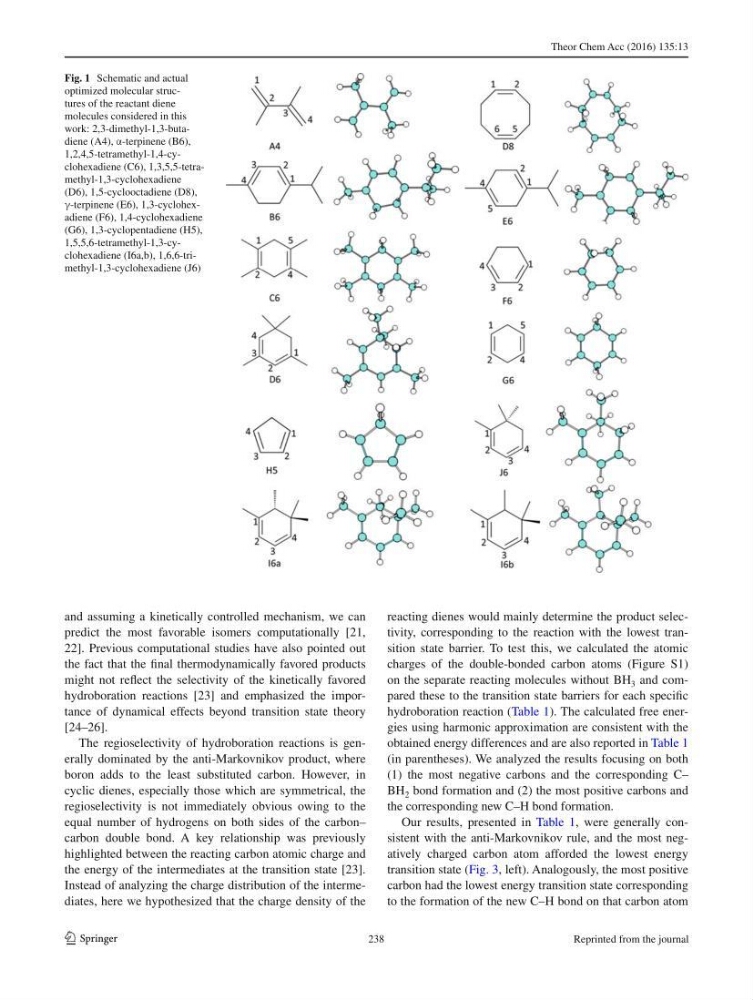
Fig. 1 Schematic and actual
optimized molecular structures of the reactant diene
molecules considered in this
work: 2,3-dimethyl-1,3-butadiene (A4), α-terpinene (B6),
1,2,4,5-tetramethyl-1,4-cyclohexadiene (C6), 1,3,5,5-tetramethyl-1,3-cyclohexadiene
(D6), 1,5-cyclooctadiene (D8),
γ-terpinene (E6), 1,3-cyclohexadiene (F6), 1,4-cyclohexadiene
(G6), 1,3-cyclopentadiene (H5),
1,5,5,6-tetramethyl-1,3-cyclohexadiene (I6a,b), 1,6,6-trimethyl-1,3-cyclohexadiene (J6)
238
Reprinted from the journal
1 3
and assuming a kinetically controlled mechanism, we can
predict the most favorable isomers computationally [ 21 ,
22 ]. Previous computational studies have also pointed out
the fact that the fi nal thermodynamically favored products
might not refl ect the selectivity of the kinetically favored
hydroboration reactions [ 23 ] and emphasized the importance of dynamical effects beyond transition state theory
[ 24 – 26 ].
The regioselectivity of hydroboration reactions is generally dominated by the anti-Markovnikov product, where
boron adds to the least substituted carbon. However, in
cyclic dienes, especially those which are symmetrical, the
regioselectivity is not immediately obvious owing to the
equal number of hydrogens on both sides of the carbon–
carbon double bond. A key relationship was previously
highlighted between the reacting carbon atomic charge and
the energy of the intermediates at the transition state [ 23 ].
Instead of analyzing the charge distribution of the intermediates, here we hypothesized that the charge density of the
reacting dienes would mainly determine the product selectivity, corresponding to the reaction with the lowest transition state barrier. To test this, we calculated the atomic
charges of the double-bonded carbon atoms (Figure S1)
on the separate reacting molecules without BH 3 and compared these to the transition state barriers for each specifi c
hydroboration reaction (Table 1 ). The calculated free energies using harmonic approximation are consistent with the
obtained energy differences and are also reported in Table 1
(in parentheses). We analyzed the results focusing on both
(1) the most negative carbons and the corresponding C–
BH 2 bond formation and (2) the most positive carbons and
the corresponding new C–H bond formation.
Our results, presented in Table 1 , were generally consistent with the anti-Markovnikov rule, and the most negatively charged carbon atom afforded the lowest energy
transition state (Fig. 3 , left). Analogously, the most positive
carbon had the lowest energy transition state corresponding
to the formation of the new C–H bond on that carbon atom
Fig. 1 Schematic and actual
optimized molecular structures of the reactant diene
molecules considered in this
work: 2,3-dimethyl-1,3-butadiene (A4), α-terpinene (B6),
1,2,4,5-tetramethyl-1,4-cyclohexadiene (C6), 1,3,5,5-tetramethyl-1,3-cyclohexadiene
(D6), 1,5-cyclooctadiene (D8),
γ-terpinene (E6), 1,3-cyclohexadiene (F6), 1,4-cyclohexadiene
(G6), 1,3-cyclopentadiene (H5),
1,5,5,6-tetramethyl-1,3-cyclohexadiene (I6a,b), 1,6,6-trimethyl-1,3-cyclohexadiene (J6)
238
Reprinted from the journal