

Theor Chem Acc (2016) 135:13
1 3
using the high-energy BH 3 -diene adducts as our starting
reactant states [ 17 ]. We calculated the energies of geometry-optimized reactant and transition states corresponding
to hydroboration on all possible sp
2 carbons of the 8 molecules with previously available experimental data [ 17 ]
from Fig. 1 . With the calculated transition state barriers,
H 2 B
BH 2
BH
BH
BH 2
BH 2
BH 2
H
H
H
H
B
B
BH 2
BH 2
BH 2
B
BH 2
BH 2
H
B
H
B
B
H
H
BH BH
H
H
H
H
BH 2
B
B
H
H
BH 2
B
B
BH 2
'BH 3 '
Intramolecular
B-H-B bridges
+ isomers
Intermolecular
B-H-B bridges
Intermolecular
Hydroboration
Intramolecular
Hydroboration
+ isomers
Intermolecular
B-H-B bridges
Intermolecular
B-H-B bridges
Intermolecular
Hydroboration
H
'BH 3 '
A
B
C
D
E
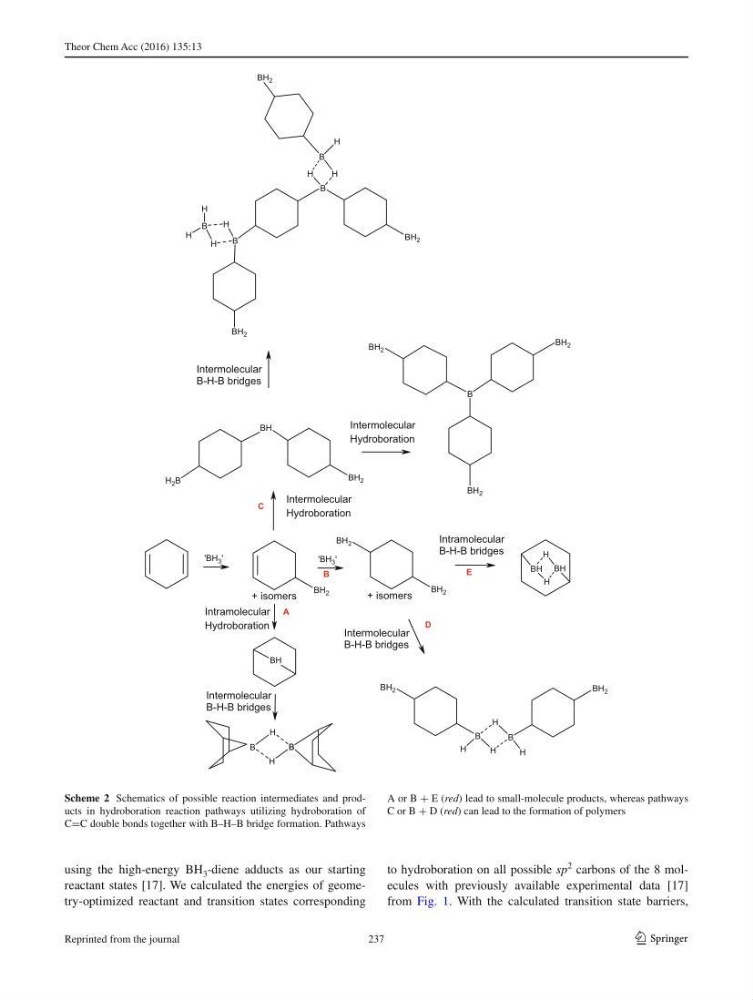
Scheme 2 Schematics of possible reaction intermediates and products in hydroboration reaction pathways utilizing hydroboration of
C=C double bonds together with B–H–B bridge formation. Pathways
A or B + E ( red ) lead to small-molecule products, whereas pathways
C or B + D ( red ) can lead to the formation of polymers
237
Reprinted from the journal
1 3
using the high-energy BH 3 -diene adducts as our starting
reactant states [ 17 ]. We calculated the energies of geometry-optimized reactant and transition states corresponding
to hydroboration on all possible sp
2 carbons of the 8 molecules with previously available experimental data [ 17 ]
from Fig. 1 . With the calculated transition state barriers,
H 2 B
BH 2
BH
BH
BH 2
BH 2
BH 2
H
H
H
H
B
B
BH 2
BH 2
BH 2
B
BH 2
BH 2
H
B
H
B
B
H
H
BH BH
H
H
H
H
BH 2
B
B
H
H
BH 2
B
B
BH 2
'BH 3 '
Intramolecular
B-H-B bridges
+ isomers
Intermolecular
B-H-B bridges
Intermolecular
Hydroboration
Intramolecular
Hydroboration
+ isomers
Intermolecular
B-H-B bridges
Intermolecular
B-H-B bridges
Intermolecular
Hydroboration
H
'BH 3 '
A
B
C
D
E
Scheme 2 Schematics of possible reaction intermediates and products in hydroboration reaction pathways utilizing hydroboration of
C=C double bonds together with B–H–B bridge formation. Pathways
A or B + E ( red ) lead to small-molecule products, whereas pathways
C or B + D ( red ) can lead to the formation of polymers
237
Reprinted from the journal