

Theor Chem Acc (2016) 135:13
1 3
hydroboration products in the fi nal product specifi city,
previous studies have mainly focused on the subsequent
reactions, such as their oxidation to form alcohols, and the
direct unoxidized hydroboration products have until now
received little attention [ 15 – 17 ].
Stereo- and regiospecifi city of the fi nal synthetic products depends on the specifi city of the fi rst hydroboration
reaction steps. It is well established that hydroboration
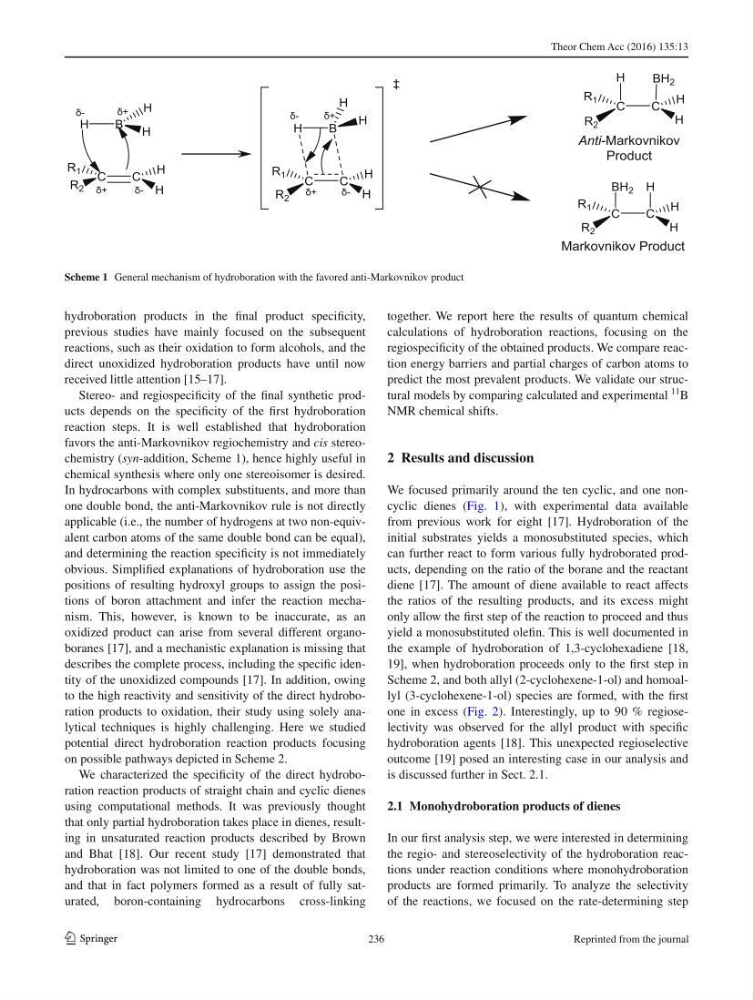
favors the anti-Markovnikov regiochemistry and cis stereochemistry ( syn -addition, Scheme 1 ), hence highly useful in
chemical synthesis where only one stereoisomer is desired.
In hydrocarbons with complex substituents, and more than
one double bond, the anti-Markovnikov rule is not directly
applicable (i.e., the number of hydrogens at two non-equivalent carbon atoms of the same double bond can be equal),
and determining the reaction specifi city is not immediately
obvious. Simplifi ed explanations of hydroboration use the
positions of resulting hydroxyl groups to assign the positions of boron attachment and infer the reaction mechanism. This, however, is known to be inaccurate, as an
oxidized product can arise from several different organoboranes [ 17 ], and a mechanistic explanation is missing that
describes the complete process, including the specifi c identity of the unoxidized compounds [ 17 ]. In addition, owing
to the high reactivity and sensitivity of the direct hydroboration products to oxidation, their study using solely analytical techniques is highly challenging. Here we studied
potential direct hydroboration reaction products focusing
on possible pathways depicted in Scheme 2 .
We characterized the specifi city of the direct hydroboration reaction products of straight chain and cyclic dienes
using computational methods. It was previously thought
that only partial hydroboration takes place in dienes, resulting in unsaturated reaction products described by Brown
and Bhat [ 18 ]. Our recent study [ 17 ] demonstrated that
hydroboration was not limited to one of the double bonds,
and that in fact polymers formed as a result of fully saturated, boron-containing hydrocarbons cross-linking
together. We report here the results of quantum chemical
calculations of hydroboration reactions, focusing on the
regiospecifi city of the obtained products. We compare reaction energy barriers and partial charges of carbon atoms to
predict the most prevalent products. We validate our structural models by comparing calculated and experimental
11 B
NMR chemical shifts.
2 Results and discussion
We focused primarily around the ten cyclic, and one noncyclic dienes (Fig. 1 ), with experimental data available
from previous work for eight [ 17 ]. Hydroboration of the
initial substrates yields a monosubstituted species, which
can further react to form various fully hydroborated products, depending on the ratio of the borane and the reactant
diene [ 17 ]. The amount of diene available to react affects
the ratios of the resulting products, and its excess might
only allow the fi rst step of the reaction to proceed and thus
yield a monosubstituted olefi n. This is well documented in
the example of hydroboration of 1,3-cyclohexadiene [ 18 ,
19 ], when hydroboration proceeds only to the fi rst step in
Scheme 2 , and both allyl (2-cyclohexene-1-ol) and homoallyl (3-cyclohexene-1-ol) species are formed, with the fi rst
one in excess (Fig. 2 ). Interestingly, up to 90 % regioselectivity was observed for the allyl product with specifi c
hydroboration agents [ 18 ]. This unexpected regioselective
outcome [ 19 ] posed an interesting case in our analysis and
is discussed further in Sect. 2.1 .
2.1 Monohydroboration products of dienes
In our fi rst analysis step, we were interested in determining
the regio- and stereoselectivity of the hydroboration reactions under reaction conditions where monohydroboration
products are formed primarily. To analyze the selectivity
of the reactions, we focused on the rate-determining step
Scheme 1 General mechanism of hydroboration with the favored anti-Markovnikov product
236
Reprinted from the journal
1 3
hydroboration products in the fi nal product specifi city,
previous studies have mainly focused on the subsequent
reactions, such as their oxidation to form alcohols, and the
direct unoxidized hydroboration products have until now
received little attention [ 15 – 17 ].
Stereo- and regiospecifi city of the fi nal synthetic products depends on the specifi city of the fi rst hydroboration
reaction steps. It is well established that hydroboration
favors the anti-Markovnikov regiochemistry and cis stereochemistry ( syn -addition, Scheme 1 ), hence highly useful in
chemical synthesis where only one stereoisomer is desired.
In hydrocarbons with complex substituents, and more than
one double bond, the anti-Markovnikov rule is not directly
applicable (i.e., the number of hydrogens at two non-equivalent carbon atoms of the same double bond can be equal),
and determining the reaction specifi city is not immediately
obvious. Simplifi ed explanations of hydroboration use the
positions of resulting hydroxyl groups to assign the positions of boron attachment and infer the reaction mechanism. This, however, is known to be inaccurate, as an
oxidized product can arise from several different organoboranes [ 17 ], and a mechanistic explanation is missing that
describes the complete process, including the specifi c identity of the unoxidized compounds [ 17 ]. In addition, owing
to the high reactivity and sensitivity of the direct hydroboration products to oxidation, their study using solely analytical techniques is highly challenging. Here we studied
potential direct hydroboration reaction products focusing
on possible pathways depicted in Scheme 2 .
We characterized the specifi city of the direct hydroboration reaction products of straight chain and cyclic dienes
using computational methods. It was previously thought
that only partial hydroboration takes place in dienes, resulting in unsaturated reaction products described by Brown
and Bhat [ 18 ]. Our recent study [ 17 ] demonstrated that
hydroboration was not limited to one of the double bonds,
and that in fact polymers formed as a result of fully saturated, boron-containing hydrocarbons cross-linking
together. We report here the results of quantum chemical
calculations of hydroboration reactions, focusing on the
regiospecifi city of the obtained products. We compare reaction energy barriers and partial charges of carbon atoms to
predict the most prevalent products. We validate our structural models by comparing calculated and experimental
11 B
NMR chemical shifts.
2 Results and discussion
We focused primarily around the ten cyclic, and one noncyclic dienes (Fig. 1 ), with experimental data available
from previous work for eight [ 17 ]. Hydroboration of the
initial substrates yields a monosubstituted species, which
can further react to form various fully hydroborated products, depending on the ratio of the borane and the reactant
diene [ 17 ]. The amount of diene available to react affects
the ratios of the resulting products, and its excess might
only allow the fi rst step of the reaction to proceed and thus
yield a monosubstituted olefi n. This is well documented in
the example of hydroboration of 1,3-cyclohexadiene [ 18 ,
19 ], when hydroboration proceeds only to the fi rst step in
Scheme 2 , and both allyl (2-cyclohexene-1-ol) and homoallyl (3-cyclohexene-1-ol) species are formed, with the fi rst
one in excess (Fig. 2 ). Interestingly, up to 90 % regioselectivity was observed for the allyl product with specifi c
hydroboration agents [ 18 ]. This unexpected regioselective
outcome [ 19 ] posed an interesting case in our analysis and
is discussed further in Sect. 2.1 .
2.1 Monohydroboration products of dienes
In our fi rst analysis step, we were interested in determining
the regio- and stereoselectivity of the hydroboration reactions under reaction conditions where monohydroboration
products are formed primarily. To analyze the selectivity
of the reactions, we focused on the rate-determining step
Scheme 1 General mechanism of hydroboration with the favored anti-Markovnikov product
236
Reprinted from the journal