

Theor Chem Acc (2015) 134:100
1 3
symmetrical expression. The zero-order Hamiltonian of
option 1a, introduced in projected MCPT (pMCPT) [ 11 , 13 ],
can be extended as
MS standing for "multistate." Overlap treatment option 1b,
applied, e.g., in Ref. [ 16 ], can be extended for multiple reference vectors as
Finally, the complete biorthogonal treatment of option
2a, termed originally SC2-MCPT or unprojected MCPT
(uMCPT) [ 12 , 13 ], can be extended to the multistate case
as
Diagonal matrices E
(0)
P and E
(0)
P⊥ above contain zero-order
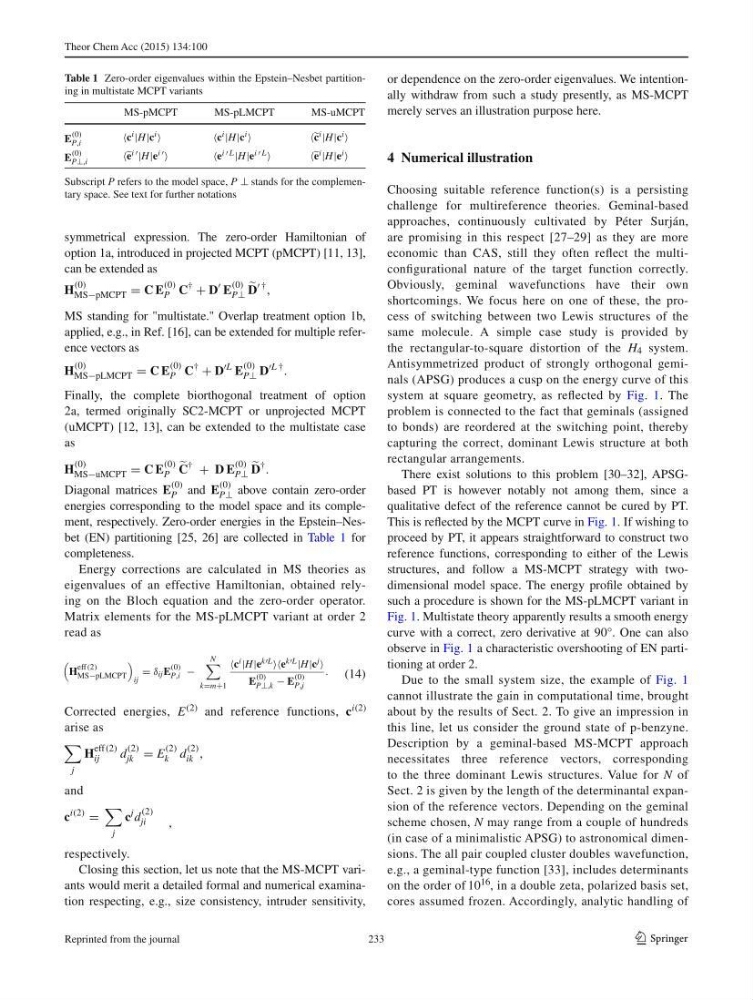
energies corresponding to the model space and its complement, respectively. Zero-order energies in the Epstein–Nesbet (EN) partitioning [ 25 , 26 ] are collected in Table 1 for
completeness.
Energy corrections are calculated in MS theories as
eigenvalues of an effective Hamiltonian, obtained relying on the Bloch equation and the zero-order operator.
Matrix elements for the MS-pLMCPT variant at order 2
read as
Corrected energies, E (2) and reference functions, c i(2)
arise as
and
respectively.
Closing this section, let us note that the MS-MCPT variants would merit a detailed formal and numerical examination respecting, e.g., size consistency, intruder sensitivity,
H
(0)
MS−pMCPT = C E
(0)
P C
†
+ D
E
(0)
P⊥
D
† ,
H
(0)
MS−pLMCPT = C E
(0)
P C
†
+ D
L E
(0)
P⊥ D
L † .
H
(0)
MS−uMCPT = C E
(0)
P
C
†
+ D E
(0)
P⊥
D
† .
(14)
H
eff(2)
MS−pLMCPT
ij
= δ ij E
(0)
P,i −
N
k=m+1
c i |H|e kL e kL |H|c j
E
(0)
P⊥,k − E
(0)
P,j
.
j
H
eff(2)
ij
d
(2)
jk = E
(2)
k d
(2)
ik ,
c
i(2)
=
j
c
j d
(2)
ji
,
or dependence on the zero-order eigenvalues. We intentionally withdraw from such a study presently, as MS-MCPT
merely serves an illustration purpose here.
4 Numerical illustration
Choosing suitable reference function(s) is a persisting
challenge for multireference theories. Geminal-based
approaches, continuously cultivated by Péter Surján,
are promising in this respect [ 27 – 29 ] as they are more
economic than CAS, still they often refl ect the multiconfi gurational nature of the target function correctly.
Obviously, geminal wavefunctions have their own
shortcomings. We focus here on one of these, the process of switching between two Lewis structures of the
same molecule. A simple case study is provided by
the rectangular-to-square distortion of the H 4 system.
Antisymmetrized product of strongly orthogonal geminals (APSG) produces a cusp on the energy curve of this
system at square geometry, as refl ected by Fig. 1 . The
problem is connected to the fact that geminals (assigned
to bonds) are reordered at the switching point, thereby
capturing the correct, dominant Lewis structure at both
rectangular arrangements.
There exist solutions to this problem [ 30 – 32 ], APSGbased PT is however notably not among them, since a
qualitative defect of the reference cannot be cured by PT.
This is refl ected by the MCPT curve in Fig. 1 . If wishing to
proceed by PT, it appears straightforward to construct two
reference functions, corresponding to either of the Lewis
structures, and follow a MS-MCPT strategy with twodimensional model space. The energy profi le obtained by
such a procedure is shown for the MS-pLMCPT variant in
Fig. 1 . Multistate theory apparently results a smooth energy
curve with a correct, zero derivative at 90°. One can also
observe in Fig. 1 a characteristic overshooting of EN partitioning at order 2.
Due to the small system size, the example of Fig. 1
cannot illustrate the gain in computational time, brought
about by the results of Sect. 2 . To give an impression in
this line, let us consider the ground state of p-benzyne.
Description by a geminal-based MS-MCPT approach
necessitates three reference vectors, corresponding
to the three dominant Lewis structures. Value for N of
Sect. 2 is given by the length of the determinantal expansion of the reference vectors. Depending on the geminal
scheme chosen, N may range from a couple of hundreds
(in case of a minimalistic APSG) to astronomical dimensions. The all pair coupled cluster doubles wavefunction,
e.g., a geminal-type function [ 33 ], includes determinants
on the order of 10 16 , in a double zeta, polarized basis set,
cores assumed frozen. Accordingly, analytic handling of
Table 1 Zero-order eigenvalues within the Epstein–Nesbet partitioning in multistate MCPT variants
Subscript P refers to the model space, P ⊥ stands for the complementary space. See text for further notations
MS-pMCPT
MS-pLMCPT
MS-uMCPT
E
(0)
P,i
c i |H|c i
c i |H|c i
c i |H|c i
E
(0)
P⊥,i
e i |H|e i
e i L |H|e i L
e i |H|e i
233
Reprinted from the journal
1 3
symmetrical expression. The zero-order Hamiltonian of
option 1a, introduced in projected MCPT (pMCPT) [ 11 , 13 ],
can be extended as
MS standing for "multistate." Overlap treatment option 1b,
applied, e.g., in Ref. [ 16 ], can be extended for multiple reference vectors as
Finally, the complete biorthogonal treatment of option
2a, termed originally SC2-MCPT or unprojected MCPT
(uMCPT) [ 12 , 13 ], can be extended to the multistate case
as
Diagonal matrices E
(0)
P and E
(0)
P⊥ above contain zero-order
energies corresponding to the model space and its complement, respectively. Zero-order energies in the Epstein–Nesbet (EN) partitioning [ 25 , 26 ] are collected in Table 1 for
completeness.
Energy corrections are calculated in MS theories as
eigenvalues of an effective Hamiltonian, obtained relying on the Bloch equation and the zero-order operator.
Matrix elements for the MS-pLMCPT variant at order 2
read as
Corrected energies, E (2) and reference functions, c i(2)
arise as
and
respectively.
Closing this section, let us note that the MS-MCPT variants would merit a detailed formal and numerical examination respecting, e.g., size consistency, intruder sensitivity,
H
(0)
MS−pMCPT = C E
(0)
P C
†
+ D
E
(0)
P⊥
D
† ,
H
(0)
MS−pLMCPT = C E
(0)
P C
†
+ D
L E
(0)
P⊥ D
L † .
H
(0)
MS−uMCPT = C E
(0)
P
C
†
+ D E
(0)
P⊥
D
† .
(14)
H
eff(2)
MS−pLMCPT
ij
= δ ij E
(0)
P,i −
N
k=m+1
c i |H|e kL e kL |H|c j
E
(0)
P⊥,k − E
(0)
P,j
.
j
H
eff(2)
ij
d
(2)
jk = E
(2)
k d
(2)
ik ,
c
i(2)
=
j
c
j d
(2)
ji
,
or dependence on the zero-order eigenvalues. We intentionally withdraw from such a study presently, as MS-MCPT
merely serves an illustration purpose here.
4 Numerical illustration
Choosing suitable reference function(s) is a persisting
challenge for multireference theories. Geminal-based
approaches, continuously cultivated by Péter Surján,
are promising in this respect [ 27 – 29 ] as they are more
economic than CAS, still they often refl ect the multiconfi gurational nature of the target function correctly.
Obviously, geminal wavefunctions have their own
shortcomings. We focus here on one of these, the process of switching between two Lewis structures of the
same molecule. A simple case study is provided by
the rectangular-to-square distortion of the H 4 system.
Antisymmetrized product of strongly orthogonal geminals (APSG) produces a cusp on the energy curve of this
system at square geometry, as refl ected by Fig. 1 . The
problem is connected to the fact that geminals (assigned
to bonds) are reordered at the switching point, thereby
capturing the correct, dominant Lewis structure at both
rectangular arrangements.
There exist solutions to this problem [ 30 – 32 ], APSGbased PT is however notably not among them, since a
qualitative defect of the reference cannot be cured by PT.
This is refl ected by the MCPT curve in Fig. 1 . If wishing to
proceed by PT, it appears straightforward to construct two
reference functions, corresponding to either of the Lewis
structures, and follow a MS-MCPT strategy with twodimensional model space. The energy profi le obtained by
such a procedure is shown for the MS-pLMCPT variant in
Fig. 1 . Multistate theory apparently results a smooth energy
curve with a correct, zero derivative at 90°. One can also
observe in Fig. 1 a characteristic overshooting of EN partitioning at order 2.
Due to the small system size, the example of Fig. 1
cannot illustrate the gain in computational time, brought
about by the results of Sect. 2 . To give an impression in
this line, let us consider the ground state of p-benzyne.
Description by a geminal-based MS-MCPT approach
necessitates three reference vectors, corresponding
to the three dominant Lewis structures. Value for N of
Sect. 2 is given by the length of the determinantal expansion of the reference vectors. Depending on the geminal
scheme chosen, N may range from a couple of hundreds
(in case of a minimalistic APSG) to astronomical dimensions. The all pair coupled cluster doubles wavefunction,
e.g., a geminal-type function [ 33 ], includes determinants
on the order of 10 16 , in a double zeta, polarized basis set,
cores assumed frozen. Accordingly, analytic handling of
Table 1 Zero-order eigenvalues within the Epstein–Nesbet partitioning in multistate MCPT variants
Subscript P refers to the model space, P ⊥ stands for the complementary space. See text for further notations
MS-pMCPT
MS-pLMCPT
MS-uMCPT
E
(0)
P,i
c i |H|c i
c i |H|c i
c i |H|c i
E
(0)
P⊥,i
e i |H|e i
e i L |H|e i L
e i |H|e i
233
Reprinted from the journal