

Theor Chem Acc (2015) 134:100
1 3
having made use of Eqs. ( 4 ), ( 5 ), and ( 12 ).
2.3 Extended option 2a
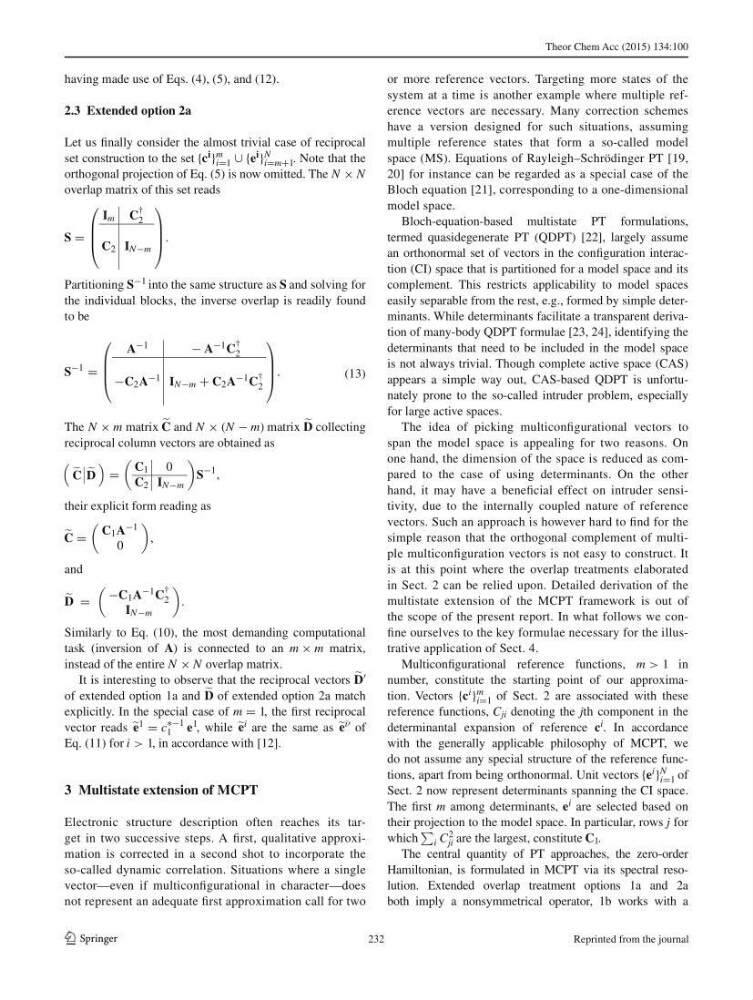
Let us fi nally consider the almost trivial case of reciprocal
set construction to the set {c i } m
i=1 ∪ {e i }
N
i=m+1 . Note that the
orthogonal projection of Eq. ( 5 ) is now omitted. The N × N
overlap matrix of this set reads
Partitioning S −1 into the same structure as S and solving for
the individual blocks, the inverse overlap is readily found
to be
The N × m matrix
C and N × (N − m) matrix
D collecting
reciprocal column vectors are obtained as
their explicit form reading as
and
Similarly to Eq. ( 10 ), the most demanding computational
task (inversion of A ) is connected to an m × m matrix,
instead of the entire N × N overlap matrix.
It is interesting to observe that the reciprocal vectors
D
of extended option 1a and
D of extended option 2a match
explicitly. In the special case of m = 1 , the fi rst reciprocal
vector reads e 1 = c
∗−1
1
e 1 , while e i are the same as e i of
Eq. ( 11 ) for i > 1 , in accordance with [ 12 ].
3 Multistate extension of MCPT
Electronic structure description often reaches its target in two successive steps. A fi rst, qualitative approximation is corrected in a second shot to incorporate the
so-called dynamic correlation. Situations where a single
vector—even if multiconfi gurational in character—does
not represent an adequate fi rst approximation call for two
S =
⎛
⎜
⎜
⎝
I m C
†
2
C 2 I N−m
⎞
⎟
⎟
⎠ .
(13)
S
−1
=
⎛
⎜
⎜
⎝
A −1
− A −1 C
†
2
−C 2 A −1 I N−m + C 2 A −1 C
†
2
⎞
⎟
⎟
⎠ .
C
D
=
C 1 0
C 2 I N−m
S
−1 ,
C =
C 1 A −1
0
,
D =
−C 1 A −1 C
†
2
I N−m
.
or more reference vectors. Targeting more states of the
system at a time is another example where multiple reference vectors are necessary. Many correction schemes
have a version designed for such situations, assuming
multiple reference states that form a so-called model
space (MS). Equations of Rayleigh–Schrödinger PT [ 19 ,
20 ] for instance can be regarded as a special case of the
Bloch equation [ 21 ], corresponding to a one-dimensional
model space.
Bloch-equation-based multistate PT formulations,
termed quasidegenerate PT (QDPT) [ 22 ], largely assume
an orthonormal set of vectors in the confi guration interaction (CI) space that is partitioned for a model space and its
complement. This restricts applicability to model spaces
easily separable from the rest, e.g., formed by simple determinants. While determinants facilitate a transparent derivation of many-body QDPT formulae [ 23 , 24 ], identifying the
determinants that need to be included in the model space
is not always trivial. Though complete active space (CAS)
appears a simple way out, CAS-based QDPT is unfortunately prone to the so-called intruder problem, especially
for large active spaces.
The idea of picking multiconfi gurational vectors to
span the model space is appealing for two reasons. On
one hand, the dimension of the space is reduced as compared to the case of using determinants. On the other
hand, it may have a benefi cial effect on intruder sensitivity, due to the internally coupled nature of reference
vectors. Such an approach is however hard to fi nd for the
simple reason that the orthogonal complement of multiple multiconfi guration vectors is not easy to construct. It
is at this point where the overlap treatments elaborated
in Sect. 2 can be relied upon. Detailed derivation of the
multistate extension of the MCPT framework is out of
the scope of the present report. In what follows we confi ne ourselves to the key formulae necessary for the illustrative application of Sect. 4 .
Multiconfi gurational reference functions, m > 1 in
number, constitute the starting point of our approximation. Vectors {c i } m
i=1 of Sect. 2 are associated with these
reference functions, C ji denoting the j th component in the
determinantal expansion of reference c i . In accordance
with the generally applicable philosophy of MCPT, we
do not assume any special structure of the reference functions, apart from being orthonormal. Unit vectors {e i }
N
i=1 of
Sect. 2 now represent determinants spanning the CI space.
The fi rst m among determinants, e i are selected based on
their projection to the model space. In particular, rows j for
which
i C 2
ji are the largest, constitute C 1 .
The central quantity of PT approaches, the zero-order
Hamiltonian, is formulated in MCPT via its spectral resolution. Extended overlap treatment options 1a and 2a
both imply a nonsymmetrical operator, 1b works with a
232
Reprinted from the journal
1 3
having made use of Eqs. ( 4 ), ( 5 ), and ( 12 ).
2.3 Extended option 2a
Let us fi nally consider the almost trivial case of reciprocal
set construction to the set {c i } m
i=1 ∪ {e i }
N
i=m+1 . Note that the
orthogonal projection of Eq. ( 5 ) is now omitted. The N × N
overlap matrix of this set reads
Partitioning S −1 into the same structure as S and solving for
the individual blocks, the inverse overlap is readily found
to be
The N × m matrix
C and N × (N − m) matrix
D collecting
reciprocal column vectors are obtained as
their explicit form reading as
and
Similarly to Eq. ( 10 ), the most demanding computational
task (inversion of A ) is connected to an m × m matrix,
instead of the entire N × N overlap matrix.
It is interesting to observe that the reciprocal vectors
D
of extended option 1a and
D of extended option 2a match
explicitly. In the special case of m = 1 , the fi rst reciprocal
vector reads e 1 = c
∗−1
1
e 1 , while e i are the same as e i of
Eq. ( 11 ) for i > 1 , in accordance with [ 12 ].
3 Multistate extension of MCPT
Electronic structure description often reaches its target in two successive steps. A fi rst, qualitative approximation is corrected in a second shot to incorporate the
so-called dynamic correlation. Situations where a single
vector—even if multiconfi gurational in character—does
not represent an adequate fi rst approximation call for two
S =
⎛
⎜
⎜
⎝
I m C
†
2
C 2 I N−m
⎞
⎟
⎟
⎠ .
(13)
S
−1
=
⎛
⎜
⎜
⎝
A −1
− A −1 C
†
2
−C 2 A −1 I N−m + C 2 A −1 C
†
2
⎞
⎟
⎟
⎠ .
C
D
=
C 1 0
C 2 I N−m
S
−1 ,
C =
C 1 A −1
0
,
D =
−C 1 A −1 C
†
2
I N−m
.
or more reference vectors. Targeting more states of the
system at a time is another example where multiple reference vectors are necessary. Many correction schemes
have a version designed for such situations, assuming
multiple reference states that form a so-called model
space (MS). Equations of Rayleigh–Schrödinger PT [ 19 ,
20 ] for instance can be regarded as a special case of the
Bloch equation [ 21 ], corresponding to a one-dimensional
model space.
Bloch-equation-based multistate PT formulations,
termed quasidegenerate PT (QDPT) [ 22 ], largely assume
an orthonormal set of vectors in the confi guration interaction (CI) space that is partitioned for a model space and its
complement. This restricts applicability to model spaces
easily separable from the rest, e.g., formed by simple determinants. While determinants facilitate a transparent derivation of many-body QDPT formulae [ 23 , 24 ], identifying the
determinants that need to be included in the model space
is not always trivial. Though complete active space (CAS)
appears a simple way out, CAS-based QDPT is unfortunately prone to the so-called intruder problem, especially
for large active spaces.
The idea of picking multiconfi gurational vectors to
span the model space is appealing for two reasons. On
one hand, the dimension of the space is reduced as compared to the case of using determinants. On the other
hand, it may have a benefi cial effect on intruder sensitivity, due to the internally coupled nature of reference
vectors. Such an approach is however hard to fi nd for the
simple reason that the orthogonal complement of multiple multiconfi guration vectors is not easy to construct. It
is at this point where the overlap treatments elaborated
in Sect. 2 can be relied upon. Detailed derivation of the
multistate extension of the MCPT framework is out of
the scope of the present report. In what follows we confi ne ourselves to the key formulae necessary for the illustrative application of Sect. 4 .
Multiconfi gurational reference functions, m > 1 in
number, constitute the starting point of our approximation. Vectors {c i } m
i=1 of Sect. 2 are associated with these
reference functions, C ji denoting the j th component in the
determinantal expansion of reference c i . In accordance
with the generally applicable philosophy of MCPT, we
do not assume any special structure of the reference functions, apart from being orthonormal. Unit vectors {e i }
N
i=1 of
Sect. 2 now represent determinants spanning the CI space.
The fi rst m among determinants, e i are selected based on
their projection to the model space. In particular, rows j for
which
i C 2
ji are the largest, constitute C 1 .
The central quantity of PT approaches, the zero-order
Hamiltonian, is formulated in MCPT via its spectral resolution. Extended overlap treatment options 1a and 2a
both imply a nonsymmetrical operator, 1b works with a
232
Reprinted from the journal