

Theor Chem Acc (2015) 134:74
1 3
Exploiting these defi nitions, Eq. ( 5 ) can be recast as
To get rid of the r
−1
12 factors, they were approximated by the
expansion proposed by Hackbusch et al. [ 55 ], where ω n
and κ n are, respectively, the weight and exponent of the
n th exponential term in the expansion, and m is the number of terms. The exponentials in the above expansion
can also be regarded as ellipsoidal Gaussians, that is, if
the
6 × 6 matrix is introduced, the exponent of the n th exponential function can be expressed as −r † n r, and fi nally
operator r
−1
12 is approximated as
Substituting this into Eq. ( 10 ), utilizing the properties of
the exponential function, an (ss|ss) -type integral can be calculated using the
formula, where n = n + , and the S n integrals are evaluated according to the
analytic expression.
Two-electron integrals including functions of higher
angular momentum quantum numbers can be derived by
differentiating Eq. ( 15 ) with respect to the components of
vector J . Taking into account Eq. ( 3 ) and the above derivation a (p z s|ss) , two-electron integral can be calculated
as
(10)
e
−
r † r−J † r
−c 1
r 12
dr 1 dr 2 .
(11)
1
r 12
=
m
n=1
ω n e
−κ n r 2
12
(12)
n =
⎛
⎜
⎜
⎜
⎜
⎜
⎜
⎜
⎝
κ n
0
0
− κ n
0
0
0
κ n
0
0
− κ n
0
0
0
κ n
0
0
− κ n
−κ n
0
0
κ n
0
0
0
− κ n
0
0
κ n
0
0
0
− κ n
0
0
κ n
⎞
⎟
⎟
⎟
⎟
⎟
⎟
⎟
⎠
(13)
1
r 12
=
m
n=1
ω n e
−r † n r .
(14)
m
n=1
ω n
e
−
r † n r−J † r
−c dr =
m
n=1
ω n S n
(15)
S n =
e
−
r † n r−J † r
−c dr =
π 6
det n
e
1
4 J † −1
n J−c
(16)
(p z s|ss) =
m
n=1
ω n
(z 1 − A z )e
−
r † n r−J † r
−c dr.
If we differentiate the corresponding (ss|ss) integral with
respect to J 3 , we arrive at the
expression, where (
−1
) ij is the corresponding element of
the inverse of matrix , and obviously the integrals in the
above expansion can be evaluated as
It is easy to see that similar expressions apply to the (p x s|ss)
and (p y s|ss) integrals which can be derived by the differentiation of the (ss|ss) integral with respect to J 1 and J 2 ,
respectively.
Following this procedure, expressions can be derived for
integrals with more p functions and also for higher angular momentum functions. For instance, to derive working
equations for the evaluation of the (p z p z |ss) integrals, the
second derivative of S n is calculated with respect to J 3 as
Utilizing this, the (p z p z |ss) integral can be evaluated via
the
(17)
∂S n
∂J 3
=
z 1 e
−
r † nr−J † r
−c dr =
1
2
−1
13
J 1 +
−1
23
J 2
+
−1
33
J 3 +
−1
34
J 4 +
−1
35
J 5
+
−1
36
J 6
S n = S
z 1
n
(18)
(z 1 − A z )e
−
r † n r−J † r
−c dr =
∂
∂J 3
− A z
S n
= S
z 1
n − A z S n .
(19)
∂ 2 S n
∂J 2
3
=
∂S z 1
n
∂J 3
=
z
2
1 e
−
r † n r−J † r
−c dr
=
1
2
−1
33
S n + S
z 1 z 1
n .
(20)
(p z p z |ss) =
∂
∂J 3
− A z
∂
∂J 3
− B z
S n
= S
z 1 z 1
n
− S
z 1
n A z S n − S
z 1
n B z S n + A z B z S n
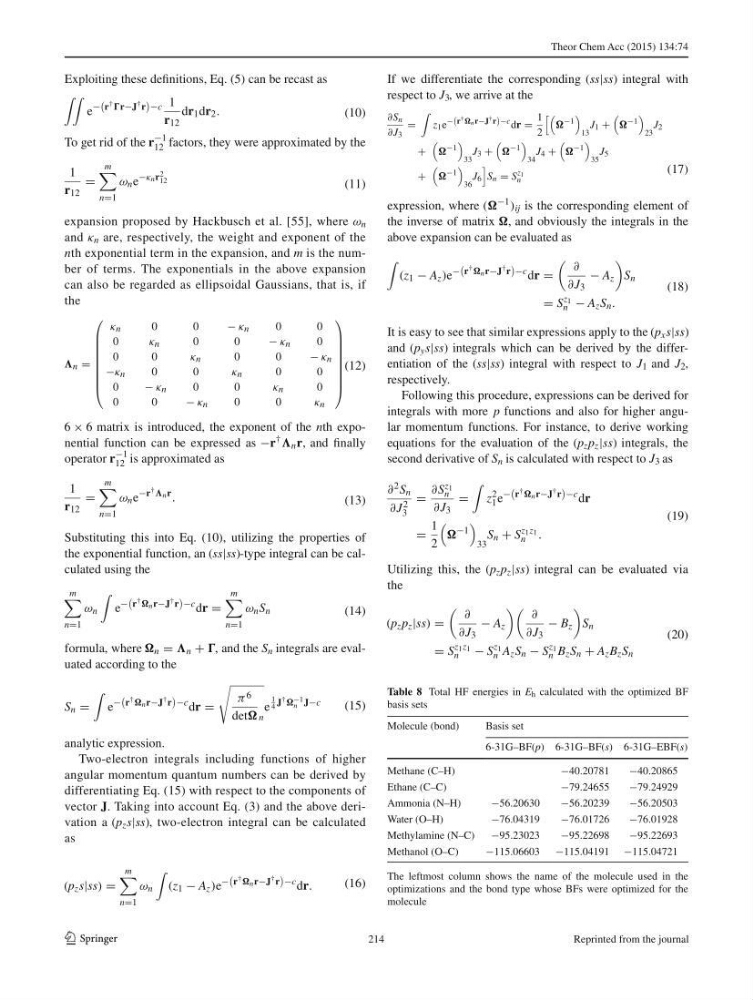
Table 8 Total HF energies in E h calculated with the optimized BF
basis sets
The leftmost column shows the name of the molecule used in the
optimizations and the bond type whose BFs were optimized for the
molecule
Molecule (bond)
Basis set
6-31G–BF( p ) 6-31G–BF( s ) 6-31G–EBF( s )
Methane (C–H)
−40.20781
−40.20865
Ethane (C–C)
−79.24655
−79.24929
Ammonia (N–H)
−56.20630
−56.20239
−56.20503
Water (O–H)
−76.04319
−76.01726
−76.01928
Methylamine (N–C)
−95.23023
−95.22698
−95.22693
Methanol (O–C)
−115.06603 −115.04191 −115.04721
214
Reprinted from the journal
1 3
Exploiting these defi nitions, Eq. ( 5 ) can be recast as
To get rid of the r
−1
12 factors, they were approximated by the
expansion proposed by Hackbusch et al. [ 55 ], where ω n
and κ n are, respectively, the weight and exponent of the
n th exponential term in the expansion, and m is the number of terms. The exponentials in the above expansion
can also be regarded as ellipsoidal Gaussians, that is, if
the
6 × 6 matrix is introduced, the exponent of the n th exponential function can be expressed as −r † n r, and fi nally
operator r
−1
12 is approximated as
Substituting this into Eq. ( 10 ), utilizing the properties of
the exponential function, an (ss|ss) -type integral can be calculated using the
formula, where n = n + , and the S n integrals are evaluated according to the
analytic expression.
Two-electron integrals including functions of higher
angular momentum quantum numbers can be derived by
differentiating Eq. ( 15 ) with respect to the components of
vector J . Taking into account Eq. ( 3 ) and the above derivation a (p z s|ss) , two-electron integral can be calculated
as
(10)
e
−
r † r−J † r
−c 1
r 12
dr 1 dr 2 .
(11)
1
r 12
=
m
n=1
ω n e
−κ n r 2
12
(12)
n =
⎛
⎜
⎜
⎜
⎜
⎜
⎜
⎜
⎝
κ n
0
0
− κ n
0
0
0
κ n
0
0
− κ n
0
0
0
κ n
0
0
− κ n
−κ n
0
0
κ n
0
0
0
− κ n
0
0
κ n
0
0
0
− κ n
0
0
κ n
⎞
⎟
⎟
⎟
⎟
⎟
⎟
⎟
⎠
(13)
1
r 12
=
m
n=1
ω n e
−r † n r .
(14)
m
n=1
ω n
e
−
r † n r−J † r
−c dr =
m
n=1
ω n S n
(15)
S n =
e
−
r † n r−J † r
−c dr =
π 6
det n
e
1
4 J † −1
n J−c
(16)
(p z s|ss) =
m
n=1
ω n
(z 1 − A z )e
−
r † n r−J † r
−c dr.
If we differentiate the corresponding (ss|ss) integral with
respect to J 3 , we arrive at the
expression, where (
−1
) ij is the corresponding element of
the inverse of matrix , and obviously the integrals in the
above expansion can be evaluated as
It is easy to see that similar expressions apply to the (p x s|ss)
and (p y s|ss) integrals which can be derived by the differentiation of the (ss|ss) integral with respect to J 1 and J 2 ,
respectively.
Following this procedure, expressions can be derived for
integrals with more p functions and also for higher angular momentum functions. For instance, to derive working
equations for the evaluation of the (p z p z |ss) integrals, the
second derivative of S n is calculated with respect to J 3 as
Utilizing this, the (p z p z |ss) integral can be evaluated via
the
(17)
∂S n
∂J 3
=
z 1 e
−
r † nr−J † r
−c dr =
1
2
−1
13
J 1 +
−1
23
J 2
+
−1
33
J 3 +
−1
34
J 4 +
−1
35
J 5
+
−1
36
J 6
S n = S
z 1
n
(18)
(z 1 − A z )e
−
r † n r−J † r
−c dr =
∂
∂J 3
− A z
S n
= S
z 1
n − A z S n .
(19)
∂ 2 S n
∂J 2
3
=
∂S z 1
n
∂J 3
=
z
2
1 e
−
r † n r−J † r
−c dr
=
1
2
−1
33
S n + S
z 1 z 1
n .
(20)
(p z p z |ss) =
∂
∂J 3
− A z
∂
∂J 3
− B z
S n
= S
z 1 z 1
n
− S
z 1
n A z S n − S
z 1
n B z S n + A z B z S n
Table 8 Total HF energies in E h calculated with the optimized BF
basis sets
The leftmost column shows the name of the molecule used in the
optimizations and the bond type whose BFs were optimized for the
molecule
Molecule (bond)
Basis set
6-31G–BF( p ) 6-31G–BF( s ) 6-31G–EBF( s )
Methane (C–H)
−40.20781
−40.20865
Ethane (C–C)
−79.24655
−79.24929
Ammonia (N–H)
−56.20630
−56.20239
−56.20503
Water (O–H)
−76.04319
−76.01726
−76.01928
Methylamine (N–C)
−95.23023
−95.22698
−95.22693
Methanol (O–C)
−115.06603 −115.04191 −115.04721
214
Reprinted from the journal