

Theor Chem Acc (2015) 134:74
1 3
expression. Analogously, for integrals (p z s|p z s), (p z p z |p z s) ,
and (p z p z |p z p z ) , we arrive at the
formulas. For other Cartesian components, the corresponding components of vector J and the appropriate nuclear
centers should be considered.
We have derived and coded the analytical formulas for
the (ss|ss) , (ps|ss) , (ps|ps) , (pp|ss) , (pp|ps) , and (pp|pp)
integrals. For the approximation of r
−1
12 , simply the largest expansion with m = 51 proposed by Hackbusch and
co-workers was taken. Probably this expansion is far too
long for our purposes, but no attempt has been made to fi nd
the optimal expansion and to increase the effi ciency of the
integral calculation. As we tested for integrals over conventional Gaussians, the error in the fi nal total energies introduced by this approximation is negligible. We also note
that the above algorithm is only executed if at least one of
the four functions in the integral is an ellipsoidal Gaussian. Other integrals are still evaluated with the conventional
algorithms.
3.2 Determination of the exponent matrix
The processing of conventional Gaussian BFs is trivial,
however, that for the EBFs is a bit more complicated. In
addition to the molecular integrals, the determination of
(21)
(p z s|p z s) =
∂
∂J 3
− A z
∂
∂J 6
− C z
S n
(22)
(p z p z |p z s) =
∂
∂J 3
− A z
∂
∂J 3
− B z
∂
∂J 6
− C z
S n
(23)
(p z p z |p z p z ) =
∂
∂J 3
− A z
∂
∂J 3
− B z
∂
∂J 6
− C z
∂
∂J 6
− D z
S n
exponent matrix α also requires special treatment. In order
to avoid the coordinate-system dependence and to be consistent with the chemical picture, the ellipsoidal Gaussians
must be stretched in the direction of the chemical bond.
The corresponding exponent matrix can be constructed as
follows.
A specifi c coordinate system is defi ned for each ellipsoidal Gaussian. Its origin is the center of the Gaussian, hereafter denoted by E , while its z -axis points in the direction
of the bond. In the bond-specifi c coordinate system, the
exponent matrix denoted by α takes the
form, where α will be referred to as the exponent and ε is
the stretch factor. Thus, in these coordinate systems, the
general ellipsoidal Gaussian is equivalent to a diagonal one,
that is, reduces to Eq. ( 1 ) with α 1 = α 2 = α and α 3 = αε.
To obtain the parameters of the ellipsoidal Gaussian in laboratory coordinate system, the
transformation is required, where r is a vector in the bondspecifi c coordinate systems. If U is the rotation matrix
transforming the coordinate systems into each other, the
fi nal exponent matrix is calculated as α = U † αU.
In contrast to simple Gaussian BFs, which have two
parameters, the exponent and the position, in the case of
EBFs, there are three adjustable parameters: the exponent,
the position, and the stretch factor. These parameters were
varied in the basis set optimizations.
3.3 Numerical results and discussion
In this initial study, only s -type EBFs were considered, and
the EBF basis sets were optimized for single bonds. We
(24)
α =
⎛
⎝
α 0
0
0 α
0
0
0 αε
⎞
⎠
(25)
e
−r † αr
→ e
−(r−E) † α(r−E)
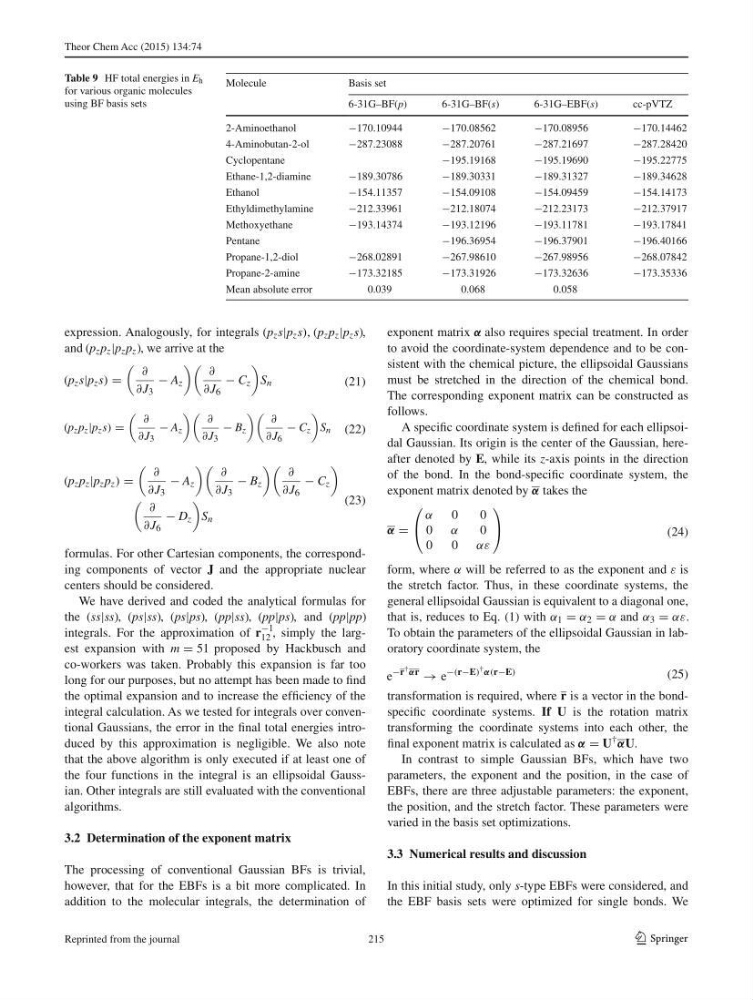
Table 9 HF total energies in E h
for various organic molecules
using BF basis sets
Molecule
Basis set
6-31G–BF( p )
6-31G–BF( s )
6-31G–EBF( s )
cc-pVTZ
2-Aminoethanol
−170.10944
−170.08562
−170.08956
−170.14462
4-Aminobutan-2-ol
−287.23088
−287.20761
−287.21697
−287.28420
Cyclopentane
−195.19168
−195.19690
−195.22775
Ethane-1,2-diamine
−189.30786
−189.30331
−189.31327
−189.34628
Ethanol
−154.11357
−154.09108
−154.09459
−154.14173
Ethyldimethylamine
−212.33961
−212.18074
−212.23173
−212.37917
Methoxyethane
−193.14374
−193.12196
−193.11781
−193.17841
Pentane
−196.36954
−196.37901
−196.40166
Propane-1,2-diol
−268.02891
−267.98610
−267.98956
−268.07842
Propane-2-amine
−173.32185
−173.31926
−173.32636
−173.35336
Mean absolute error
0.039
0.068
0.058
215
Reprinted from the journal
1 3
expression. Analogously, for integrals (p z s|p z s), (p z p z |p z s) ,
and (p z p z |p z p z ) , we arrive at the
formulas. For other Cartesian components, the corresponding components of vector J and the appropriate nuclear
centers should be considered.
We have derived and coded the analytical formulas for
the (ss|ss) , (ps|ss) , (ps|ps) , (pp|ss) , (pp|ps) , and (pp|pp)
integrals. For the approximation of r
−1
12 , simply the largest expansion with m = 51 proposed by Hackbusch and
co-workers was taken. Probably this expansion is far too
long for our purposes, but no attempt has been made to fi nd
the optimal expansion and to increase the effi ciency of the
integral calculation. As we tested for integrals over conventional Gaussians, the error in the fi nal total energies introduced by this approximation is negligible. We also note
that the above algorithm is only executed if at least one of
the four functions in the integral is an ellipsoidal Gaussian. Other integrals are still evaluated with the conventional
algorithms.
3.2 Determination of the exponent matrix
The processing of conventional Gaussian BFs is trivial,
however, that for the EBFs is a bit more complicated. In
addition to the molecular integrals, the determination of
(21)
(p z s|p z s) =
∂
∂J 3
− A z
∂
∂J 6
− C z
S n
(22)
(p z p z |p z s) =
∂
∂J 3
− A z
∂
∂J 3
− B z
∂
∂J 6
− C z
S n
(23)
(p z p z |p z p z ) =
∂
∂J 3
− A z
∂
∂J 3
− B z
∂
∂J 6
− C z
∂
∂J 6
− D z
S n
exponent matrix α also requires special treatment. In order
to avoid the coordinate-system dependence and to be consistent with the chemical picture, the ellipsoidal Gaussians
must be stretched in the direction of the chemical bond.
The corresponding exponent matrix can be constructed as
follows.
A specifi c coordinate system is defi ned for each ellipsoidal Gaussian. Its origin is the center of the Gaussian, hereafter denoted by E , while its z -axis points in the direction
of the bond. In the bond-specifi c coordinate system, the
exponent matrix denoted by α takes the
form, where α will be referred to as the exponent and ε is
the stretch factor. Thus, in these coordinate systems, the
general ellipsoidal Gaussian is equivalent to a diagonal one,
that is, reduces to Eq. ( 1 ) with α 1 = α 2 = α and α 3 = αε.
To obtain the parameters of the ellipsoidal Gaussian in laboratory coordinate system, the
transformation is required, where r is a vector in the bondspecifi c coordinate systems. If U is the rotation matrix
transforming the coordinate systems into each other, the
fi nal exponent matrix is calculated as α = U † αU.
In contrast to simple Gaussian BFs, which have two
parameters, the exponent and the position, in the case of
EBFs, there are three adjustable parameters: the exponent,
the position, and the stretch factor. These parameters were
varied in the basis set optimizations.
3.3 Numerical results and discussion
In this initial study, only s -type EBFs were considered, and
the EBF basis sets were optimized for single bonds. We
(24)
α =
⎛
⎝
α 0
0
0 α
0
0
0 αε
⎞
⎠
(25)
e
−r † αr
→ e
−(r−E) † α(r−E)
Table 9 HF total energies in E h
for various organic molecules
using BF basis sets
Molecule
Basis set
6-31G–BF( p )
6-31G–BF( s )
6-31G–EBF( s )
cc-pVTZ
2-Aminoethanol
−170.10944
−170.08562
−170.08956
−170.14462
4-Aminobutan-2-ol
−287.23088
−287.20761
−287.21697
−287.28420
Cyclopentane
−195.19168
−195.19690
−195.22775
Ethane-1,2-diamine
−189.30786
−189.30331
−189.31327
−189.34628
Ethanol
−154.11357
−154.09108
−154.09459
−154.14173
Ethyldimethylamine
−212.33961
−212.18074
−212.23173
−212.37917
Methoxyethane
−193.14374
−193.12196
−193.11781
−193.17841
Pentane
−196.36954
−196.37901
−196.40166
Propane-1,2-diol
−268.02891
−267.98610
−267.98956
−268.07842
Propane-2-amine
−173.32185
−173.31926
−173.32636
−173.35336
Mean absolute error
0.039
0.068
0.058
215
Reprinted from the journal