

Theor Chem Acc (2016) 135:3
1 3
in Table 1 . One can see that the largest deviation from
benchmark results is only 0.30 μhartrees.
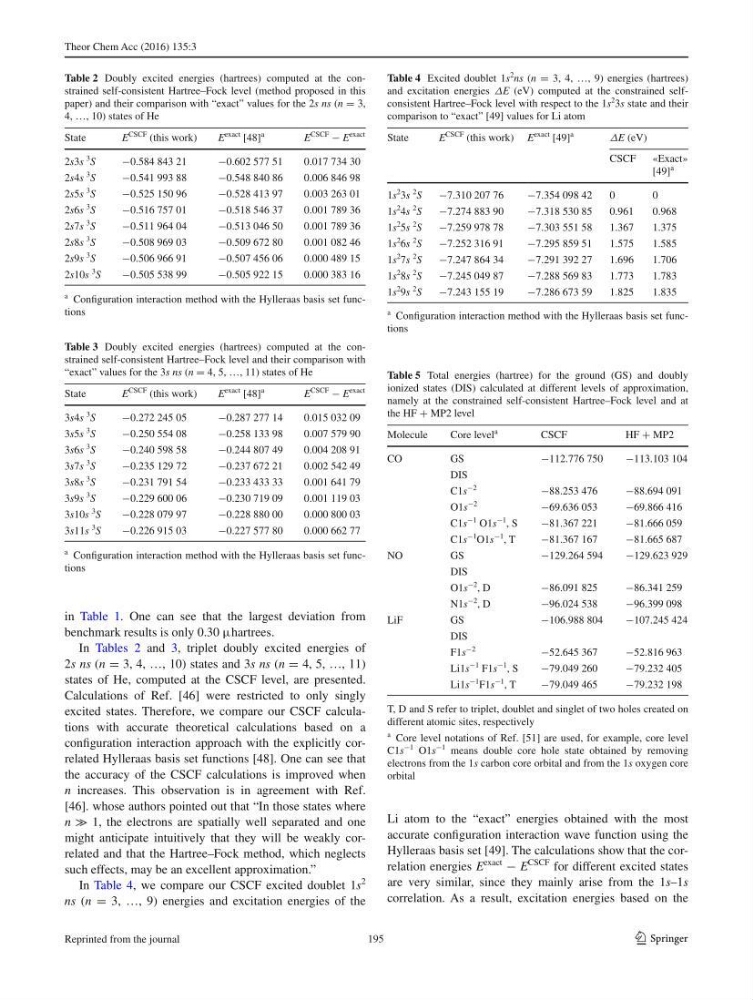
In Tables 2 and 3 , triplet doubly excited energies of
2 s ns ( n = 3, 4, …, 10) states and 3 s ns ( n = 4, 5, …, 11)
states of He, computed at the CSCF level, are presented.
Calculations of Ref. [ 46 ] were restricted to only singly
excited states. Therefore, we compare our CSCF calculations with accurate theoretical calculations based on a
confi guration interaction approach with the explicitly correlated Hylleraas basis set functions [ 48 ]. One can see that
the accuracy of the CSCF calculations is improved when
n increases. This observation is in agreement with Ref.
[ 46 ]. whose authors pointed out that “In those states where
n ≫ 1, the electrons are spatially well separated and one
might anticipate intuitively that they will be weakly correlated and that the Hartree–Fock method, which neglects
such effects, may be an excellent approximation.”
In Table 4 , we compare our CSCF excited doublet 1 s
2
ns ( n = 3, …, 9) energies and excitation energies of the
Li atom to the “exact” energies obtained with the most
accurate confi guration interaction wave function using the
Hylleraas basis set [ 49 ]. The calculations show that the correlation energies E
exact
− E
CSCF for different excited states
are very similar, since they mainly arise from the 1 s –1 s
correlation. As a result, excitation energies based on the
Table 2 Doubly excited energies (hartrees) computed at the constrained self-consistent Hartree–Fock level (method proposed in this
paper) and their comparison with “exact” values for the 2 s ns ( n = 3,
4, …, 10) states of He
a Confi guration interaction method with the Hylleraas basis set functions
State
E
CSCF (this work)
E
exact [ 48 ]
a
E
CSCF − E
exact
2 s 3 s
3 S
−0.584 843 21
−0.602 577 51
0.017 734 30
2 s 4 s
3 S
−0.541 993 88
−0.548 840 86
0.006 846 98
2 s 5 s
3 S
−0.525 150 96
−0.528 413 97
0.003 263 01
2 s 6 s
3 S
−0.516 757 01
−0.518 546 37
0.001 789 36
2 s 7 s
3 S
−0.511 964 04
−0.513 046 50
0.001 789 36
2 s 8 s
3 S
−0.508 969 03
−0.509 672 80
0.001 082 46
2 s 9 s
3 S
−0.506 966 91
−0.507 456 06
0.000 489 15
2 s 10 s
3 S
−0.505 538 99
−0.505 922 15
0.000 383 16
Table 3 Doubly excited energies (hartrees) computed at the constrained self-consistent Hartree–Fock level and their comparison with
“exact” values for the 3 s ns ( n = 4, 5, …, 11) states of He
a Confi guration interaction method with the Hylleraas basis set functions
State
E
CSCF (this work)
E
exact [ 48 ]
a
E
CSCF − E
exact
3 s 4 s
3 S
−0.272 245 05
−0.287 277 14
0.015 032 09
3 s 5 s
3 S
−0.250 554 08
−0.258 133 98
0.007 579 90
3 s 6 s
3 S
−0.240 598 58
−0.244 807 49
0.004 208 91
3 s 7 s
3 S
−0.235 129 72
−0.237 672 21
0.002 542 49
3 s 8 s
3 S
−0.231 791 54
−0.233 433 33
0.001 641 79
3 s 9 s
3 S
−0.229 600 06
−0.230 719 09
0.001 119 03
3 s 10 s
3 S
−0.228 079 97
−0.228 880 00
0.000 800 03
3 s 11 s
3 S
−0.226 915 03
−0.227 577 80
0.000 662 77
Table 4 Excited doublet 1 s
2
ns ( n = 3, 4, …, 9) energies (hartrees)
and excitation energies ΔE (eV) computed at the constrained selfconsistent Hartree–Fock level with respect to the 1 s
2 3 s state and their
comparison to “exact” [ 49 ] values for Li atom
a Confi guration interaction method with the Hylleraas basis set functions
State
E
CSCF (this work) E
exact [ 49 ]
a
ΔE (eV)
CSCF
«Exact»
[ 49 ]
a
1 s
2 3 s
2
S
−7.310 207 76
−7.354 098 42
0
0
1 s
2 4 s
2
S
−7.274 883 90
−7.318 530 85
0.961
0.968
1 s
2 5 s
2
S
−7.259 978 78
−7.303 551 58
1.367
1.375
1 s
2 6 s
2
S
−7.252 316 91
−7.295 859 51
1.575
1.585
1 s
2 7 s
2
S
−7.247 864 34
−7.291 392 27
1.696
1.706
1 s
2 8 s
2
S
−7.245 049 87
−7.288 569 83
1.773
1.783
1 s
2 9 s
2
S
−7.243 155 19
−7.286 673 59
1.825
1.835
Table 5 Total energies (hartree) for the ground (GS) and doubly
ionized states (DIS) calculated at different levels of approximation,
namely at the constrained self-consistent Hartree–Fock level and at
the HF + MP2 level
T, D and S refer to triplet, doublet and singlet of two holes created on
different atomic sites, respectively
a Core level notations of Ref. [ 51 ] are used, for example, core level
C1 s
−1 O1 s
−1 means double core hole state obtained by removing
electrons from the 1 s carbon core orbital and from the 1 s oxygen core
orbital
Molecule
Core level
a
CSCF
HF + MP2
CO
GS
−112.776 750
−113.103 104
DIS
C1 s
−2
−88.253 476
−88.694 091
O1 s
−2
−69.636 053
−69.866 416
C1 s
−1 O1 s
−1
, S
−81.367 221
−81.666 059
C1 s
−1
O1 s
−1
, T
−81.367 167
−81.665 687
NO
GS
−129.264 594
−129.623 929
DIS
O1 s
−2
, D
−86.091 825
−86.341 259
N1 s
−2
, D
−96.024 538
−96.399 098
LiF
GS
−106.988 804
−107.245 424
DIS
F1 s
−2
−52.645 367
−52.816 963
Li1 s
−1 F1 s
−1
, S
−79.049 260
−79.232 405
Li1 s
−1
F1 s
−1
, T
−79.049 465
−79.232 198
195
Reprinted from the journal
1 3
in Table 1 . One can see that the largest deviation from
benchmark results is only 0.30 μhartrees.
In Tables 2 and 3 , triplet doubly excited energies of
2 s ns ( n = 3, 4, …, 10) states and 3 s ns ( n = 4, 5, …, 11)
states of He, computed at the CSCF level, are presented.
Calculations of Ref. [ 46 ] were restricted to only singly
excited states. Therefore, we compare our CSCF calculations with accurate theoretical calculations based on a
confi guration interaction approach with the explicitly correlated Hylleraas basis set functions [ 48 ]. One can see that
the accuracy of the CSCF calculations is improved when
n increases. This observation is in agreement with Ref.
[ 46 ]. whose authors pointed out that “In those states where
n ≫ 1, the electrons are spatially well separated and one
might anticipate intuitively that they will be weakly correlated and that the Hartree–Fock method, which neglects
such effects, may be an excellent approximation.”
In Table 4 , we compare our CSCF excited doublet 1 s
2
ns ( n = 3, …, 9) energies and excitation energies of the
Li atom to the “exact” energies obtained with the most
accurate confi guration interaction wave function using the
Hylleraas basis set [ 49 ]. The calculations show that the correlation energies E
exact
− E
CSCF for different excited states
are very similar, since they mainly arise from the 1 s –1 s
correlation. As a result, excitation energies based on the
Table 2 Doubly excited energies (hartrees) computed at the constrained self-consistent Hartree–Fock level (method proposed in this
paper) and their comparison with “exact” values for the 2 s ns ( n = 3,
4, …, 10) states of He
a Confi guration interaction method with the Hylleraas basis set functions
State
E
CSCF (this work)
E
exact [ 48 ]
a
E
CSCF − E
exact
2 s 3 s
3 S
−0.584 843 21
−0.602 577 51
0.017 734 30
2 s 4 s
3 S
−0.541 993 88
−0.548 840 86
0.006 846 98
2 s 5 s
3 S
−0.525 150 96
−0.528 413 97
0.003 263 01
2 s 6 s
3 S
−0.516 757 01
−0.518 546 37
0.001 789 36
2 s 7 s
3 S
−0.511 964 04
−0.513 046 50
0.001 789 36
2 s 8 s
3 S
−0.508 969 03
−0.509 672 80
0.001 082 46
2 s 9 s
3 S
−0.506 966 91
−0.507 456 06
0.000 489 15
2 s 10 s
3 S
−0.505 538 99
−0.505 922 15
0.000 383 16
Table 3 Doubly excited energies (hartrees) computed at the constrained self-consistent Hartree–Fock level and their comparison with
“exact” values for the 3 s ns ( n = 4, 5, …, 11) states of He
a Confi guration interaction method with the Hylleraas basis set functions
State
E
CSCF (this work)
E
exact [ 48 ]
a
E
CSCF − E
exact
3 s 4 s
3 S
−0.272 245 05
−0.287 277 14
0.015 032 09
3 s 5 s
3 S
−0.250 554 08
−0.258 133 98
0.007 579 90
3 s 6 s
3 S
−0.240 598 58
−0.244 807 49
0.004 208 91
3 s 7 s
3 S
−0.235 129 72
−0.237 672 21
0.002 542 49
3 s 8 s
3 S
−0.231 791 54
−0.233 433 33
0.001 641 79
3 s 9 s
3 S
−0.229 600 06
−0.230 719 09
0.001 119 03
3 s 10 s
3 S
−0.228 079 97
−0.228 880 00
0.000 800 03
3 s 11 s
3 S
−0.226 915 03
−0.227 577 80
0.000 662 77
Table 4 Excited doublet 1 s
2
ns ( n = 3, 4, …, 9) energies (hartrees)
and excitation energies ΔE (eV) computed at the constrained selfconsistent Hartree–Fock level with respect to the 1 s
2 3 s state and their
comparison to “exact” [ 49 ] values for Li atom
a Confi guration interaction method with the Hylleraas basis set functions
State
E
CSCF (this work) E
exact [ 49 ]
a
ΔE (eV)
CSCF
«Exact»
[ 49 ]
a
1 s
2 3 s
2
S
−7.310 207 76
−7.354 098 42
0
0
1 s
2 4 s
2
S
−7.274 883 90
−7.318 530 85
0.961
0.968
1 s
2 5 s
2
S
−7.259 978 78
−7.303 551 58
1.367
1.375
1 s
2 6 s
2
S
−7.252 316 91
−7.295 859 51
1.575
1.585
1 s
2 7 s
2
S
−7.247 864 34
−7.291 392 27
1.696
1.706
1 s
2 8 s
2
S
−7.245 049 87
−7.288 569 83
1.773
1.783
1 s
2 9 s
2
S
−7.243 155 19
−7.286 673 59
1.825
1.835
Table 5 Total energies (hartree) for the ground (GS) and doubly
ionized states (DIS) calculated at different levels of approximation,
namely at the constrained self-consistent Hartree–Fock level and at
the HF + MP2 level
T, D and S refer to triplet, doublet and singlet of two holes created on
different atomic sites, respectively
a Core level notations of Ref. [ 51 ] are used, for example, core level
C1 s
−1 O1 s
−1 means double core hole state obtained by removing
electrons from the 1 s carbon core orbital and from the 1 s oxygen core
orbital
Molecule
Core level
a
CSCF
HF + MP2
CO
GS
−112.776 750
−113.103 104
DIS
C1 s
−2
−88.253 476
−88.694 091
O1 s
−2
−69.636 053
−69.866 416
C1 s
−1 O1 s
−1
, S
−81.367 221
−81.666 059
C1 s
−1
O1 s
−1
, T
−81.367 167
−81.665 687
NO
GS
−129.264 594
−129.623 929
DIS
O1 s
−2
, D
−86.091 825
−86.341 259
N1 s
−2
, D
−96.024 538
−96.399 098
LiF
GS
−106.988 804
−107.245 424
DIS
F1 s
−2
−52.645 367
−52.816 963
Li1 s
−1 F1 s
−1
, S
−79.049 260
−79.232 405
Li1 s
−1
F1 s
−1
, T
−79.049 465
−79.232 198
195
Reprinted from the journal