

Theor Chem Acc (2016) 135:3
1 3
shall also omit the subscript “1” for a given ES and
Φ 1 ≡ Φ (0) , Φ 0 ≡ Φ
(0)
0 .
In contrast to the ground state case, for the excited state
it is necessary to take into consideration the orthogonality
constraints. For the fi rst-order correction to the excited state
reference function, Φ (1) , these constraints have the form
and the constraints determined by the orthogonality condition for the states in the fi rst-order perturbation theory leads
to equation
where
P
(0)
0 = |Φ
(0)
0 Φ
(0)
0 |
and
P
(1)
0 = |Φ
(0)
0 Φ
(1)
0 | + |Φ
(1)
0 Φ
(0)
0 | Then one can show
that the Rayleigh–Schrödinger perturbation theory leads to
the following expression for the second-order correction to
the ES energy [ 10 ]:
Here subscripts “ i ” and “ j ” are occupied and “ a ,” “ b ” are
virtual orbitals in Φ (0) .
The fi rst term in Eq. ( 25 ) is immediately recognized as
the second-order perturbation theory expression for the
ground state energy [ cf. with ( 24 )]. The second term in
Eq. ( 25 ) appears because the Hartree–Fock ground and
excited state functions are not eigenfunctions of the Hamiltonian H . In practice, if the ground state and excited state
energies and the corresponding wave functions are known
accurately then the coupling matrix element Φ (0) |H|Φ
(0)
0
Φ
(0)
|Φ
(1)
= 0,
P
(0)
0
Φ
(0)
+ P
(1)
0
Φ
(1)
= 0
(25)
E
(2)
=
occ
i>j
virt
a>b
ϕ a ϕ i |ϕ b ϕ j
−
ϕ a ϕ j |ϕ b ϕ i
2
i + j − a − b
−
Φ
(0)
|H|Φ
(0)
0
Φ
(1)
0 |Φ
(0)
is expected to be small (see also [ 14 ], Sect. 3.1). Furthermore, as the overlap element Φ
(1)
0 |Φ (0) < 1, the last term
in Eq. ( 25 ) may be neglected during the fi rst stage of calculations. We used this approximation here.
Thus, we obtain comparable perturbation schemes for
the ground and excited state energies. Use of the asymptotic projection technique ensures that calculations for
excited states require practically the same computational
time as those for the ground state.
5 Results and discussion
At present, there are only very few published fi nite basis
set calculations for excited states (especially for Rydberg
states [ 46 ]) having the same symmetry as the ground state
which are based on existing Hartree–Fock methods. In this
section we demonstrate the potential of our methodology
by means of the HF calculations for highly doubly excited
3 S states of the He atom (2 s ns , n = 3, 4, …, 10 and 3 s ns ,
n = 4, 5, …, 11), highly excited 1 s
2 ns ( n = 3, …, 9) states
of the Li atom and of the doubly ionized core hole states
for some diatomic molecules (CO, NO, LiF) computed at
the HF + MP2 level of theory.
5.1 Atoms
For atoms, basis sets of 42 s -gaussians were constructed
according to the even-tempered prescription i.e., the exponents, ζ p , were defi ned by the geometric series:
The parameters α and β were optimized for each atom
and a given excited state. Information of the even-tempered
basis sets for low-lying states of the He and Li atom can
be found in Ref. [ 47 ]. More information for highly excited
state basis sets is available from authors on request.
As a fi rst test for orthogonality-constrained HF method,
hereafter denoted CSCF for constrained self-consistent
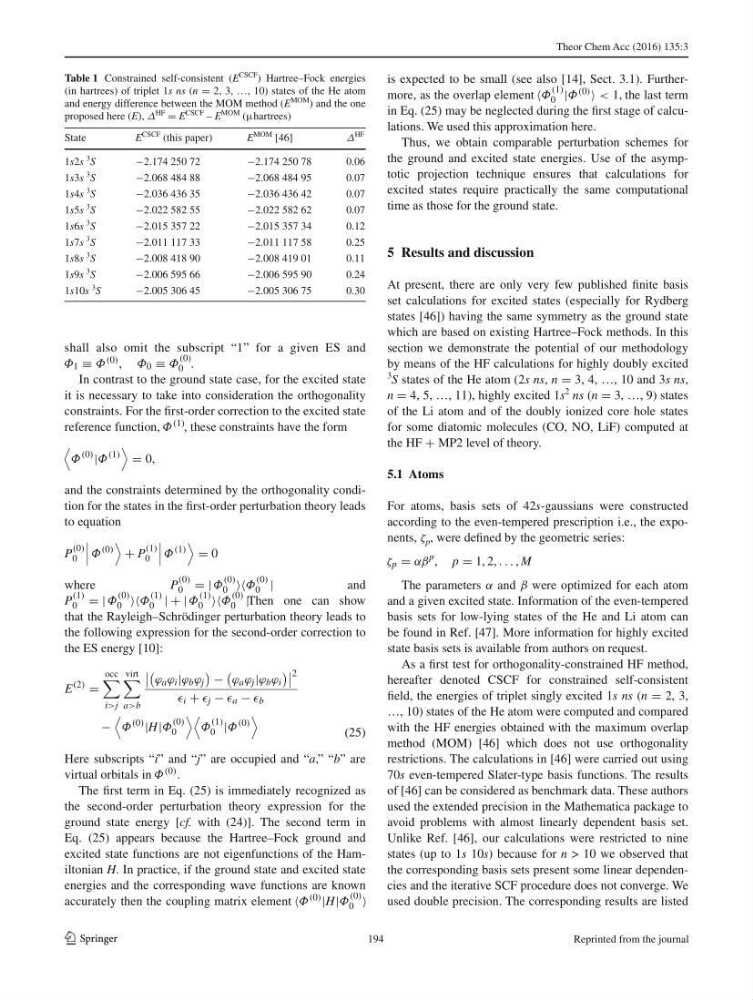
fi eld, the energies of triplet singly excited 1 s ns ( n = 2, 3,
…, 10) states of the He atom were computed and compared
with the HF energies obtained with the maximum overlap
method (MOM) [ 46 ] which does not use orthogonality
restrictions. The calculations in [ 46 ] were carried out using
70 s even-tempered Slater-type basis functions. The results
of [ 46 ] can be considered as benchmark data. These authors
used the extended precision in the Mathematica package to
avoid problems with almost linearly dependent basis set.
Unlike Ref. [ 46 ], our calculations were restricted to nine
states (up to 1 s 10 s ) because for n > 10 we observed that
the corresponding basis sets present some linear dependencies and the iterative SCF procedure does not converge. We
used double precision. The corresponding results are listed
ζ p = αβ
p , p = 1, 2, . . . , M
Table 1 Constrained self-consistent ( E
CSCF
) Hartree–Fock energies
(in hartrees) of triplet 1 s ns ( n = 2, 3, …, 10) states of the He atom
and energy difference between the MOM method ( E
MOM ) and the one
proposed here ( E ), Δ
HF = E
CSCF – E
MOM (μhartrees)
State
E
CSCF (this paper)
E
MOM [ 46 ]
Δ
HF
1 s 2 s
3 S
−2.174 250 72
−2.174 250 78
0.06
1 s 3 s
3 S
−2.068 484 88
−2.068 484 95
0.07
1 s 4 s
3 S
−2.036 436 35
−2.036 436 42
0.07
1 s 5 s
3 S
−2.022 582 55
−2.022 582 62
0.07
1 s 6 s
3 S
−2.015 357 22
−2.015 357 34
0.12
1 s 7 s
3 S
−2.011 117 33
−2.011 117 58
0.25
1 s 8 s
3 S
−2.008 418 90
−2.008 419 01
0.11
1 s 9 s
3 S
−2.006 595 66
−2.006 595 90
0.24
1 s 10 s
3 S
−2.005 306 45
−2.005 306 75
0.30
194
Reprinted from the journal
1 3
shall also omit the subscript “1” for a given ES and
Φ 1 ≡ Φ (0) , Φ 0 ≡ Φ
(0)
0 .
In contrast to the ground state case, for the excited state
it is necessary to take into consideration the orthogonality
constraints. For the fi rst-order correction to the excited state
reference function, Φ (1) , these constraints have the form
and the constraints determined by the orthogonality condition for the states in the fi rst-order perturbation theory leads
to equation
where
P
(0)
0 = |Φ
(0)
0 Φ
(0)
0 |
and
P
(1)
0 = |Φ
(0)
0 Φ
(1)
0 | + |Φ
(1)
0 Φ
(0)
0 | Then one can show
that the Rayleigh–Schrödinger perturbation theory leads to
the following expression for the second-order correction to
the ES energy [ 10 ]:
Here subscripts “ i ” and “ j ” are occupied and “ a ,” “ b ” are
virtual orbitals in Φ (0) .
The fi rst term in Eq. ( 25 ) is immediately recognized as
the second-order perturbation theory expression for the
ground state energy [ cf. with ( 24 )]. The second term in
Eq. ( 25 ) appears because the Hartree–Fock ground and
excited state functions are not eigenfunctions of the Hamiltonian H . In practice, if the ground state and excited state
energies and the corresponding wave functions are known
accurately then the coupling matrix element Φ (0) |H|Φ
(0)
0
Φ
(0)
|Φ
(1)
= 0,
P
(0)
0
Φ
(0)
+ P
(1)
0
Φ
(1)
= 0
(25)
E
(2)
=
occ
i>j
virt
a>b
ϕ a ϕ i |ϕ b ϕ j
−
ϕ a ϕ j |ϕ b ϕ i
2
i + j − a − b
−
Φ
(0)
|H|Φ
(0)
0
Φ
(1)
0 |Φ
(0)
is expected to be small (see also [ 14 ], Sect. 3.1). Furthermore, as the overlap element Φ
(1)
0 |Φ (0) < 1, the last term
in Eq. ( 25 ) may be neglected during the fi rst stage of calculations. We used this approximation here.
Thus, we obtain comparable perturbation schemes for
the ground and excited state energies. Use of the asymptotic projection technique ensures that calculations for
excited states require practically the same computational
time as those for the ground state.
5 Results and discussion
At present, there are only very few published fi nite basis
set calculations for excited states (especially for Rydberg
states [ 46 ]) having the same symmetry as the ground state
which are based on existing Hartree–Fock methods. In this
section we demonstrate the potential of our methodology
by means of the HF calculations for highly doubly excited
3 S states of the He atom (2 s ns , n = 3, 4, …, 10 and 3 s ns ,
n = 4, 5, …, 11), highly excited 1 s
2 ns ( n = 3, …, 9) states
of the Li atom and of the doubly ionized core hole states
for some diatomic molecules (CO, NO, LiF) computed at
the HF + MP2 level of theory.
5.1 Atoms
For atoms, basis sets of 42 s -gaussians were constructed
according to the even-tempered prescription i.e., the exponents, ζ p , were defi ned by the geometric series:
The parameters α and β were optimized for each atom
and a given excited state. Information of the even-tempered
basis sets for low-lying states of the He and Li atom can
be found in Ref. [ 47 ]. More information for highly excited
state basis sets is available from authors on request.
As a fi rst test for orthogonality-constrained HF method,
hereafter denoted CSCF for constrained self-consistent
fi eld, the energies of triplet singly excited 1 s ns ( n = 2, 3,
…, 10) states of the He atom were computed and compared
with the HF energies obtained with the maximum overlap
method (MOM) [ 46 ] which does not use orthogonality
restrictions. The calculations in [ 46 ] were carried out using
70 s even-tempered Slater-type basis functions. The results
of [ 46 ] can be considered as benchmark data. These authors
used the extended precision in the Mathematica package to
avoid problems with almost linearly dependent basis set.
Unlike Ref. [ 46 ], our calculations were restricted to nine
states (up to 1 s 10 s ) because for n > 10 we observed that
the corresponding basis sets present some linear dependencies and the iterative SCF procedure does not converge. We
used double precision. The corresponding results are listed
ζ p = αβ
p , p = 1, 2, . . . , M
Table 1 Constrained self-consistent ( E
CSCF
) Hartree–Fock energies
(in hartrees) of triplet 1 s ns ( n = 2, 3, …, 10) states of the He atom
and energy difference between the MOM method ( E
MOM ) and the one
proposed here ( E ), Δ
HF = E
CSCF – E
MOM (μhartrees)
State
E
CSCF (this paper)
E
MOM [ 46 ]
Δ
HF
1 s 2 s
3 S
−2.174 250 72
−2.174 250 78
0.06
1 s 3 s
3 S
−2.068 484 88
−2.068 484 95
0.07
1 s 4 s
3 S
−2.036 436 35
−2.036 436 42
0.07
1 s 5 s
3 S
−2.022 582 55
−2.022 582 62
0.07
1 s 6 s
3 S
−2.015 357 22
−2.015 357 34
0.12
1 s 7 s
3 S
−2.011 117 33
−2.011 117 58
0.25
1 s 8 s
3 S
−2.008 418 90
−2.008 419 01
0.11
1 s 9 s
3 S
−2.006 595 66
−2.006 595 90
0.24
1 s 10 s
3 S
−2.005 306 45
−2.005 306 75
0.30
194
Reprinted from the journal