

Theor Chem Acc (2015) 134:125
1 3
where,
and,
So, the expectation value of S − S + is,
Similarly, the expectation value of S + S − is,
Using Eq.( 4 ) and putting together Eqs. ( 10 ), ( 17 ) and ( 18 ),
one obtains the expectation value of S
2 ,
(14)
S
−
Φ GCHF =
N e
i=1
`
Φ
i
GCHF ,
(15)
`
Φ
i
GCHF = φ 1 ∧ · · · ∧ φ i−1 ∧ `
φ i ∧ φ i+1 ∧ · · · ∧ φ N e ,
(16)
`
φ i =
0
+φ iα
.
(17)
Φ GCHF |S
− S
+ |Φ GCHF =
S
+ Φ GCHF |S
+ Φ GCHF
=
Ne
i,j=1
´
Φ
i
GCHF | ´
Φ
j
GCHF
=
Ne
i=1
´
Φ
i
GCHF | ´
Φ
i
GCHF
+
Ne
i,j=1
i =j
´
Φ
i
GCHF | ´
Φ
j
GCHF
=
Ne
i=1
⎛
⎜
⎜
⎝
´
φ i | ´
φ i
+
Ne
j=1
j =i
(−1) |
´
φ i |φ j
|
2 +
´
φ i |φ i
φ j | ´
φ j
⎞
⎟
⎟
⎠
=
Ne
i=1
⎛
⎜
⎜
⎝ φ iβ |φ iβ +
Ne
j=1
j =i
(−1) ||φ iβ |φ jα |
2 + +φ iβ |φ iα φ jα |φ jβ
⎞
⎟
⎟
⎠
= N β +
Ne
i,j=1
φ iβ |φ iα φ jα |φ jβ − −φ iβ |φ jα φ jα |φ iβ
.
(18)
Φ GCHF |S
+ S
− |Φ GCHF = =S
− Φ GCHF |S
− Φ GCHF
=
Ne
i=1
⎛
⎜
⎜
⎝ `
φ i | `
φ i +
Ne
j=1
j =i
(−1) || `
φ i |φ j |
2 + + `
φ i |φ i φ j | `
φ j
⎞
⎟
⎟
⎠
=
Ne
i=1
⎛
⎜
⎜
⎝ φ iα |φ iα +
Ne
j=1
j =i
(−1) ||φ iα |φ jβ |
2 + +φ iα |φ iβ φ jβ |φ jα
⎞
⎟
⎟
⎠
= N α +
Ne
i,j=1
φ iα |φ iβ φ jβ |φ jα − −φ iα |φ jβ φ jβ |φ iα .
(19)
Φ GCHF |S
2
|Φ GCHF =
N α
2
−
N β
2
2
+
N α
2
+
N β
2
+
1
4
⎛
⎝ N e −
N e
i,j=1
||φ iα |φ jα − −φ iβ |φ jβ |
2
⎞
⎠
+
N e
i,j=1
φ iα |φ iβ φ jβ |φ jα − −φ iα |φ jβ φ jβ |φ iα .
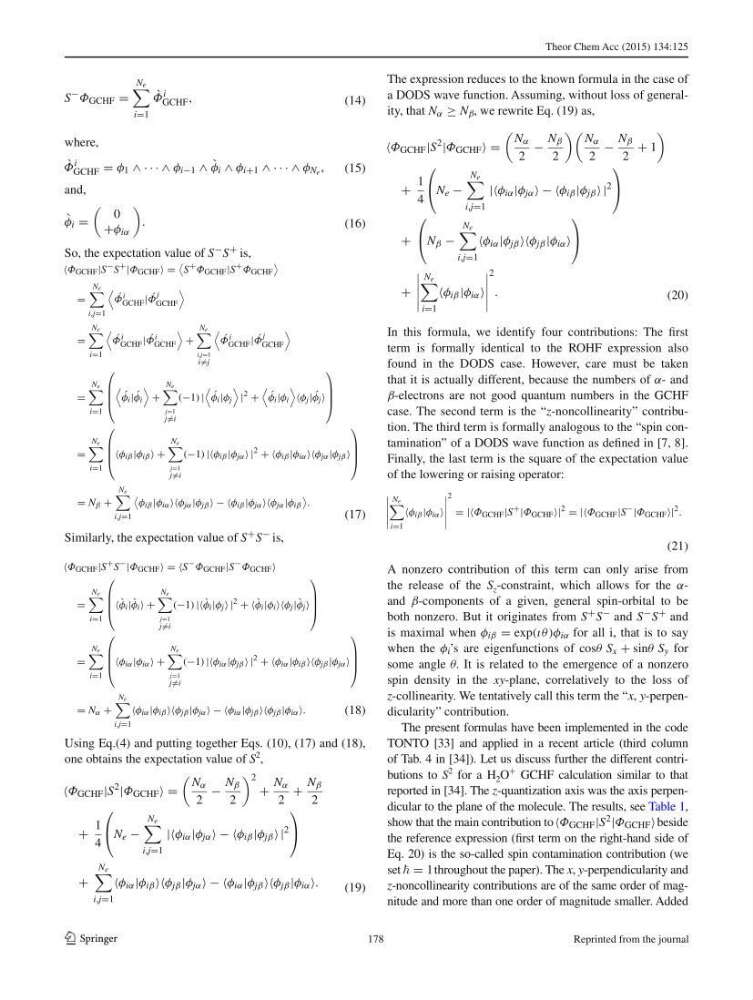
The expression reduces to the known formula in the case of
a DODS wave function. Assuming, without loss of generality, that N α ≥ N β , we rewrite Eq. ( 19 ) as,
In this formula, we identify four contributions: The fi rst
term is formally identical to the ROHF expression also
found in the DODS case. However, care must be taken
that it is actually different, because the numbers of α - and
β -electrons are not good quantum numbers in the GCHF
case. The second term is the “ z -noncollinearity” contribution. The third term is formally analogous to the “spin contamination” of a DODS wave function as defi ned in [ 7 , 8 ].
Finally, the last term is the square of the expectation value
of the lowering or raising operator:
A nonzero contribution of this term can only arise from
the release of the S z -constraint, which allows for the α -
and β -components of a given, general spin-orbital to be
both nonzero. But it originates from S + S − and S − S + and
is maximal when φ iβ = exp(ıθ)φ iα for all i, that is to say
when the φ i ’s are eigenfunctions of cosθ S x + sinθ S y for
some angle θ . It is related to the emergence of a nonzero
spin density in the xy -plane, correlatively to the loss of
z -collinearity. We tentatively call this term the “ x , y -perpendicularity” contribution.
The present formulas have been implemented in the code
TONTO [ 33 ] and applied in a recent article (third column
of Tab. 4 in [ 34 ]). Let us discuss further the different contributions to S
2 for a H 2 O
+ GCHF calculation similar to that
reported in [ 34 ]. The z -quantization axis was the axis perpendicular to the plane of the molecule. The results, see Table 1 ,
show that the main contribution to Φ GCHF |S 2 |Φ GCHF beside
the reference expression (fi rst term on the right-hand side of
Eq. 20 ) is the so-called spin contamination contribution (we
set = 1 throughout the paper). The x , y -perpendicularity and
z -noncollinearity contributions are of the same order of magnitude and more than one order of magnitude smaller. Added
(20)
Φ GCHF |S
2
|Φ GCHF =
N α
2
−
N β
2
N α
2
−
N β
2
+ 1
+
1
4
⎛
⎝ N e −
N e
i,j=1
||φ iα |φ jα − −φ iβ |φ jβ |
2
⎞
⎠
+
⎛
⎝ N β −
N e
i,j=1
φ iα |φ jβ φ jβ |φ iα
⎞
⎠
+
N e
i=1
φ iβ |φ iα
2
.
(21)
Ne
i=1
φ iβ |φ iα
2
= ||Φ GCHF |S
+ |Φ GCHF |
2 = ||Φ GCHF |S
− |Φ GCHF |
2 .
178
Reprinted from the journal
1 3
where,
and,
So, the expectation value of S − S + is,
Similarly, the expectation value of S + S − is,
Using Eq.( 4 ) and putting together Eqs. ( 10 ), ( 17 ) and ( 18 ),
one obtains the expectation value of S
2 ,
(14)
S
−
Φ GCHF =
N e
i=1
`
Φ
i
GCHF ,
(15)
`
Φ
i
GCHF = φ 1 ∧ · · · ∧ φ i−1 ∧ `
φ i ∧ φ i+1 ∧ · · · ∧ φ N e ,
(16)
`
φ i =
0
+φ iα
.
(17)
Φ GCHF |S
− S
+ |Φ GCHF =
S
+ Φ GCHF |S
+ Φ GCHF
=
Ne
i,j=1
´
Φ
i
GCHF | ´
Φ
j
GCHF
=
Ne
i=1
´
Φ
i
GCHF | ´
Φ
i
GCHF
+
Ne
i,j=1
i =j
´
Φ
i
GCHF | ´
Φ
j
GCHF
=
Ne
i=1
⎛
⎜
⎜
⎝
´
φ i | ´
φ i
+
Ne
j=1
j =i
(−1) |
´
φ i |φ j
|
2 +
´
φ i |φ i
φ j | ´
φ j
⎞
⎟
⎟
⎠
=
Ne
i=1
⎛
⎜
⎜
⎝ φ iβ |φ iβ +
Ne
j=1
j =i
(−1) ||φ iβ |φ jα |
2 + +φ iβ |φ iα φ jα |φ jβ
⎞
⎟
⎟
⎠
= N β +
Ne
i,j=1
φ iβ |φ iα φ jα |φ jβ − −φ iβ |φ jα φ jα |φ iβ
.
(18)
Φ GCHF |S
+ S
− |Φ GCHF = =S
− Φ GCHF |S
− Φ GCHF
=
Ne
i=1
⎛
⎜
⎜
⎝ `
φ i | `
φ i +
Ne
j=1
j =i
(−1) || `
φ i |φ j |
2 + + `
φ i |φ i φ j | `
φ j
⎞
⎟
⎟
⎠
=
Ne
i=1
⎛
⎜
⎜
⎝ φ iα |φ iα +
Ne
j=1
j =i
(−1) ||φ iα |φ jβ |
2 + +φ iα |φ iβ φ jβ |φ jα
⎞
⎟
⎟
⎠
= N α +
Ne
i,j=1
φ iα |φ iβ φ jβ |φ jα − −φ iα |φ jβ φ jβ |φ iα .
(19)
Φ GCHF |S
2
|Φ GCHF =
N α
2
−
N β
2
2
+
N α
2
+
N β
2
+
1
4
⎛
⎝ N e −
N e
i,j=1
||φ iα |φ jα − −φ iβ |φ jβ |
2
⎞
⎠
+
N e
i,j=1
φ iα |φ iβ φ jβ |φ jα − −φ iα |φ jβ φ jβ |φ iα .
The expression reduces to the known formula in the case of
a DODS wave function. Assuming, without loss of generality, that N α ≥ N β , we rewrite Eq. ( 19 ) as,
In this formula, we identify four contributions: The fi rst
term is formally identical to the ROHF expression also
found in the DODS case. However, care must be taken
that it is actually different, because the numbers of α - and
β -electrons are not good quantum numbers in the GCHF
case. The second term is the “ z -noncollinearity” contribution. The third term is formally analogous to the “spin contamination” of a DODS wave function as defi ned in [ 7 , 8 ].
Finally, the last term is the square of the expectation value
of the lowering or raising operator:
A nonzero contribution of this term can only arise from
the release of the S z -constraint, which allows for the α -
and β -components of a given, general spin-orbital to be
both nonzero. But it originates from S + S − and S − S + and
is maximal when φ iβ = exp(ıθ)φ iα for all i, that is to say
when the φ i ’s are eigenfunctions of cosθ S x + sinθ S y for
some angle θ . It is related to the emergence of a nonzero
spin density in the xy -plane, correlatively to the loss of
z -collinearity. We tentatively call this term the “ x , y -perpendicularity” contribution.
The present formulas have been implemented in the code
TONTO [ 33 ] and applied in a recent article (third column
of Tab. 4 in [ 34 ]). Let us discuss further the different contributions to S
2 for a H 2 O
+ GCHF calculation similar to that
reported in [ 34 ]. The z -quantization axis was the axis perpendicular to the plane of the molecule. The results, see Table 1 ,
show that the main contribution to Φ GCHF |S 2 |Φ GCHF beside
the reference expression (fi rst term on the right-hand side of
Eq. 20 ) is the so-called spin contamination contribution (we
set = 1 throughout the paper). The x , y -perpendicularity and
z -noncollinearity contributions are of the same order of magnitude and more than one order of magnitude smaller. Added
(20)
Φ GCHF |S
2
|Φ GCHF =
N α
2
−
N β
2
N α
2
−
N β
2
+ 1
+
1
4
⎛
⎝ N e −
N e
i,j=1
||φ iα |φ jα − −φ iβ |φ jβ |
2
⎞
⎠
+
⎛
⎝ N β −
N e
i,j=1
φ iα |φ jβ φ jβ |φ iα
⎞
⎠
+
N e
i=1
φ iβ |φ iα
2
.
(21)
Ne
i=1
φ iβ |φ iα
2
= ||Φ GCHF |S
+ |Φ GCHF |
2 = ||Φ GCHF |S
− |Φ GCHF |
2 .
178
Reprinted from the journal