

Theor Chem Acc (2015) 134:125
1 3
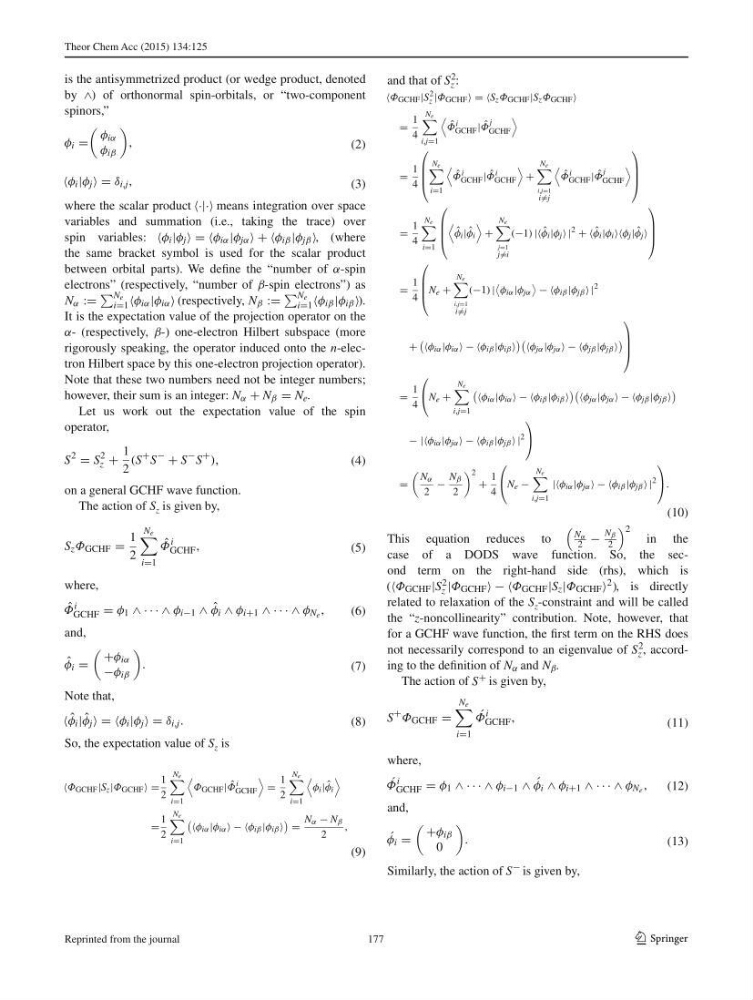
is the antisymmetrized product (or wedge product, denoted
by ∧ ) of orthonormal spin-orbitals, or “two-component
spinors,”
where the scalar product ·|· means integration over space
variables and summation (i.e., taking the trace) over
spin variables: φ i |φ j = φ iα |φ jα + φ iβ |φ jβ , (where
the same bracket symbol is used for the scalar product
between orbital parts). We defi ne the “number of α -spin
electrons” (respectively, “number of β -spin electrons”) as
N α :=
N e
i=1 φ iα |φ iα (respectively, N β :=
N e
i=1 φ iβ |φ iβ ).
It is the expectation value of the projection operator on the
α - (respectively, β -) one-electron Hilbert subspace (more
rigorously speaking, the operator induced onto the n -electron Hilbert space by this one-electron projection operator).
Note that these two numbers need not be integer numbers;
however, their sum is an integer: N α + N β = N e .
Let us work out the expectation value of the spin
operator,
on a general GCHF wave function.
The action of S z is given by,
where,
and,
Note that,
So, the expectation value of S z is
(2)
φ i =
φ iα
φ iβ
,
(3)
φ i |φ j = δ i,j ,
(4)
S
2
= S
2
z +
1
2
(S
+ S
−
+ S
− S
+
),
(5)
S z Φ GCHF =
1
2
N e
i=1
ˆ
Φ
i
GCHF ,
(6)
ˆ
Φ
i
GCHF = φ 1 ∧ · · · ∧ φ i−1 ∧ ˆ
φ i ∧ φ i+1 ∧ · · · ∧ φ N e ,
(7)
ˆ
φ i =
+φ iα
−φ iβ
.
(8)
ˆ
φ i | ˆ
φ j = =φ i |φ j = δ i,j .
(9)
Φ GCHF |S z |Φ GCHF =
1
2
Ne
i=1
Φ GCHF | ˆ
Φ
i
GCHF
=
1
2
Ne
i=1
φ i | ˆ
φ i
=
1
2
Ne
i=1
φ iα |φ iα − −φ iβ |φ iβ
=
N α − N β
2
,
and that of S 2
z :
This equation reduces to
N α
2 −
N β
2
2
in the
case of a DODS wave function. So, the second term on the right-hand side (rhs), which is
(Φ GCHF |S 2
z |Φ GCHF − −Φ GCHF |S z |Φ GCHF 2 ) , is directly
related to relaxation of the S z -constraint and will be called
the “ z -noncollinearity” contribution. Note, however, that
for a GCHF wave function, the fi rst term on the RHS does
not necessarily correspond to an eigenvalue of S 2
z , according to the defi nition of N α and N β .
The action of S + is given by,
where,
and,
Similarly, the action of S − is given by,
(10)
Φ GCHF |S
2
z |Φ GCHF = =S z Φ GCHF |S z Φ GCHF
=
1
4
Ne
i,j=1
ˆ
Φ
i
GCHF | ˆ
Φ
j
GCHF
=
1
4
⎛
⎜
⎜
⎝
Ne
i=1
ˆ
Φ
i
GCHF | ˆ
Φ
i
GCHF
+
Ne
i,j=1
i =j
ˆ
Φ
i
GCHF | ˆ
Φ
j
GCHF
⎞
⎟
⎟
⎠
=
1
4
Ne
i=1
⎛
⎜
⎜
⎝
ˆ
φ i | ˆ
φ i
+
Ne
j=1
j =i
(−1) || ˆ
φ i |φ j |
2 + + ˆ
φ i |φ i φ j | ˆ
φ j
⎞
⎟
⎟
⎠
=
1
4
⎛
⎜
⎜
⎝ N e +
Ne
i,j=1
i =j
(−1) |
φ iα |φ jα
− −φ iβ |φ jβ |
2
+
φ iα |φ iα − −φ iβ |φ iβ
φ jα |φ jα − −φ jβ |φ jβ
⎞
⎟
⎟
⎠
=
1
4
⎛
⎝ N e +
Ne
i,j=1
φ iα |φ iα − −φ iβ |φ iβ
φ jα |φ jα − −φ jβ |φ jβ
− ||φ iα |φ jα − −φ iβ |φ jβ |
2
⎞
⎠
=
N α
2
−
N β
2
2
+
1
4
⎛
⎝ N e −
Ne
i,j=1
||φ iα |φ jα − −φ iβ |φ jβ |
2
⎞
⎠ .
(11)
S
+
Φ GCHF =
N e
i=1
´
Φ
i
GCHF ,
(12)
´
Φ
i
GCHF = φ 1 ∧ · · · ∧ φ i−1 ∧ ´
φ i ∧ φ i+1 ∧ · · · ∧ φ N e ,
(13)
´
φ i =
+φ iβ
0
.
177
Reprinted from the journal
1 3
is the antisymmetrized product (or wedge product, denoted
by ∧ ) of orthonormal spin-orbitals, or “two-component
spinors,”
where the scalar product ·|· means integration over space
variables and summation (i.e., taking the trace) over
spin variables: φ i |φ j = φ iα |φ jα + φ iβ |φ jβ , (where
the same bracket symbol is used for the scalar product
between orbital parts). We defi ne the “number of α -spin
electrons” (respectively, “number of β -spin electrons”) as
N α :=
N e
i=1 φ iα |φ iα (respectively, N β :=
N e
i=1 φ iβ |φ iβ ).
It is the expectation value of the projection operator on the
α - (respectively, β -) one-electron Hilbert subspace (more
rigorously speaking, the operator induced onto the n -electron Hilbert space by this one-electron projection operator).
Note that these two numbers need not be integer numbers;
however, their sum is an integer: N α + N β = N e .
Let us work out the expectation value of the spin
operator,
on a general GCHF wave function.
The action of S z is given by,
where,
and,
Note that,
So, the expectation value of S z is
(2)
φ i =
φ iα
φ iβ
,
(3)
φ i |φ j = δ i,j ,
(4)
S
2
= S
2
z +
1
2
(S
+ S
−
+ S
− S
+
),
(5)
S z Φ GCHF =
1
2
N e
i=1
ˆ
Φ
i
GCHF ,
(6)
ˆ
Φ
i
GCHF = φ 1 ∧ · · · ∧ φ i−1 ∧ ˆ
φ i ∧ φ i+1 ∧ · · · ∧ φ N e ,
(7)
ˆ
φ i =
+φ iα
−φ iβ
.
(8)
ˆ
φ i | ˆ
φ j = =φ i |φ j = δ i,j .
(9)
Φ GCHF |S z |Φ GCHF =
1
2
Ne
i=1
Φ GCHF | ˆ
Φ
i
GCHF
=
1
2
Ne
i=1
φ i | ˆ
φ i
=
1
2
Ne
i=1
φ iα |φ iα − −φ iβ |φ iβ
=
N α − N β
2
,
and that of S 2
z :
This equation reduces to
N α
2 −
N β
2
2
in the
case of a DODS wave function. So, the second term on the right-hand side (rhs), which is
(Φ GCHF |S 2
z |Φ GCHF − −Φ GCHF |S z |Φ GCHF 2 ) , is directly
related to relaxation of the S z -constraint and will be called
the “ z -noncollinearity” contribution. Note, however, that
for a GCHF wave function, the fi rst term on the RHS does
not necessarily correspond to an eigenvalue of S 2
z , according to the defi nition of N α and N β .
The action of S + is given by,
where,
and,
Similarly, the action of S − is given by,
(10)
Φ GCHF |S
2
z |Φ GCHF = =S z Φ GCHF |S z Φ GCHF
=
1
4
Ne
i,j=1
ˆ
Φ
i
GCHF | ˆ
Φ
j
GCHF
=
1
4
⎛
⎜
⎜
⎝
Ne
i=1
ˆ
Φ
i
GCHF | ˆ
Φ
i
GCHF
+
Ne
i,j=1
i =j
ˆ
Φ
i
GCHF | ˆ
Φ
j
GCHF
⎞
⎟
⎟
⎠
=
1
4
Ne
i=1
⎛
⎜
⎜
⎝
ˆ
φ i | ˆ
φ i
+
Ne
j=1
j =i
(−1) || ˆ
φ i |φ j |
2 + + ˆ
φ i |φ i φ j | ˆ
φ j
⎞
⎟
⎟
⎠
=
1
4
⎛
⎜
⎜
⎝ N e +
Ne
i,j=1
i =j
(−1) |
φ iα |φ jα
− −φ iβ |φ jβ |
2
+
φ iα |φ iα − −φ iβ |φ iβ
φ jα |φ jα − −φ jβ |φ jβ
⎞
⎟
⎟
⎠
=
1
4
⎛
⎝ N e +
Ne
i,j=1
φ iα |φ iα − −φ iβ |φ iβ
φ jα |φ jα − −φ jβ |φ jβ
− ||φ iα |φ jα − −φ iβ |φ jβ |
2
⎞
⎠
=
N α
2
−
N β
2
2
+
1
4
⎛
⎝ N e −
Ne
i,j=1
||φ iα |φ jα − −φ iβ |φ jβ |
2
⎞
⎠ .
(11)
S
+
Φ GCHF =
N e
i=1
´
Φ
i
GCHF ,
(12)
´
Φ
i
GCHF = φ 1 ∧ · · · ∧ φ i−1 ∧ ´
φ i ∧ φ i+1 ∧ · · · ∧ φ N e ,
(13)
´
φ i =
+φ iβ
0
.
177
Reprinted from the journal