

Theor Chem Acc (2015) 134:125
1 3
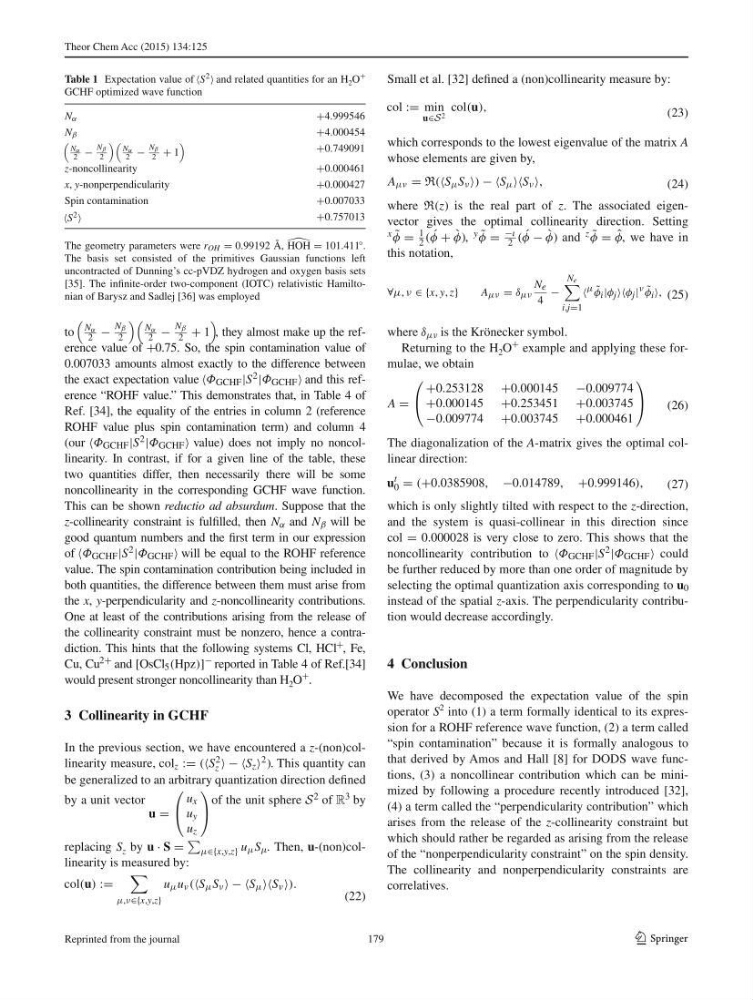
to
N α
2 −
N β
2
N α
2 −
N β
2 + 1
, they almost make up the reference value of + 0.75. So, the spin contamination value of
0.007033 amounts almost exactly to the difference between
the exact expectation value Φ GCHF |S 2 |Φ GCHF and this reference “ROHF value.” This demonstrates that, in Table 4 of
Ref. [ 34 ], the equality of the entries in column 2 (reference
ROHF value plus spin contamination term) and column 4
(our Φ GCHF |S 2 |Φ GCHF value) does not imply no noncollinearity. In contrast, if for a given line of the table, these
two quantities differ, then necessarily there will be some
noncollinearity in the corresponding GCHF wave function.
This can be shown reductio ad absurdum . Suppose that the
z -collinearity constraint is fulfi lled, then N α and N β will be
good quantum numbers and the fi rst term in our expression
of Φ GCHF |S 2 |Φ GCHF will be equal to the ROHF reference
value. The spin contamination contribution being included in
both quantities, the difference between them must arise from
the x , y -perpendicularity and z -noncollinearity contributions.
One at least of the contributions arising from the release of
the collinearity constraint must be nonzero, hence a contradiction. This hints that the following systems Cl, HCl + , Fe,
Cu, Cu 2+ and [OsCl 5 (Hpz)] − reported in Table 4 of Ref.[ 34 ]
would present stronger noncollinearity than H 2 O
+
.
3 Collinearity in GCHF
In the previous section, we have encountered a z -(non)collinearity measure, col z := (S 2
z − −S z 2 ) . This quantity can
be generalized to an arbitrary quantization direction defi ned
by a unit vector
u =
⎛
⎝
u x
u y
u z
⎞
⎠
of the unit sphere S 2 of R 3 by
replacing S z by u · S =
μ∈{x,y,z} u μ S μ . Then, u -(non)collinearity is measured by:
(22)
col(u) :=
μ,ν∈{x,y,z}
u μ u ν (S μ S ν − −S μ S ν ).
Small et al. [ 32 ] defi ned a (non)collinearity measure by:
which corresponds to the lowest eigenvalue of the matrix A
whose elements are given by,
where R(z) is the real part of z . The associated eigenvector gives the optimal collinearity direction. Setting
x ˜
φ =
1
2 ( ´
φ + `
φ) , y ˜
φ =
−ı
2 ( ´
φ − `
φ) and z ˜
φ = ˆ
φ , we have in
this notation,
where δ μν is the Krönecker symbol.
Returning to the H 2 O
+ example and applying these formulae, we obtain
The diagonalization of the A -matrix gives the optimal collinear direction:
which is only slightly tilted with respect to the z -direction,
and the system is quasi-collinear in this direction since
col = 0.000028 is very close to zero. This shows that the
noncollinearity contribution to Φ GCHF |S 2 |Φ GCHF could
be further reduced by more than one order of magnitude by
selecting the optimal quantization axis corresponding to u 0
instead of the spatial z -axis. The perpendicularity contribution would decrease accordingly.
4 Conclusion
We have decomposed the expectation value of the spin
operator S
2 into (1) a term formally identical to its expression for a ROHF reference wave function, (2) a term called
“spin contamination” because it is formally analogous to
that derived by Amos and Hall [ 8 ] for DODS wave functions, (3) a noncollinear contribution which can be minimized by following a procedure recently introduced [ 32 ],
(4) a term called the “perpendicularity contribution” which
arises from the release of the z -collinearity constraint but
which should rather be regarded as arising from the release
of the “nonperpendicularity constraint” on the spin density.
The collinearity and nonperpendicularity constraints are
correlatives.
(23)
col := min
u∈S 2
col(u),
(24)
A μν = R(S μ S ν ) − −S μ S ν ,
(25)
∀μ, ν ∈ {x, y, z}
A μν = δ μν
N e
4
−
N e
i,j=1
μ ˜
φ i |φ j φ j | ν ˜
φ i ,
(26)
A =
⎛
⎝
+0.253128 +0.000145 −0.009774
+0.000145 +0.253451 +0.003745
−0.009774 +0.003745 +0.000461
⎞
⎠
(27)
u
t
0 = (+0.0385908, −0.014789, +0.999146),
Table 1 Expectation value of S 2 and related quantities for an H 2 O
+
GCHF optimized wave function
The geometry parameters were r OH = 0.99192 Å,
HOH = 101.411 °.
The basis set consisted of the primitives Gaussian functions left
uncontracted of Dunning’s cc-pVDZ hydrogen and oxygen basis sets
[ 35 ]. The infi nite-order two-component (IOTC) relativistic Hamiltonian of Barysz and Sadlej [ 36 ] was employed
N α
+4.999546
N β
+4.000454
Nα
2 −
Nβ
2
Nα
2 −
Nβ
2 + 1
+0.749091
z -noncollinearity
+0.000461
x , y -nonperpendicularity
+0.000427
Spin contamination
+0.007033
S 2
+0.757013
179
Reprinted from the journal
1 3
to
N α
2 −
N β
2
N α
2 −
N β
2 + 1
, they almost make up the reference value of + 0.75. So, the spin contamination value of
0.007033 amounts almost exactly to the difference between
the exact expectation value Φ GCHF |S 2 |Φ GCHF and this reference “ROHF value.” This demonstrates that, in Table 4 of
Ref. [ 34 ], the equality of the entries in column 2 (reference
ROHF value plus spin contamination term) and column 4
(our Φ GCHF |S 2 |Φ GCHF value) does not imply no noncollinearity. In contrast, if for a given line of the table, these
two quantities differ, then necessarily there will be some
noncollinearity in the corresponding GCHF wave function.
This can be shown reductio ad absurdum . Suppose that the
z -collinearity constraint is fulfi lled, then N α and N β will be
good quantum numbers and the fi rst term in our expression
of Φ GCHF |S 2 |Φ GCHF will be equal to the ROHF reference
value. The spin contamination contribution being included in
both quantities, the difference between them must arise from
the x , y -perpendicularity and z -noncollinearity contributions.
One at least of the contributions arising from the release of
the collinearity constraint must be nonzero, hence a contradiction. This hints that the following systems Cl, HCl + , Fe,
Cu, Cu 2+ and [OsCl 5 (Hpz)] − reported in Table 4 of Ref.[ 34 ]
would present stronger noncollinearity than H 2 O
+
.
3 Collinearity in GCHF
In the previous section, we have encountered a z -(non)collinearity measure, col z := (S 2
z − −S z 2 ) . This quantity can
be generalized to an arbitrary quantization direction defi ned
by a unit vector
u =
⎛
⎝
u x
u y
u z
⎞
⎠
of the unit sphere S 2 of R 3 by
replacing S z by u · S =
μ∈{x,y,z} u μ S μ . Then, u -(non)collinearity is measured by:
(22)
col(u) :=
μ,ν∈{x,y,z}
u μ u ν (S μ S ν − −S μ S ν ).
Small et al. [ 32 ] defi ned a (non)collinearity measure by:
which corresponds to the lowest eigenvalue of the matrix A
whose elements are given by,
where R(z) is the real part of z . The associated eigenvector gives the optimal collinearity direction. Setting
x ˜
φ =
1
2 ( ´
φ + `
φ) , y ˜
φ =
−ı
2 ( ´
φ − `
φ) and z ˜
φ = ˆ
φ , we have in
this notation,
where δ μν is the Krönecker symbol.
Returning to the H 2 O
+ example and applying these formulae, we obtain
The diagonalization of the A -matrix gives the optimal collinear direction:
which is only slightly tilted with respect to the z -direction,
and the system is quasi-collinear in this direction since
col = 0.000028 is very close to zero. This shows that the
noncollinearity contribution to Φ GCHF |S 2 |Φ GCHF could
be further reduced by more than one order of magnitude by
selecting the optimal quantization axis corresponding to u 0
instead of the spatial z -axis. The perpendicularity contribution would decrease accordingly.
4 Conclusion
We have decomposed the expectation value of the spin
operator S
2 into (1) a term formally identical to its expression for a ROHF reference wave function, (2) a term called
“spin contamination” because it is formally analogous to
that derived by Amos and Hall [ 8 ] for DODS wave functions, (3) a noncollinear contribution which can be minimized by following a procedure recently introduced [ 32 ],
(4) a term called the “perpendicularity contribution” which
arises from the release of the z -collinearity constraint but
which should rather be regarded as arising from the release
of the “nonperpendicularity constraint” on the spin density.
The collinearity and nonperpendicularity constraints are
correlatives.
(23)
col := min
u∈S 2
col(u),
(24)
A μν = R(S μ S ν ) − −S μ S ν ,
(25)
∀μ, ν ∈ {x, y, z}
A μν = δ μν
N e
4
−
N e
i,j=1
μ ˜
φ i |φ j φ j | ν ˜
φ i ,
(26)
A =
⎛
⎝
+0.253128 +0.000145 −0.009774
+0.000145 +0.253451 +0.003745
−0.009774 +0.003745 +0.000461
⎞
⎠
(27)
u
t
0 = (+0.0385908, −0.014789, +0.999146),
Table 1 Expectation value of S 2 and related quantities for an H 2 O
+
GCHF optimized wave function
The geometry parameters were r OH = 0.99192 Å,
HOH = 101.411 °.
The basis set consisted of the primitives Gaussian functions left
uncontracted of Dunning’s cc-pVDZ hydrogen and oxygen basis sets
[ 35 ]. The infi nite-order two-component (IOTC) relativistic Hamiltonian of Barysz and Sadlej [ 36 ] was employed
N α
+4.999546
N β
+4.000454
Nα
2 −
Nβ
2
Nα
2 −
Nβ
2 + 1
+0.749091
z -noncollinearity
+0.000461
x , y -nonperpendicularity
+0.000427
Spin contamination
+0.007033
S 2
+0.757013
179
Reprinted from the journal