

Theor Chem Acc (2015) 134:128
1 3
parameters. Because of the cylindrical symmetry of the
problem, L ϕ = m is a good quantum number and we have
only concentrated on discussing the m = 0 case.
Applying the nuclear wave function the kinetic energy
release (KER) and the angular distribution of the photofragments [ 62 ] are defi ned as:
where −iW is the complex absorbing potential (CAP) used
at the last 10 a.u. of the grid related to the vibrational degree
of freedom ( W = 0.00005 · (r − 70) 3 , if r > 70 a.u. on the
1sσ g surface and W = 0.00236 · (r − 75) 3 , if r > 75 a.u. on
the 2pσ u surface), and
where −iW θ j is the projection of the CAP to a specifi c
direction of the angular grid (j = 0, . . . N θ ) , and w j is the
weight related to this grid point according to the applied
DVR.
To stress the impact of the laser-induced conical intersection on the dissociation process of D
+
2 , we compare the
results obtained from the full two-dimensional (2d) model
in which both the rotational and vibrational coordinates are
accounted as dynamical variables with one-dimensional
(1d) calculations where the rotational degree of freedom
and accordingly the LICI is not considered. In the 1d situation the molecule’s initial orientation is not changing during the dissociation and the “effective fi eld strength” in the
Hamiltonian Eq. ( 1 ) was the projection of the real fi eld to
the axis of the molecule: ε eff
0 = ε 0 cos θ (I eff
0 = I 0 cos 2 θ) .
This restriction implies that the molecular rotation is frozen
and therefore the orientation of the molecular axis relative
to the polarization of the laser fi eld does not change during
the whole process.
(3)
P KER (E) =
∞
0
dt
∞
0
dt
ψ(t)|W |ψ(t
)e
−iE(t−t )
(4)
P(θ j ) =
1
w j
∞
0
dtψ(t)|W θ j |ψ(t)
3 Results and discussion
We used linearly polarized Gaussian laser pulses centered
around t = 12.3 fs in the calculations. This is the value
of the delay time when the mean of the internuclear distance of the ground state wave packet vertically transferred to the ground state of the ion reaches its maximal
value in the fi eld-free case. The center wavelength is
200 nm and the two employed laser fi eld intensity values
are ( 1 × 10 12 W cm −2 , 1 × 10 14 W cm −2 ). Several different pulse lengths given by their full width at half-maximum (FWHM) ( t pulse = 10, 20, 30, 40 and 50 fs) have been
applied.
The initial wave packet is provided by a vertical transfer of the vibrational ground state of the neutral molecule
to the potential energy curve of the ground electronic state
of the D
+
2 . This Franck–Condon distribution of the vibrational states of the ion has been employed. To obtain back
the vibrational ground state of the neutral molecule one has
to assume the initial wave packet on the 1sσ g curve as the
superposition of all the vibrational states of the D
+
2 ion.
No preliminary alignments have been considered for the
molecules. We applied isotropic initial distributions in the
numerical simulations (with the rotational quantum number
of J = 0 ).
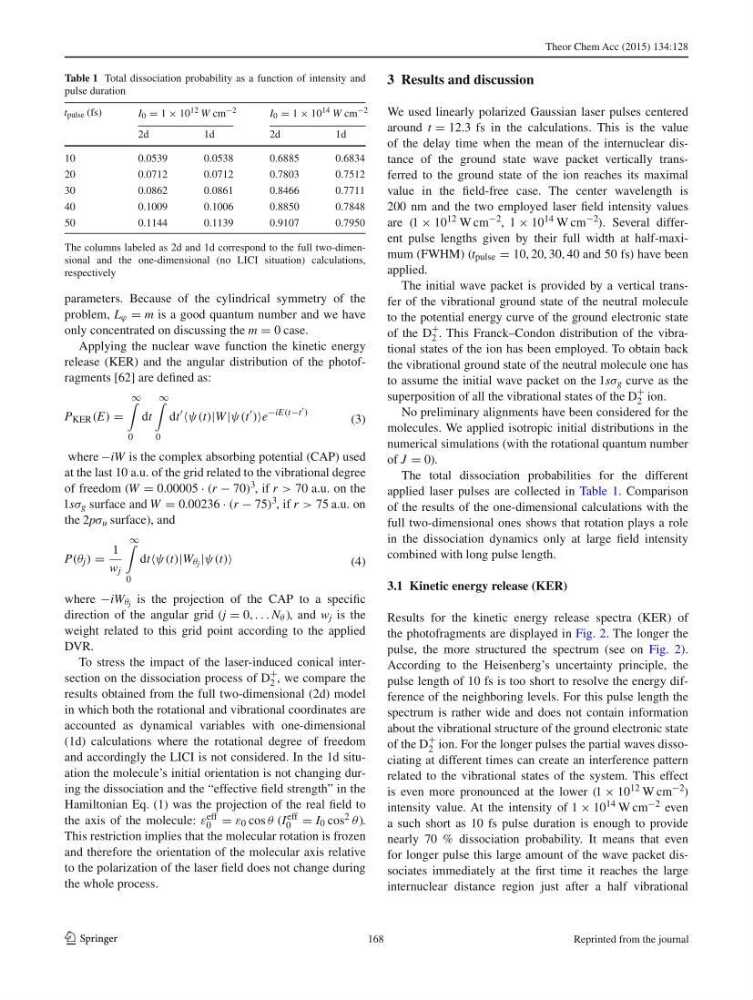
The total dissociation probabilities for the different
applied laser pulses are collected in Table 1 . Comparison
of the results of the one-dimensional calculations with the
full two-dimensional ones shows that rotation plays a role
in the dissociation dynamics only at large fi eld intensity
combined with long pulse length.
3.1 Kinetic energy release (KER)
Results for the kinetic energy release spectra (KER) of
the photofragments are displayed in Fig. 2 . The longer the
pulse, the more structured the spectrum (see on Fig. 2 ).
According to the Heisenberg’s uncertainty principle, the
pulse length of 10 fs is too short to resolve the energy difference of the neighboring levels. For this pulse length the
spectrum is rather wide and does not contain information
about the vibrational structure of the ground electronic state
of the D
+
2 ion. For the longer pulses the partial waves dissociating at different times can create an interference pattern
related to the vibrational states of the system. This effect
is even more pronounced at the lower ( 1 × 10 12 W cm −2 )
intensity value. At the intensity of 1 × 10 14 W cm −2 even
a such short as 10 fs pulse duration is enough to provide
nearly 70 % dissociation probability. It means that even
for longer pulse this large amount of the wave packet dissociates immediately at the fi rst time it reaches the large
internuclear distance region just after a half vibrational
Table 1 Total dissociation probability as a function of intensity and
pulse duration
The columns labeled as 2d and 1d correspond to the full two-dimensional and the one-dimensional (no LICI situation) calculations,
respectively
t pulse (fs)
I 0 = 1 × 10 12 W cm −2
I 0 = 1 × 10 14 W cm −2
2d
1d
2d
1d
10
0.0539
0.0538
0.6885
0.6834
20
0.0712
0.0712
0.7803
0.7512
30
0.0862
0.0861
0.8466
0.7711
40
0.1009
0.1006
0.8850
0.7848
50
0.1144
0.1139
0.9107
0.7950
168
Reprinted from the journal
1 3
parameters. Because of the cylindrical symmetry of the
problem, L ϕ = m is a good quantum number and we have
only concentrated on discussing the m = 0 case.
Applying the nuclear wave function the kinetic energy
release (KER) and the angular distribution of the photofragments [ 62 ] are defi ned as:
where −iW is the complex absorbing potential (CAP) used
at the last 10 a.u. of the grid related to the vibrational degree
of freedom ( W = 0.00005 · (r − 70) 3 , if r > 70 a.u. on the
1sσ g surface and W = 0.00236 · (r − 75) 3 , if r > 75 a.u. on
the 2pσ u surface), and
where −iW θ j is the projection of the CAP to a specifi c
direction of the angular grid (j = 0, . . . N θ ) , and w j is the
weight related to this grid point according to the applied
DVR.
To stress the impact of the laser-induced conical intersection on the dissociation process of D
+
2 , we compare the
results obtained from the full two-dimensional (2d) model
in which both the rotational and vibrational coordinates are
accounted as dynamical variables with one-dimensional
(1d) calculations where the rotational degree of freedom
and accordingly the LICI is not considered. In the 1d situation the molecule’s initial orientation is not changing during the dissociation and the “effective fi eld strength” in the
Hamiltonian Eq. ( 1 ) was the projection of the real fi eld to
the axis of the molecule: ε eff
0 = ε 0 cos θ (I eff
0 = I 0 cos 2 θ) .
This restriction implies that the molecular rotation is frozen
and therefore the orientation of the molecular axis relative
to the polarization of the laser fi eld does not change during
the whole process.
(3)
P KER (E) =
∞
0
dt
∞
0
dt
ψ(t)|W |ψ(t
)e
−iE(t−t )
(4)
P(θ j ) =
1
w j
∞
0
dtψ(t)|W θ j |ψ(t)
3 Results and discussion
We used linearly polarized Gaussian laser pulses centered
around t = 12.3 fs in the calculations. This is the value
of the delay time when the mean of the internuclear distance of the ground state wave packet vertically transferred to the ground state of the ion reaches its maximal
value in the fi eld-free case. The center wavelength is
200 nm and the two employed laser fi eld intensity values
are ( 1 × 10 12 W cm −2 , 1 × 10 14 W cm −2 ). Several different pulse lengths given by their full width at half-maximum (FWHM) ( t pulse = 10, 20, 30, 40 and 50 fs) have been
applied.
The initial wave packet is provided by a vertical transfer of the vibrational ground state of the neutral molecule
to the potential energy curve of the ground electronic state
of the D
+
2 . This Franck–Condon distribution of the vibrational states of the ion has been employed. To obtain back
the vibrational ground state of the neutral molecule one has
to assume the initial wave packet on the 1sσ g curve as the
superposition of all the vibrational states of the D
+
2 ion.
No preliminary alignments have been considered for the
molecules. We applied isotropic initial distributions in the
numerical simulations (with the rotational quantum number
of J = 0 ).
The total dissociation probabilities for the different
applied laser pulses are collected in Table 1 . Comparison
of the results of the one-dimensional calculations with the
full two-dimensional ones shows that rotation plays a role
in the dissociation dynamics only at large fi eld intensity
combined with long pulse length.
3.1 Kinetic energy release (KER)
Results for the kinetic energy release spectra (KER) of
the photofragments are displayed in Fig. 2 . The longer the
pulse, the more structured the spectrum (see on Fig. 2 ).
According to the Heisenberg’s uncertainty principle, the
pulse length of 10 fs is too short to resolve the energy difference of the neighboring levels. For this pulse length the
spectrum is rather wide and does not contain information
about the vibrational structure of the ground electronic state
of the D
+
2 ion. For the longer pulses the partial waves dissociating at different times can create an interference pattern
related to the vibrational states of the system. This effect
is even more pronounced at the lower ( 1 × 10 12 W cm −2 )
intensity value. At the intensity of 1 × 10 14 W cm −2 even
a such short as 10 fs pulse duration is enough to provide
nearly 70 % dissociation probability. It means that even
for longer pulse this large amount of the wave packet dissociates immediately at the fi rst time it reaches the large
internuclear distance region just after a half vibrational
Table 1 Total dissociation probability as a function of intensity and
pulse duration
The columns labeled as 2d and 1d correspond to the full two-dimensional and the one-dimensional (no LICI situation) calculations,
respectively
t pulse (fs)
I 0 = 1 × 10 12 W cm −2
I 0 = 1 × 10 14 W cm −2
2d
1d
2d
1d
10
0.0539
0.0538
0.6885
0.6834
20
0.0712
0.0712
0.7803
0.7512
30
0.0862
0.0861
0.8466
0.7711
40
0.1009
0.1006
0.8850
0.7848
50
0.1144
0.1139
0.9107
0.7950
168
Reprinted from the journal