

Theor Chem Acc (2015) 134:128
1 3
and the direction of the transition dipole and thus one of
the angles of rotation of the molecule. V 1 (R) ( 1sσ g ) and
V 2 (R) ( 2pσ u ) are the bare potential curves of the two electronic states coupled by the laser (whose frequency is ω L
and maximal amplitude is 0 ), f ( t ) is the envelop function and d(R)(= −−ψ e
1 |
j r j |ψ e
2 ) is the transition dipole
matrix element ( e = m e = = 1 ; atomic units are used
throughout the article). The potential energies V 1 (R) and
V 2 (R) and the transition dipole moment were borrowed
from [ 58 , 59 ].
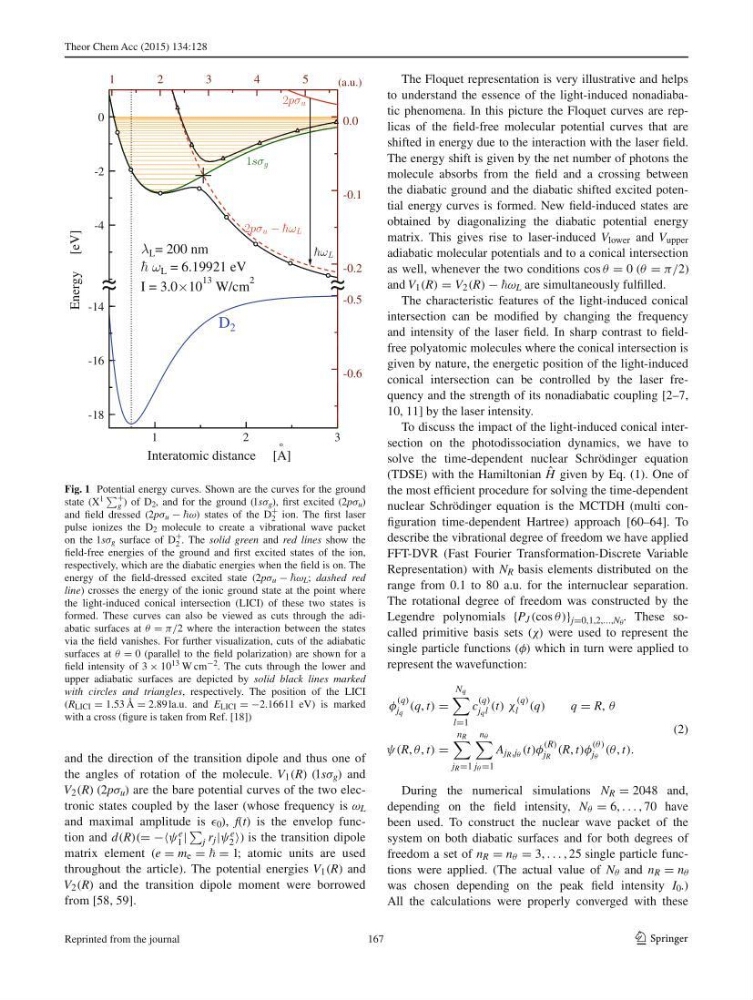
The Floquet representation is very illustrative and helps
to understand the essence of the light-induced nonadiabatic phenomena. In this picture the Floquet curves are replicas of the fi eld-free molecular potential curves that are
shifted in energy due to the interaction with the laser fi eld.
The energy shift is given by the net number of photons the
molecule absorbs from the fi eld and a crossing between
the diabatic ground and the diabatic shifted excited potential energy curves is formed. New fi eld-induced states are
obtained by diagonalizing the diabatic potential energy
matrix. This gives rise to laser-induced V lower and V upper
adiabatic molecular potentials and to a conical intersection
as well, whenever the two conditions cos θ = 0 (θ = π/2)
and V 1 (R) = V 2 (R) − ω L are simultaneously fulfi lled.
The characteristic features of the light-induced conical
intersection can be modifi ed by changing the frequency
and intensity of the laser fi eld. In sharp contrast to fi eldfree polyatomic molecules where the conical intersection is
given by nature, the energetic position of the light-induced
conical intersection can be controlled by the laser frequency and the strength of its nonadiabatic coupling [ 2 – 7 ,
10 , 11 ] by the laser intensity.
To discuss the impact of the light-induced conical intersection on the photodissociation dynamics, we have to
solve the time-dependent nuclear Schrödinger equation
(TDSE) with the Hamiltonian ˆ
H given by Eq. ( 1 ). One of
the most effi cient procedure for solving the time-dependent
nuclear Schrödinger equation is the MCTDH (multi confi guration time-dependent Hartree) approach [ 60 – 64 ]. To
describe the vibrational degree of freedom we have applied
FFT-DVR (Fast Fourier Transformation-Discrete Variable
Representation) with N R basis elements distributed on the
range from 0.1 to 80 a.u. for the internuclear separation.
The rotational degree of freedom was constructed by the
Legendre polynomials {P J (cos θ)} j=0,1,2,...,N θ . These socalled primitive basis sets ( χ ) were used to represent the
single particle functions ( φ ) which in turn were applied to
represent the wavefunction:
During the numerical simulations N R = 2048 and,
depending on the fi eld intensity, N θ = 6, . . . , 70 have
been used. To construct the nuclear wave packet of the
system on both diabatic surfaces and for both degrees of
freedom a set of n R = n θ = 3, . . . , 25 single particle functions were applied. (The actual value of N θ and n R = n θ
was chosen depending on the peak fi eld intensity I 0 .)
All the calculations were properly converged with these
(2)
φ
(q)
j q
(q, t) =
N q
l=1
c
(q)
j q l (t) χ
(q)
l (q)
q = R, θ
ψ(R, θ, t) =
n R
j R =1
n θ
j θ =1
A j R ,j θ (t)φ
(R)
j R
(R, t)φ
(θ)
j θ
(θ, t).
-18
-16
-14
-0.6
-0.5
D 2
L = 200 nm
L = 6.19921 eV
I = 3.0 10
13 W/cm
2
-4
-2
0
Energy [eV]
-0.2
-0.1
0.0
1
2
3
Interatomic distance [A]
1
2
3
4
5
~ ~
~ ~
(a.u.)
¯
h
1sσ g
2pσ u
¯
hω L
2pσ u − ¯
hω L
Fig. 1 Potential energy curves. Shown are the curves for the ground
state ( X 1 +
g ) of D 2 , and for the ground ( 1sσ g ), fi rst excited ( 2pσ u )
and fi eld dressed ( 2pσ u − ω ) states of the D
+
2 ion. The fi rst laser
pulse ionizes the D 2 molecule to create a vibrational wave packet
on the 1sσ g surface of D
+
2 . The solid green and red lines show the
fi eld-free energies of the ground and fi rst excited states of the ion,
respectively, which are the diabatic energies when the fi eld is on. The
energy of the fi eld-dressed excited state ( 2pσ u − ω L ; dashed red
line ) crosses the energy of the ionic ground state at the point where
the light-induced conical intersection (LICI) of these two states is
formed. These curves can also be viewed as cuts through the adiabatic surfaces at θ = π/2 where the interaction between the states
via the fi eld vanishes. For further visualization, cuts of the adiabatic
surfaces at θ = 0 (parallel to the fi eld polarization) are shown for a
fi eld intensity of 3 × 10 13 W cm −2 . The cuts through the lower and
upper adiabatic surfaces are depicted by solid black lines marked
with circles and triangles , respectively. The position of the LICI
( R LICI = 1.53 Å = 2.891 a.u. and E LICI = −2.16611 eV) is marked
with a cross (fi gure is taken from Ref. [ 18 ])
167
Reprinted from the journal
1 3
and the direction of the transition dipole and thus one of
the angles of rotation of the molecule. V 1 (R) ( 1sσ g ) and
V 2 (R) ( 2pσ u ) are the bare potential curves of the two electronic states coupled by the laser (whose frequency is ω L
and maximal amplitude is 0 ), f ( t ) is the envelop function and d(R)(= −−ψ e
1 |
j r j |ψ e
2 ) is the transition dipole
matrix element ( e = m e = = 1 ; atomic units are used
throughout the article). The potential energies V 1 (R) and
V 2 (R) and the transition dipole moment were borrowed
from [ 58 , 59 ].
The Floquet representation is very illustrative and helps
to understand the essence of the light-induced nonadiabatic phenomena. In this picture the Floquet curves are replicas of the fi eld-free molecular potential curves that are
shifted in energy due to the interaction with the laser fi eld.
The energy shift is given by the net number of photons the
molecule absorbs from the fi eld and a crossing between
the diabatic ground and the diabatic shifted excited potential energy curves is formed. New fi eld-induced states are
obtained by diagonalizing the diabatic potential energy
matrix. This gives rise to laser-induced V lower and V upper
adiabatic molecular potentials and to a conical intersection
as well, whenever the two conditions cos θ = 0 (θ = π/2)
and V 1 (R) = V 2 (R) − ω L are simultaneously fulfi lled.
The characteristic features of the light-induced conical
intersection can be modifi ed by changing the frequency
and intensity of the laser fi eld. In sharp contrast to fi eldfree polyatomic molecules where the conical intersection is
given by nature, the energetic position of the light-induced
conical intersection can be controlled by the laser frequency and the strength of its nonadiabatic coupling [ 2 – 7 ,
10 , 11 ] by the laser intensity.
To discuss the impact of the light-induced conical intersection on the photodissociation dynamics, we have to
solve the time-dependent nuclear Schrödinger equation
(TDSE) with the Hamiltonian ˆ
H given by Eq. ( 1 ). One of
the most effi cient procedure for solving the time-dependent
nuclear Schrödinger equation is the MCTDH (multi confi guration time-dependent Hartree) approach [ 60 – 64 ]. To
describe the vibrational degree of freedom we have applied
FFT-DVR (Fast Fourier Transformation-Discrete Variable
Representation) with N R basis elements distributed on the
range from 0.1 to 80 a.u. for the internuclear separation.
The rotational degree of freedom was constructed by the
Legendre polynomials {P J (cos θ)} j=0,1,2,...,N θ . These socalled primitive basis sets ( χ ) were used to represent the
single particle functions ( φ ) which in turn were applied to
represent the wavefunction:
During the numerical simulations N R = 2048 and,
depending on the fi eld intensity, N θ = 6, . . . , 70 have
been used. To construct the nuclear wave packet of the
system on both diabatic surfaces and for both degrees of
freedom a set of n R = n θ = 3, . . . , 25 single particle functions were applied. (The actual value of N θ and n R = n θ
was chosen depending on the peak fi eld intensity I 0 .)
All the calculations were properly converged with these
(2)
φ
(q)
j q
(q, t) =
N q
l=1
c
(q)
j q l (t) χ
(q)
l (q)
q = R, θ
ψ(R, θ, t) =
n R
j R =1
n θ
j θ =1
A j R ,j θ (t)φ
(R)
j R
(R, t)φ
(θ)
j θ
(θ, t).
-18
-16
-14
-0.6
-0.5
D 2
L = 200 nm
L = 6.19921 eV
I = 3.0 10
13 W/cm
2
-4
-2
0
Energy [eV]
-0.2
-0.1
0.0
1
2
3
Interatomic distance [A]
1
2
3
4
5
~ ~
~ ~
(a.u.)
¯
h
1sσ g
2pσ u
¯
hω L
2pσ u − ¯
hω L
Fig. 1 Potential energy curves. Shown are the curves for the ground
state ( X 1 +
g ) of D 2 , and for the ground ( 1sσ g ), fi rst excited ( 2pσ u )
and fi eld dressed ( 2pσ u − ω ) states of the D
+
2 ion. The fi rst laser
pulse ionizes the D 2 molecule to create a vibrational wave packet
on the 1sσ g surface of D
+
2 . The solid green and red lines show the
fi eld-free energies of the ground and fi rst excited states of the ion,
respectively, which are the diabatic energies when the fi eld is on. The
energy of the fi eld-dressed excited state ( 2pσ u − ω L ; dashed red
line ) crosses the energy of the ionic ground state at the point where
the light-induced conical intersection (LICI) of these two states is
formed. These curves can also be viewed as cuts through the adiabatic surfaces at θ = π/2 where the interaction between the states
via the fi eld vanishes. For further visualization, cuts of the adiabatic
surfaces at θ = 0 (parallel to the fi eld polarization) are shown for a
fi eld intensity of 3 × 10 13 W cm −2 . The cuts through the lower and
upper adiabatic surfaces are depicted by solid black lines marked
with circles and triangles , respectively. The position of the LICI
( R LICI = 1.53 Å = 2.891 a.u. and E LICI = −2.16611 eV) is marked
with a cross (fi gure is taken from Ref. [ 18 ])
167
Reprinted from the journal