

Theor Chem Acc (2015) 134:128
1 3
in previous works that conical intersections can be formed
in a molecular system both by running or by standing laser
waves even in diatomics [ 12 , 13 ]. In this case the laser-light
couples either the center of the mass motion with the internal
rovibrational degrees of freedom (in case of standing laser
fi eld) or the vibrational motion with the emerged rotational
degree of freedom (in the case of running laser fi eld) and
so-called light-induced conical intersection (LICI) arises. In
contrast to fi eld-free polyatomic molecules where the CI is
given by nature, the energetic position of the LICI is determined by the laser frequency and the strength of its nonadiabatic coupling is controlled by the laser intensity.
A few years ago, we have started a systematic study of
the nonadiabatic effect induced by laser waves in molecular systems. It has been demonstrated that the light-induced
conical intersections have very signifi cant impact on several different dynamical properties (like molecular spectra, molecular alignment or photodissociation probability
etc….) of diatomic molecules [ 14 – 20 ]. Additionally, in a
very recent paper [ 21 ] by studying carefully the dissociation process of the D
+
2 molecule we could provide the fi rst
“direct observable and measurable signature” of the lightinduced conical intersections. It was also found that resonant laser pulses of high carrier frequency may induce an
analogue of conical intersections of the complex potential
energy surfaces of the ground and fi eld-dressed resonant
states [ 22 – 24 ]. This analogue of a conical intersection in
the continuum states forms also in nature [ 25 , 26 ]. In 2013
Cederbaum and his colleague published the fi rst theoretical results on polyatomic system in the optical regime [ 27 ].
Besides these theoretical studies some important experimental papers have also been published recently. The fi rst
experimental observation of light-induced conical intersections in diatomic molecules is provided by Bucksbaum, and
his co-workers [ 28 ]. In another works the experimental outcomes of the laser-induced isomerization and photodissociation processes of polyatomic molecules were qualitatively
interpreted using the concept of the LICIs [ 29 – 32 ].
In the present article we focus on the photodissociation process of the D
+
2 molecule. This system and this process have
extensively been studied in the last decades [ 33 – 57 ], but there
are still many unclarifi ed issues. Moreover, as the D
+
2 ion is
a fairly simple system, the light-induced nonadiabatic phenomena can be investigated separately from other processes.
By solving the time-dependent nuclear Schrödinger equation,
we calculate the kinetic energy release (KER) spectra and the
angular distribution of the photodissociated fragments with
and without LICIs for several different values of the laser
intensity and laser pulse length. We perform one (1d)- and
two (2d)-dimensional calculations as well. In the fi rst case the
molecular rotational angle is only a parameter, while in the
2d situation the rotational angle is taken into account in the
numerical simulations as a dynamic variable fully including
the light-induced nonadiabatic phenomena. We will discuss
in detail how the different laser intensities and pulse lengths
infl uence the effect of the light-induced conical intersection
for the investigated dynamical properties of the D
+
2 ion. This
work can be considered as an extension of our previous work
[ 18 ]. In that paper [ 18 ] the alignment dependence of the dissociated photofragments of the D
+
2 molecular ion has been
studied, in the present work we focus on describing properly
the pulse length dependence of these photoproducts. Results
obtained by using an initial wave packet starting from one of
the vibrational eigenstates can be more easily interpreted. Initiating the dynamics from a Franck–Condon distribution, we
have a mixture of the eigenstates and it makes it more complicated to analyze the obtained results. However, from an
experimental point of view it is easier to create a FC distribution for the initial wave packet by simply photoionizing the D 2
molecule, than to create a well defi ned eigenstate of the ion.
The article is structured as follows. In the next section,
we provide the background required for our theoretical
study. The applied methods and the calculated dynamical
quantities are briefl y summarized. In the third section, we
present and discuss the numerical results for the values of
several different laser parameters. In the last section, we
summarize the conclusions.
2 Methods and details of the calculations
To study the dissociation dynamics, we consider the ground
state of the D 2 molecule ( X 1 +
g ) and the fi rst two electronic
states ( V 1 = 1sσ g and V 2 = 2pσ u ) of the D
+
2 ion (Fig. 1 ).
At fi rst the D 2 molecule is in its ground ( X 1 +
g ) electronic state and after ionization the vibrational wave packet
is launched to the 1sσ g state of D
+
2 in the Franck–Condon
region. In the next step, the D
+
2 ion is excited from the 1sσ g
state by a laser pulse to the dissociative 2pσ u state. The radiative interaction mediated by the non-vanishing electronic
dipole moment between the 1sσ g and 2pσ u electronic states
is responsible for the light-induced electronic transitions. In
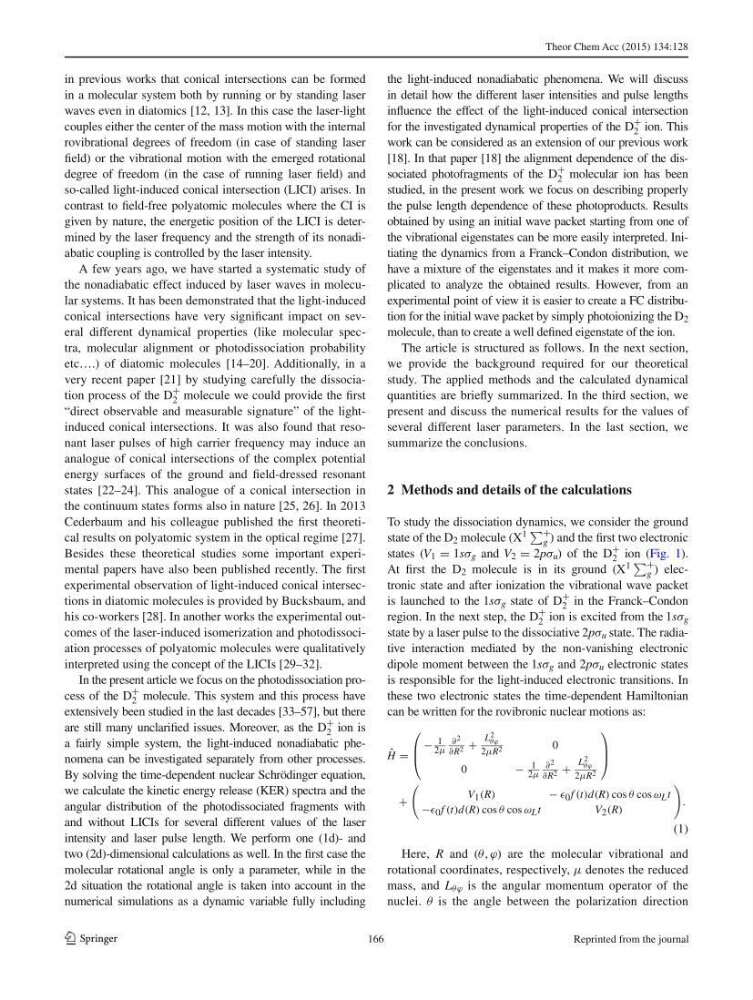
these two electronic states the time-dependent Hamiltonian
can be written for the rovibronic nuclear motions as:
Here, R and ( θ, ϕ ) are the molecular vibrational and
rotational coordinates, respectively, μ denotes the reduced
mass, and L θϕ is the angular momentum operator of the
nuclei. θ is the angle between the polarization direction
(1)
ˆ
H =
⎛
⎜
⎝
− 1
2μ
∂ 2
∂R 2 +
L 2
θϕ
2μR 2
0
0
− 1
2μ
∂ 2
∂R 2 +
L 2
θϕ
2μR 2
⎞
⎟
⎠
+
V 1 (R)
− 0 f (t)d(R) cos θ cos ω L t
− 0 f (t)d(R) cos θ cos ω L t
V 2 (R)
.
166
Reprinted from the journal
1 3
in previous works that conical intersections can be formed
in a molecular system both by running or by standing laser
waves even in diatomics [ 12 , 13 ]. In this case the laser-light
couples either the center of the mass motion with the internal
rovibrational degrees of freedom (in case of standing laser
fi eld) or the vibrational motion with the emerged rotational
degree of freedom (in the case of running laser fi eld) and
so-called light-induced conical intersection (LICI) arises. In
contrast to fi eld-free polyatomic molecules where the CI is
given by nature, the energetic position of the LICI is determined by the laser frequency and the strength of its nonadiabatic coupling is controlled by the laser intensity.
A few years ago, we have started a systematic study of
the nonadiabatic effect induced by laser waves in molecular systems. It has been demonstrated that the light-induced
conical intersections have very signifi cant impact on several different dynamical properties (like molecular spectra, molecular alignment or photodissociation probability
etc….) of diatomic molecules [ 14 – 20 ]. Additionally, in a
very recent paper [ 21 ] by studying carefully the dissociation process of the D
+
2 molecule we could provide the fi rst
“direct observable and measurable signature” of the lightinduced conical intersections. It was also found that resonant laser pulses of high carrier frequency may induce an
analogue of conical intersections of the complex potential
energy surfaces of the ground and fi eld-dressed resonant
states [ 22 – 24 ]. This analogue of a conical intersection in
the continuum states forms also in nature [ 25 , 26 ]. In 2013
Cederbaum and his colleague published the fi rst theoretical results on polyatomic system in the optical regime [ 27 ].
Besides these theoretical studies some important experimental papers have also been published recently. The fi rst
experimental observation of light-induced conical intersections in diatomic molecules is provided by Bucksbaum, and
his co-workers [ 28 ]. In another works the experimental outcomes of the laser-induced isomerization and photodissociation processes of polyatomic molecules were qualitatively
interpreted using the concept of the LICIs [ 29 – 32 ].
In the present article we focus on the photodissociation process of the D
+
2 molecule. This system and this process have
extensively been studied in the last decades [ 33 – 57 ], but there
are still many unclarifi ed issues. Moreover, as the D
+
2 ion is
a fairly simple system, the light-induced nonadiabatic phenomena can be investigated separately from other processes.
By solving the time-dependent nuclear Schrödinger equation,
we calculate the kinetic energy release (KER) spectra and the
angular distribution of the photodissociated fragments with
and without LICIs for several different values of the laser
intensity and laser pulse length. We perform one (1d)- and
two (2d)-dimensional calculations as well. In the fi rst case the
molecular rotational angle is only a parameter, while in the
2d situation the rotational angle is taken into account in the
numerical simulations as a dynamic variable fully including
the light-induced nonadiabatic phenomena. We will discuss
in detail how the different laser intensities and pulse lengths
infl uence the effect of the light-induced conical intersection
for the investigated dynamical properties of the D
+
2 ion. This
work can be considered as an extension of our previous work
[ 18 ]. In that paper [ 18 ] the alignment dependence of the dissociated photofragments of the D
+
2 molecular ion has been
studied, in the present work we focus on describing properly
the pulse length dependence of these photoproducts. Results
obtained by using an initial wave packet starting from one of
the vibrational eigenstates can be more easily interpreted. Initiating the dynamics from a Franck–Condon distribution, we
have a mixture of the eigenstates and it makes it more complicated to analyze the obtained results. However, from an
experimental point of view it is easier to create a FC distribution for the initial wave packet by simply photoionizing the D 2
molecule, than to create a well defi ned eigenstate of the ion.
The article is structured as follows. In the next section,
we provide the background required for our theoretical
study. The applied methods and the calculated dynamical
quantities are briefl y summarized. In the third section, we
present and discuss the numerical results for the values of
several different laser parameters. In the last section, we
summarize the conclusions.
2 Methods and details of the calculations
To study the dissociation dynamics, we consider the ground
state of the D 2 molecule ( X 1 +
g ) and the fi rst two electronic
states ( V 1 = 1sσ g and V 2 = 2pσ u ) of the D
+
2 ion (Fig. 1 ).
At fi rst the D 2 molecule is in its ground ( X 1 +
g ) electronic state and after ionization the vibrational wave packet
is launched to the 1sσ g state of D
+
2 in the Franck–Condon
region. In the next step, the D
+
2 ion is excited from the 1sσ g
state by a laser pulse to the dissociative 2pσ u state. The radiative interaction mediated by the non-vanishing electronic
dipole moment between the 1sσ g and 2pσ u electronic states
is responsible for the light-induced electronic transitions. In
these two electronic states the time-dependent Hamiltonian
can be written for the rovibronic nuclear motions as:
Here, R and ( θ, ϕ ) are the molecular vibrational and
rotational coordinates, respectively, μ denotes the reduced
mass, and L θϕ is the angular momentum operator of the
nuclei. θ is the angle between the polarization direction
(1)
ˆ
H =
⎛
⎜
⎝
− 1
2μ
∂ 2
∂R 2 +
L 2
θϕ
2μR 2
0
0
− 1
2μ
∂ 2
∂R 2 +
L 2
θϕ
2μR 2
⎞
⎟
⎠
+
V 1 (R)
− 0 f (t)d(R) cos θ cos ω L t
− 0 f (t)d(R) cos θ cos ω L t
V 2 (R)
.
166
Reprinted from the journal