

Theor Chem Acc (2015) 134:115
1 3
becomes redundant. The schemes are different only when
the system of H-bonds allows for defects like broken
H-bonds.
Before we start our analysis of the quality of the energy
approximation by graph invariants, it is reasonable to look
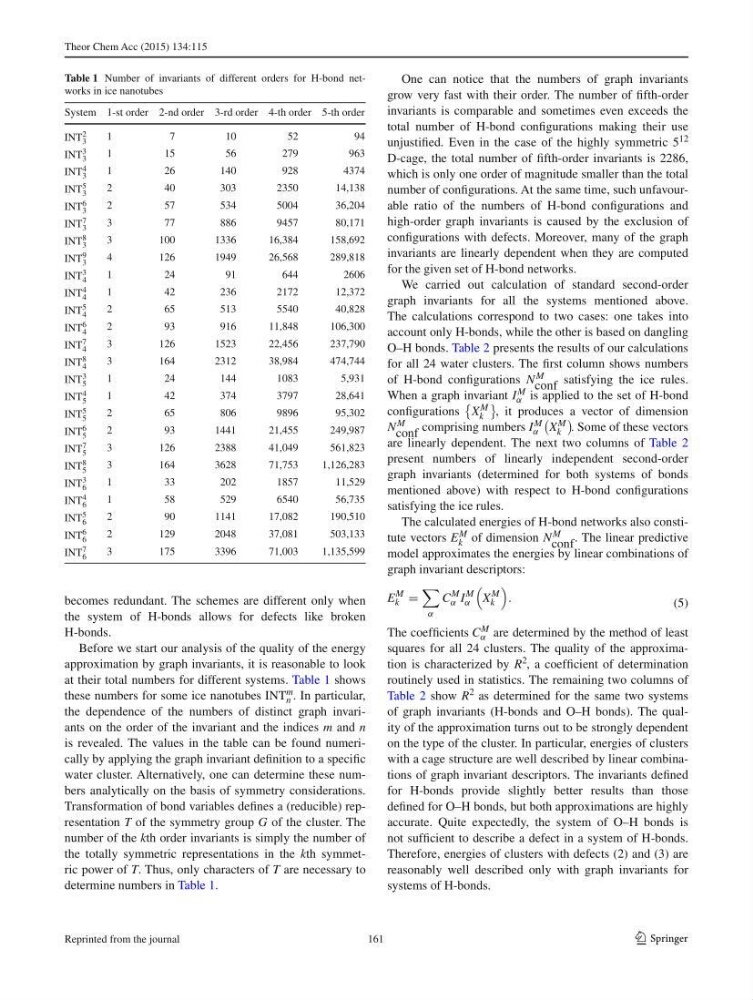
at their total numbers for different systems. Table 1 shows
these numbers for some ice nanotubes INT m
n . In particular,
the dependence of the numbers of distinct graph invariants on the order of the invariant and the indices m and n
is revealed. The values in the table can be found numerically by applying the graph invariant defi nition to a specifi c
water cluster. Alternatively, one can determine these numbers analytically on the basis of symmetry considerations.
Transformation of bond variables defi nes a (reducible) representation T of the symmetry group G of the cluster. The
number of the k th order invariants is simply the number of
the totally symmetric representations in the k th symmetric power of T . Thus, only characters of T are necessary to
determine numbers in Table 1 .
One can notice that the numbers of graph invariants
grow very fast with their order. The number of fi fth-order
invariants is comparable and sometimes even exceeds the
total number of H-bond confi gurations making their use
unjustifi ed. Even in the case of the highly symmetric 5 12
D-cage, the total number of fi fth-order invariants is 2286,
which is only one order of magnitude smaller than the total
number of confi gurations. At the same time, such unfavourable ratio of the numbers of H-bond confi gurations and
high-order graph invariants is caused by the exclusion of
confi gurations with defects. Moreover, many of the graph
invariants are linearly dependent when they are computed
for the given set of H-bond networks.
We carried out calculation of standard second-order
graph invariants for all the systems mentioned above.
The calculations correspond to two cases: one takes into
account only H-bonds, while the other is based on dangling
O–H bonds. Table 2 presents the results of our calculations
for all 24 water clusters. The fi rst column shows numbers
of H-bond confi gurations N M
conf satisfying the ice rules.
When a graph invariant I M
α is applied to the set of H-bond
confi gurations
X M
k
, it produces a vector of dimension
N M
conf comprising numbers I M
α
X M
k
. Some of these vectors
are linearly dependent. The next two columns of Table 2
present numbers of linearly independent second-order
graph invariants (determined for both systems of bonds
mentioned above) with respect to H-bond confi gurations
satisfying the ice rules.
The calculated energies of H-bond networks also constitute vectors E M
k of dimension N M
conf . The linear predictive
model approximates the energies by linear combinations of
graph invariant descriptors:
The coeffi cients C M
α are determined by the method of least
squares for all 24 clusters. The quality of the approximation is characterized by R 2 , a coeffi cient of determination
routinely used in statistics. The remaining two columns of
Table 2 show R 2 as determined for the same two systems
of graph invariants (H-bonds and O–H bonds). The quality of the approximation turns out to be strongly dependent
on the type of the cluster. In particular, energies of clusters
with a cage structure are well described by linear combinations of graph invariant descriptors. The invariants defi ned
for H-bonds provide slightly better results than those
defi ned for O–H bonds, but both approximations are highly
accurate. Quite expectedly, the system of O–H bonds is
not suffi cient to describe a defect in a system of H-bonds.
Therefore, energies of clusters with defects (2) and (3) are
reasonably well described only with graph invariants for
systems of H-bonds.
(5)
E
M
k =
α
C
M
α I
M
α
X
M
k
.
Table 1 Number of invariants of different orders for H-bond networks in ice nanotubes
System 1-st order 2-nd order 3-rd order 4-th order 5-th order
INT 2
3
1
7
10
52
94
INT 3
3
1
15
56
279
963
INT 4
3
1
26
140
928
4374
INT 5
3
2
40
303
2350
14,138
INT 6
3
2
57
534
5004
36,204
INT 7
3
3
77
886
9457
80,171
INT 8
3
3
100
1336
16,384
158,692
INT
9
3
4
126
1949
26,568
289,818
INT 3
4
1
24
91
644
2606
INT 4
4
1
42
236
2172
12,372
INT 5
4
2
65
513
5540
40,828
INT 6
4
2
93
916
11,848
106,300
INT 7
4
3
126
1523
22,456
237,790
INT 8
4
3
164
2312
38,984
474,744
INT 3
5
1
24
144
1083
5,931
INT 4
5
1
42
374
3797
28,641
INT 5
5
2
65
806
9896
95,302
INT 6
5
2
93
1441
21,455
249,987
INT 7
5
3
126
2388
41,049
561,823
INT 8
5
3
164
3628
71,753
1,126,283
INT 3
6
1
33
202
1857
11,529
INT 4
6
1
58
529
6540
56,735
INT 5
6
2
90
1141
17,082
190,510
INT 6
6
2
129
2048
37,081
503,133
INT 7
6
3
175
3396
71,003
1,135,599
161
Reprinted from the journal
1 3
becomes redundant. The schemes are different only when
the system of H-bonds allows for defects like broken
H-bonds.
Before we start our analysis of the quality of the energy
approximation by graph invariants, it is reasonable to look
at their total numbers for different systems. Table 1 shows
these numbers for some ice nanotubes INT m
n . In particular,
the dependence of the numbers of distinct graph invariants on the order of the invariant and the indices m and n
is revealed. The values in the table can be found numerically by applying the graph invariant defi nition to a specifi c
water cluster. Alternatively, one can determine these numbers analytically on the basis of symmetry considerations.
Transformation of bond variables defi nes a (reducible) representation T of the symmetry group G of the cluster. The
number of the k th order invariants is simply the number of
the totally symmetric representations in the k th symmetric power of T . Thus, only characters of T are necessary to
determine numbers in Table 1 .
One can notice that the numbers of graph invariants
grow very fast with their order. The number of fi fth-order
invariants is comparable and sometimes even exceeds the
total number of H-bond confi gurations making their use
unjustifi ed. Even in the case of the highly symmetric 5 12
D-cage, the total number of fi fth-order invariants is 2286,
which is only one order of magnitude smaller than the total
number of confi gurations. At the same time, such unfavourable ratio of the numbers of H-bond confi gurations and
high-order graph invariants is caused by the exclusion of
confi gurations with defects. Moreover, many of the graph
invariants are linearly dependent when they are computed
for the given set of H-bond networks.
We carried out calculation of standard second-order
graph invariants for all the systems mentioned above.
The calculations correspond to two cases: one takes into
account only H-bonds, while the other is based on dangling
O–H bonds. Table 2 presents the results of our calculations
for all 24 water clusters. The fi rst column shows numbers
of H-bond confi gurations N M
conf satisfying the ice rules.
When a graph invariant I M
α is applied to the set of H-bond
confi gurations
X M
k
, it produces a vector of dimension
N M
conf comprising numbers I M
α
X M
k
. Some of these vectors
are linearly dependent. The next two columns of Table 2
present numbers of linearly independent second-order
graph invariants (determined for both systems of bonds
mentioned above) with respect to H-bond confi gurations
satisfying the ice rules.
The calculated energies of H-bond networks also constitute vectors E M
k of dimension N M
conf . The linear predictive
model approximates the energies by linear combinations of
graph invariant descriptors:
The coeffi cients C M
α are determined by the method of least
squares for all 24 clusters. The quality of the approximation is characterized by R 2 , a coeffi cient of determination
routinely used in statistics. The remaining two columns of
Table 2 show R 2 as determined for the same two systems
of graph invariants (H-bonds and O–H bonds). The quality of the approximation turns out to be strongly dependent
on the type of the cluster. In particular, energies of clusters
with a cage structure are well described by linear combinations of graph invariant descriptors. The invariants defi ned
for H-bonds provide slightly better results than those
defi ned for O–H bonds, but both approximations are highly
accurate. Quite expectedly, the system of O–H bonds is
not suffi cient to describe a defect in a system of H-bonds.
Therefore, energies of clusters with defects (2) and (3) are
reasonably well described only with graph invariants for
systems of H-bonds.
(5)
E
M
k =
α
C
M
α I
M
α
X
M
k
.
Table 1 Number of invariants of different orders for H-bond networks in ice nanotubes
System 1-st order 2-nd order 3-rd order 4-th order 5-th order
INT 2
3
1
7
10
52
94
INT 3
3
1
15
56
279
963
INT 4
3
1
26
140
928
4374
INT 5
3
2
40
303
2350
14,138
INT 6
3
2
57
534
5004
36,204
INT 7
3
3
77
886
9457
80,171
INT 8
3
3
100
1336
16,384
158,692
INT
9
3
4
126
1949
26,568
289,818
INT 3
4
1
24
91
644
2606
INT 4
4
1
42
236
2172
12,372
INT 5
4
2
65
513
5540
40,828
INT 6
4
2
93
916
11,848
106,300
INT 7
4
3
126
1523
22,456
237,790
INT 8
4
3
164
2312
38,984
474,744
INT 3
5
1
24
144
1083
5,931
INT 4
5
1
42
374
3797
28,641
INT 5
5
2
65
806
9896
95,302
INT 6
5
2
93
1441
21,455
249,987
INT 7
5
3
126
2388
41,049
561,823
INT 8
5
3
164
3628
71,753
1,126,283
INT 3
6
1
33
202
1857
11,529
INT 4
6
1
58
529
6540
56,735
INT 5
6
2
90
1141
17,082
190,510
INT 6
6
2
129
2048
37,081
503,133
INT 7
6
3
175
3396
71,003
1,135,599
161
Reprinted from the journal